Modern distribution centers store products 12–15 meters high. At that height, water from ceiling sprinklers can be held up by cartons before it reaches a fire inside the rack. That is why in-rack sprinklers are often an indispensable complement to the ceiling system in high-bay warehouses; ceiling-only protection is possible only with special designs such as ESFR and CMSA, and only within their height limits. In NFPA 13 (2025 edition) storage protection is covered in Chapters 20–25, and the in-rack sprinkler rules are in Chapter 25. An engineer's overview of in-rack design below.
Why In-Rack Sprinklers Are Needed
- High racks: fire spreads within the rack before the ceiling sprinklers open
- Flue spaces: the vertical gaps in the rack act like a chimney and pull the fire upward
- Ceiling sprinklers: upper loads hold back the water, so it cannot penetrate deep into the rack and the fire continues inside
- In-rack sprinklers: deliver water directly to the fire source
Commodity Class
NFPA 13 classifies a stored product together with its packaging (NFPA 13-2025, 20.4):
- Class I: Noncombustible product directly on wood pallets, in single-layer corrugated cartons, or shrink/paper-wrapped as a unit load (20.4.1)
- Class II: Noncombustible product in slatted wooden crates, solid wood boxes, multiple-layer corrugated cartons or equivalent combustible packaging (20.4.2)
- Class III: Product made of wood, paper, natural fibers or Group C plastics; may contain up to 5% by weight nonexpanded or 5% by volume expanded Group A/B plastic (20.4.3)
- Class IV: Product made partially or totally of Group B plastics, free-flowing Group A plastic, or cartoned product containing 5–15% by weight nonexpanded or 5–25% by volume expanded Group A plastic (20.4.4)
- Group A Plastic: Highest combustibility — ABS, polyethylene, polystyrene; above the Class IV limits the product is treated as a plastic commodity
- Group B/C Plastic: Lower combustibility; Group B products fall under Class IV, Group C products under Class III
Rack Types
- Single-row rack: No longitudinal flue space, depth up to 6 ft (1.8 m), aisles at least 3.5 ft (1.1 m) wide (3.3.208)
- Double-row rack: Rack up to 12 ft (3.7 m) deep, or two single-row racks back to back with an aggregate depth up to 12 ft (3.7 m), aisles at least 3.5 ft (1.1 m) (3.3.62)
- Multiple-row rack: Racks deeper than 12 ft (3.7 m), or single/double-row racks separated by aisles narrower than 3.5 ft (1.1 m) with an overall width over 12 ft (3.7 m) (3.3.139)
- Solid shelving: Shelves block water from reaching lower levels, so separate in-rack requirements apply (25.3)
Flue Spaces
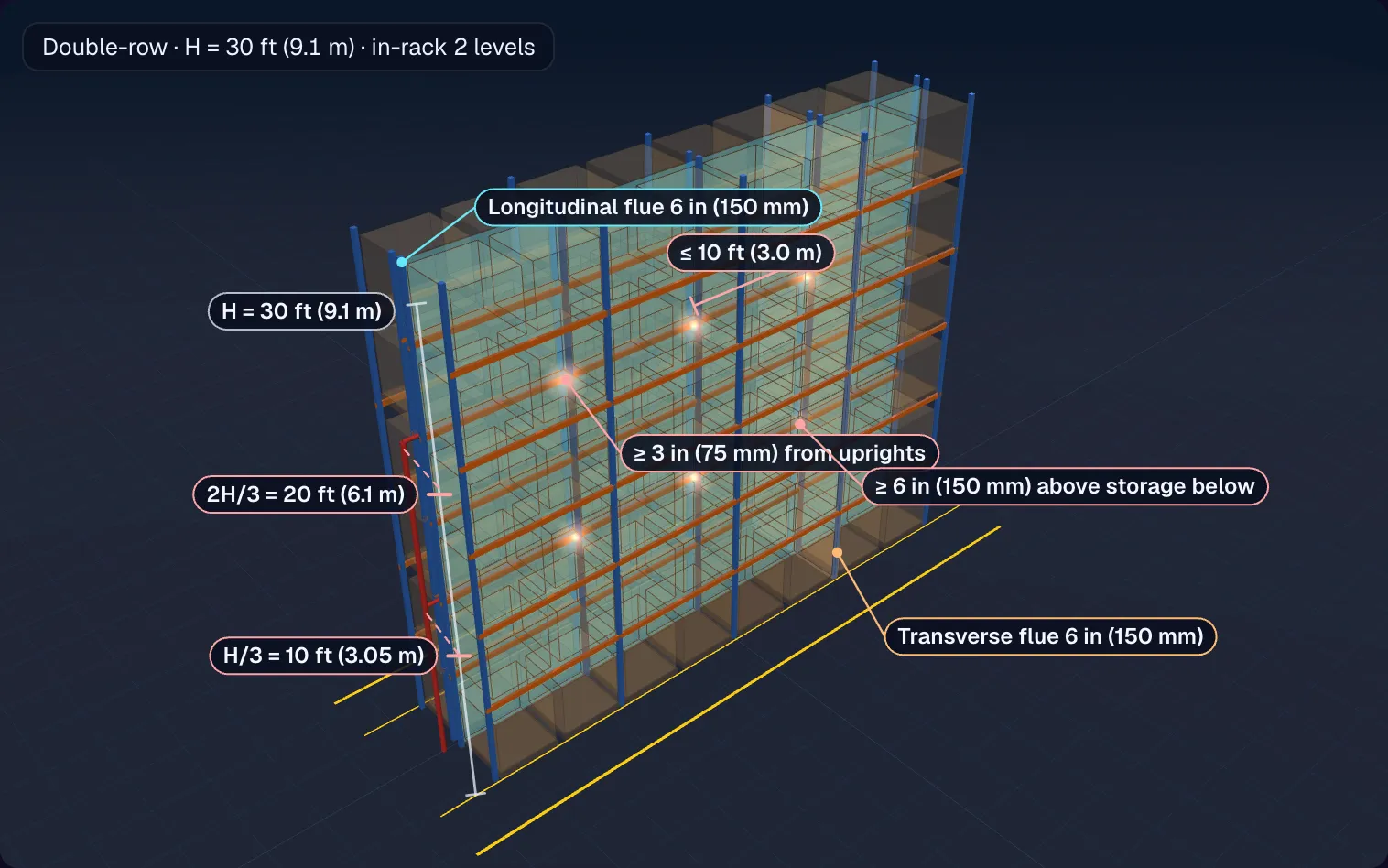
Flue spaces are the vertical paths inside a rack that let water down and hot gases up; NFPA 13-2025 gives their sizes in Section 20.6. Mind the orientation: the longitudinal flue runs parallel to the aisle.
- Transverse flue: the space between rows of storage parallel to the direction of loading, i.e. between neighbouring loads (3.3.238). Nominal 6 in (150 mm) transverse flues are maintained between loads and at rack uprights in single-, double- and multiple-row racks (20.6.2.2).
- Longitudinal flue: the space between rows perpendicular to the direction of loading, i.e. the gap between back-to-back rows parallel to the aisle, no wider than 24 in (600 mm) (3.3.127, Figure A.3.3.127). In double-row open racks it is not required for storage up to and including 25 ft (7.6 m) (20.6.2.1.1); above 25 ft a nominal 6 in (150 mm) longitudinal flue is required (20.6.2.1.2).
- Multiple-row racks need no longitudinal flue when all three apply: transverse flues of at least nominal 6 in (150 mm) at no more than 5 ft (1.5 m) intervals, rack depth up to 20 ft (6.1 m), and aisles at least 3.5 ft (1.1 m) wide (20.6.2.1.3).
- Where in-rack sprinklers go: sprinklers in longitudinal flues sit at an intersection with a transverse flue (25.1.7.3), at least 3 in (75 mm) from the side of rack uprights (25.1.7.7). With one level they go at the first tier level at or above one-half of the storage height, with two levels at or above one-third and two-thirds (25.1.8.1, 25.1.8.2), keeping at least 6 in (150 mm) between deflectors and the top of storage below (25.1.8.3.1).
In-Rack Sprinkler Levels
NFPA 13 specifies in-rack levels by storage height, commodity class and ceiling sprinkler type:
- Storage up to 25 ft (7.6 m): Class I–IV can be protected by CMDA ceiling sprinklers alone under Chapter 21; in-rack sprinklers remain an option
- Storage over 25 ft (7.6 m) with CMDA ceiling sprinklers: Class I–IV (21.4.2.1) and Group A plastics (21.6) are protected per Chapter 25, with in-rack sprinklers
- Above the top in-rack level: for exposed nonencapsulated Class I–IV over 25 ft, at most 10 ft (3.0 m) of storage in single- and double-row racks (25.4.3.1.1.4); in multiple-row racks 10 ft for Class I–III and 5 ft (1.5 m) for Class IV (25.4.3.1.1.5)
- Solid shelving: with CMDA ceiling sprinklers, in-rack sprinklers below each shelf level where shelves exceed 64 ft² (5.9 m²) or storage levels exceed 6 ft (1.8 m) (25.3.3.2); with ESFR or CMSA ceiling sprinklers, beneath all tiers under the highest solid shelf (25.3.3.3, 25.3.3.4)
ESFR vs In-Rack
ESFR (Early Suppression Fast Response) sprinklers are designed to suppress the fire from the ceiling with high flow and, within defined limits, are an alternative to in-rack sprinklers:
- ESFR pro: Ceiling only, no in-rack piping, no forklift damage to pipes
- ESFR con: Narrow application limits — ceiling-only ESFR in NFPA 13 Table 23.3.1 covers ceilings up to 13.7 m and storage up to 12.2 m; roof slope max 4 in 12 (14.2.3); wet systems only (14.2.2); at least 36 in (900 mm) clearance above storage (14.2.11); very sensitive to obstructions
- In-rack pro: Applicable at any rack height, independent of ceiling height
- In-rack con: Complex piping, hard to maintain, forklift pipe damage
In practice: high-ceiling warehouses with clean geometry that stay within the ESFR limits are usually fine with ESFR alone. Where ceiling or storage height exceeds those limits, the rack layout is complex, or the fire load is high (especially Group A plastics), an in-rack solution is the way to go.
Logistics Warehouses in Turkey
New 3PL warehouses in organized industrial zones are quickly adopting ESFR and in-rack solutions. Older warehouses typically have ceiling sprinklers only — no in-rack. When a fire starts in dense Group A plastic storage, that ceiling system is insufficient.
Common Mistakes
- Commodity class understated: Group A plastic designed as Class III.
- Rack raised, system not updated: Storage went from 6 m to 9 m; above 7.6 m a CMDA ceiling system needs in-rack levels.
- Flue spaces blocked: Gaps filled with cartons; water penetration and sprinkler response are impaired.
- Forklift pipe damage: Crushed in-rack pipe, no water at the fire.
Conclusion
In-rack sprinklers are often an indispensable complement to ceiling systems in high-bay warehouses. With correct application of the NFPA 13 tables, Class IV and Group A plastic fires can be controlled. Any design without a correct commodity class is incomplete.

MEP Calc — 110+ Engineering Calculators
MEP Calc bundles 110+ engineering modules in one iOS app: 21 fire calculations (sprinkler, fire pump, FM-200 clean agent) plus heating, cooling, HVAC, plumbing, steam and natural gas. Download it on the App Store.
Download MEP Calc on the App Store
SprinkCalc — Fire Sprinkler Design Across Three Standards
SprinkCalc covers hazard classification, design density and area, K-factor selection, water demand and hydraulic calculations for NFPA 13, FM Global and BS EN 12845 in a single iOS app, and exports a professional PDF report. One of the few tools that unifies all three major fire protection standards.
Download SprinkCalc on the App StoreCore references: NFPA 13-2025 Chapters 20–25 (storage protection; in-rack sprinklers: Chapter 25), FM Global DS 8-9. Original NFPA post: NFPA Today - Rack Storage.