Chapter 7 of NFPA 11-2024 brings together the common rules for medium- and high-expansion foam systems, total flooding, local application, LNG applications and portable foam generators. The depth, time and rate calculation for high-expansion total flooding is covered in NFPA 11 High-Expansion Foam. This article covers the rest: common rules, occupant safety, test-based medium expansion, local application and portable generators.
Clause numbers and values were read from the page images of NFPA 11-2024. Annex A text is explanatory and marked as such.
Expansion ratio: low, medium, high
Expansion is the ratio of the final foam volume to the original solution volume (3.3.5): at 100:1, one litre of solution gives 100 litres of foam. Chapter 3 frames the range indirectly: medium- and high-expansion concentrate makes foams of 20:1 to roughly 1000:1 in special equipment (3.3.11.6), aspirator-type generators usually give no more than 250:1 (3.3.13.1), and blower types drive air through screens with a fan (3.3.13.2). Annex A states the three ranges outright:
| Range | Expansion | In NFPA 11 |
|---|---|---|
| Low | Up to 20 | Outside Chapter 7, which covers medium and high expansion only (7.1) |
| Medium | 20 to 200 | Chapter 7; depth, rate and quantity set by test |
| High | 200 to about 1000 | Chapter 7; total flooding rules in 7.12, LNG with high expansion only (7.3) |
Ranges: Annex A, A.3.3.9 (explanatory).
Use and limitations (7.2–7.5)
Medium- and high-expansion foam must be specifically evaluated for the type of hazard (7.2.1). It may protect ordinary combustibles, ignitable liquids, combinations of the two and, with high expansion only, liquefied natural gas (7.3); the hazard’s susceptibility to water damage is evaluated too (7.3.1). Unless a component evaluation including tests shows otherwise, they are not used on oxygen-releasing chemicals such as cellulose nitrate, energised unenclosed electrical equipment, water-reactive metals and materials, or liquefied flammable gas (7.3.2).
The standard recognises three system types: total flooding, local application and portable foam-generating devices (7.4). One supply may serve several hazards, but where the AHJ judges that neighbouring hazards could burn together, each gets its own system or one system discharges on all at once (7.5).
Occupant safety (7.6)
- Evacuation: occupants are briefed on activation, shutdown and evacuation, and leave for a head count at a set point when the system operates (7.6.1); discharge points are placed to help evacuation where possible (7.6.2).
- Rescue: only trained rescuers in full protective equipment with self-contained breathing apparatus enter (7.6.3.1). Doors are opened fully, coarse water and an industrial silicone-based de-foaming agent are used together, and the generators run on water only (7.6.3.2, 7.6.3.2.1). Rescuers search in straight lines with search wands, within sight of each other (7.6.3.3, 7.6.3.3.1).
- The Annex A warning: life-lines are not recommended for searching a foam-filled aircraft hangar because they can snag on hidden obstacles, and thermal imaging cameras are ineffective at finding victims in foam (A.7.6.3, Annex A, explanatory).
Electrical clearances: every system component keeps the minimum clearance from live parts given in Table 7.6.4.1 (7.6.4.1). The table applies up to 1000 m (3281 ft) altitude; above that the clearance rises by 1 per cent for each 100 m (328 ft) (7.6.4.2, 7.6.4.2.1). Above 161 kV the clearance is based on the design BIL rather than the nominal voltage (7.6.4.2.3).
| Nominal line voltage | Design BIL | Minimum clearance |
|---|---|---|
| Up to 15 kV | 110 kV | 178 mm (7 in.) |
| 34.5 kV | 200 kV | 330 mm (13 in.) |
| 115 kV | 550 kV | 940 mm (37 in.) |
| 161 kV | 750 kV | 1321 mm (52 in.) |
Selected rows of Table 7.6.4.1, which runs to 500–700 kV.
Operation, control and equipment (7.7–7.11)
- Detection and alarms: fixed systems use automatic detection installed to NFPA 72, which may be omitted with AHJ approval (7.7.1.1, 7.7.1.1.1, 7.7.1.2). Faults show at once, preferably at a constantly attended location (7.7.2); audible alarms signal operation and faults and warn before discharge where people are at risk (7.7.3).
- Operating devices: electrical power is as reliable as a fire pump circuit under NFPA 20 (7.7.4.1.3). Manual controls stay accessible during a fire and do everything the automatic control does (7.7.4.4, 7.7.4.4.2), with an independent, preferably mechanical, emergency means (7.7.4.5, 7.7.4.5.2). Door and window closers, vent openers and power shutdown act with the system (7.7.4.6).
- Concentrate: listed for use with the equipment, with quality confirmed by tests (7.8.1).
- Air supply: outside air is used unless data specific to the combustion products show inside air works; such data give factors for raising the 7.12.8 rates where fire tests require (7.9.1, 7.9.2). Vents must not recirculate smoke into generator inlets (7.9.3).
- Generator location: easy to inspect and maintain (7.10.1) and as close to the hazard as possible without undue exposure. Generators inside the hazard are listed to resist fire or are protected, and fire tests may justify extra generators instead (7.10.2).
- Distribution: pipe and fittings follow Chapter 4 (7.11.1); a listed strainer sits upstream of the water valve (7.11.2.1). Duct closures are quick-opening and the actual foam rate through ducts is found by test or a method the AHJ accepts (7.11.3).
Medium expansion: why the numbers come from tests
For high-expansion total flooding the standard gives a depth rule, a time table and a rate formula. For medium expansion all three quantities are left to testing:
| Quantity | High expansion (total flooding) | Medium expansion |
|---|---|---|
| Depth over the hazard | At least 1.1 times the highest hazard and never less than 600 mm (24 in.) above it (7.12.5.2.1.1) | Varies with expansion; set by test (7.12.5.2.2) |
| Discharge rate | R = (V/T + RS) × CN × CL (7.12.8.2.3.1) | Set by test (7.12.8.1) |
| Concentrate and water | 25 min of operation or four times the submergence volume, whichever is less, never under 15 min (7.12.9.1) | Set by tests developed by an independent testing laboratory (7.12.9.2) |
So a medium-expansion design rests on equipment test results, not on the standard alone. For high expansion, the High-Expansion Foam Calculator walks through the steps.
Local application (7.13)
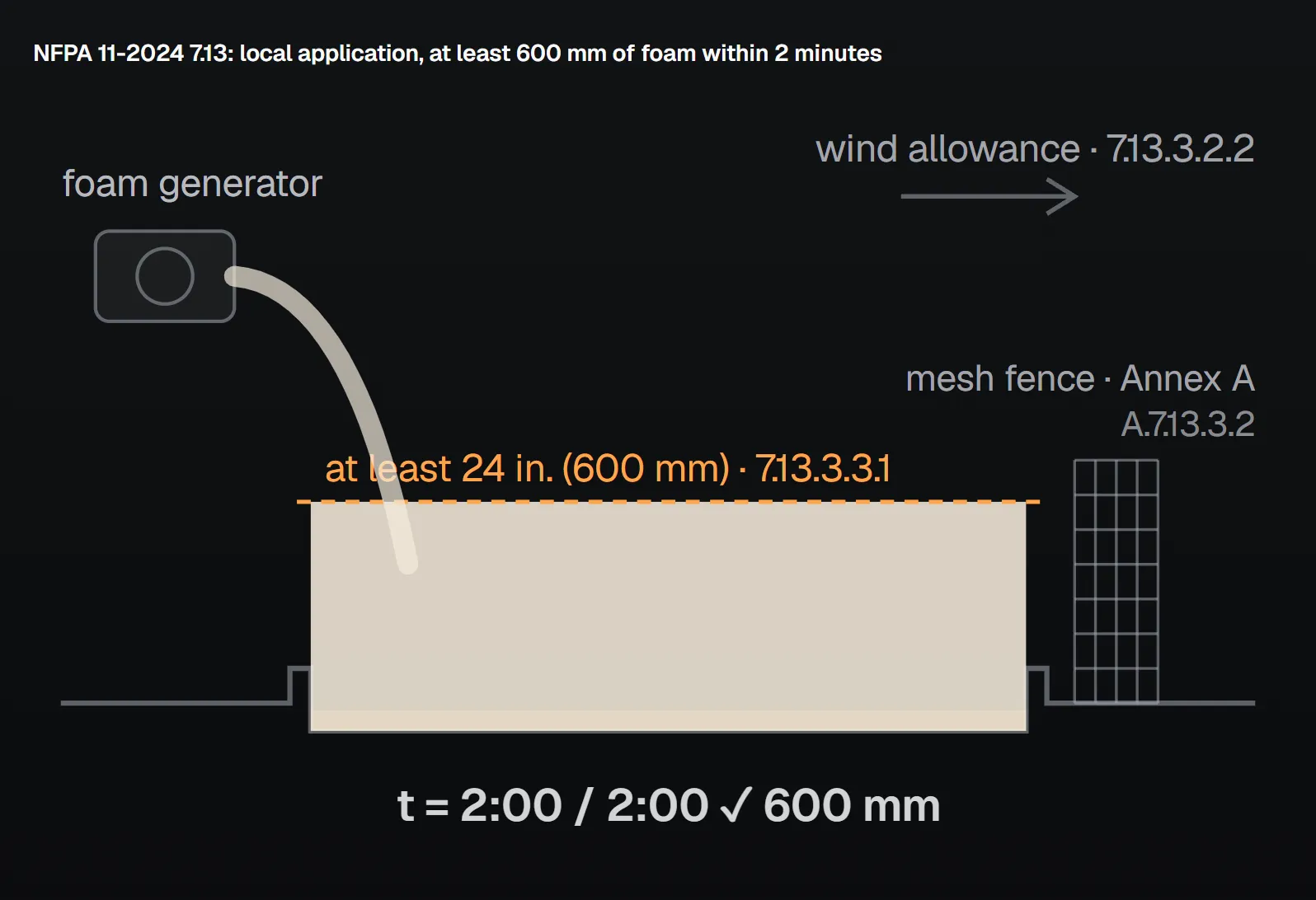
A local application system consists of fixed generators with a piped supply of concentrate and water, discharging foam directly onto a fire or spill (7.13.1.1). It may be used to extinguish or control fires in ignitable liquids, LNG and ordinary Class A combustibles where the hazard is not totally enclosed; for multi-level or three-dimensional hazards where flooding the whole building is impractical, the hazard is given its own containment (7.13.1.2). Annex A notes that these systems suit essentially flat surfaces such as confined spills, open tanks, drainboards, curbed areas, pits and trenches (A.7.13.1.2, Annex A, explanatory).
- Extent: the hazard includes every area fire could spread to or from (7.13.3.1).
- Location and weather: indoors, under partial shelter or fully outdoors, with allowance for wind and other weather effects (7.13.3.2). Annex A reports that fences of ordinary metal window screen mesh have held medium- and high-expansion foam within a protected area (A.7.13.3.2, Annex A, explanatory).
- Depth and time: for ignitable liquids and solids, foam is discharged fast enough to cover the hazard at least 600 mm (24 in.) deep within 2 minutes (7.13.3.3.1), an average rise of at least 0.3 m/min (1 ft/min).
- Quantity: concentrate and water for at least 12 minutes of continuous operation of the whole system (7.13.3.3.2.1), with reserve to 7.12.9 (7.13.3.3.2.2).
- Arrangement: outlets deliver foam over every part of the hazard, and foam must reach and stay on raised parts at the required depth (7.13.3.3.3).
A simple arithmetic example: 600 mm of foam over a 5 m × 4 m curbed spill area is 20 × 0.6 = 12 m³; building that in 2 minutes means at least 6 m³/min of net foam before any losses. Unlike total flooding, local application has no loss factors in the standard; wind and foam loss are for the designer and testing. For LNG, the rate per unit area is set by test (7.14.2.1).
Portable foam generators (7.15)
A portable device is a hand-operated, transportable generator connected by hose, or pipe and hose, to water and concentrate; proportioning may be built in or separate, and solution may come from central equipment (7.15.1.1). Only listed or approved equipment is used, on any hazard in the chapter (7.15.1.2.2, 7.15.2).
| Topic | Rule | Clause |
|---|---|---|
| Preconnected device | Accessible, with enough hose to reach the most distant hazard | 7.15.3.1 |
| Concentrate | Accessible for immediate use | 7.15.3.2 |
| Generator location | Not exposed to the hazard | 7.15.3.3 |
| Device not preconnected | Arranged for immediate transport to all designated hazards | 7.15.3.4 |
| Rate and duration | By type and potential size of hazard; Chapter 7 requirements where the hazard is identified | 7.15.4.1.1, 7.15.4.1.2 |
| Simultaneous use | Concentrate and water for the most devices that can physically be used at once | 7.15.4.1.3 |
| Hose | Listed lined hose to NFPA 1961, sized for system hydraulics, stored ready and weather-protected | 7.15.5.1 |
| Electrical | Cables rugged, impervious to water and with a ground wire; connectors waterproof | 7.15.5.2 |
| Training | Users trained on the equipment and in firefighting technique | 7.15.6 |
Annex A notes that success with portable generators depends on the operator’s individual ability and technique (A.7.15.6, Annex A, explanatory). For concentrate supply and reserve see NFPA 11 Foam Concentrate Supply and Proportioning, and for acceptance testing see NFPA 11 Acceptance Tests.
Common mistakes
- Applying the high-expansion 1.1 times and 600 mm rule, or the flooding formula, to medium expansion, where depth, rate and quantity come from tests.
- Reaching 600 mm in local application but missing the 2-minute limit or the 12-minute supply (7.13.3.3).
- Sizing concentrate and water for a single portable device when several can run at once (7.15.4.1.3).
Frequently Asked Questions
What expansion ratio counts as medium expansion?
Annex A (explanatory) puts medium expansion at 20 to 200, with low expansion up to 20 and high expansion from 200 to about 1000 (A.3.3.9). Chapter 3 defines medium- and high-expansion concentrate as producing foams of 20:1 to about 1000:1 (3.3.11.6).
How are depth and rate set for medium-expansion foam?
By test. Depth varies with expansion and is set by test (7.12.5.2.2), the discharge rate is set by test (7.12.8.1) and the quantity is set by tests developed by an independent testing laboratory (7.12.9.2).
How fast must foam build up in local application?
It must cover the hazard at least 600 mm (24 in.) deep within 2 minutes (7.13.3.3.1). Concentrate and water last at least 12 minutes (7.13.3.3.2.1), with reserve to 7.12.9.
Who may enter a foam-filled space for a rescue?
Only trained rescuers in full protective equipment with self-contained breathing apparatus. Doors are opened, coarse water and a silicone-based de-foaming agent are used together, generators run on water only, and rescuers search in straight lines within sight of each other (7.6.3).
How are concentrate and water sized for portable foam generators?
By the type and potential size of the hazard (7.15.4.1.1). Where several devices can run at once, supplies must be accessible for the largest number that can physically be used at the same time (7.15.4.1.3).
SprinkCalc — Fire Sprinkler Design Across Three Standards
SprinkCalc covers hazard classification, design density and area, K-factor selection, water demand and hydraulic calculations for NFPA 13, FM Global and BS EN 12845 in a single iOS app, and exports a professional PDF report.
Download SprinkCalc on the App Store
MEP Calc — 110+ Engineering Calculators
MEP Calc bundles 110+ engineering modules in one iOS app: 21 fire calculations plus heating, cooling, HVAC, plumbing, steam and natural gas.
Download MEP Calc on the App StoreNFPA 11, Standard for Low-, Medium-, and High-Expansion Foam, 2024 edition: 3.3.5 (p. 11-10); 3.3.11.6, 3.3.13 (p. 11-11); 7.1–7.6.2 (p. 11-36); 7.6.3–7.7.3, Table 7.6.4.1 (p. 11-37); 7.7.4–7.11 (p. 11-38); 7.12.5 (p. 11-39); 7.12.8, 7.12.9 (p. 11-40); 7.13, 7.14.1–7.14.3.2 (p. 11-41); 7.15 (p. 11-42); Annex A: A.3.3.9 (pp. 11-58, 11-59), A.7.6, A.7.6.3 (p. 11-93), A.7.13.1.2, A.7.13.3.2, A.7.15.6 (p. 11-98). The dimensions in the worked example are assumptions. The binding text is the standard itself and the decision of the authority having jurisdiction.