The general requirements chapter of NFPA 20-2025 (Chapter 4) opens with three questions: which pumps does the standard cover, what is submitted for approval and when, and who determines that the pump is running properly while it operates? This article walks through Sections 4.1, 4.2 and 4.3 clause by clause, with the reasons taken from Annex A and the NFPA 20 Handbook (2022) commentary. As the Handbook points out, NFPA 20 does not itself require a fire pump to be installed; the need comes from the hydraulic demand of the suppression systems and the flow and pressure the available water supply can deliver. Where a pump is part of the system, its design, installation and acceptance testing follow this standard.
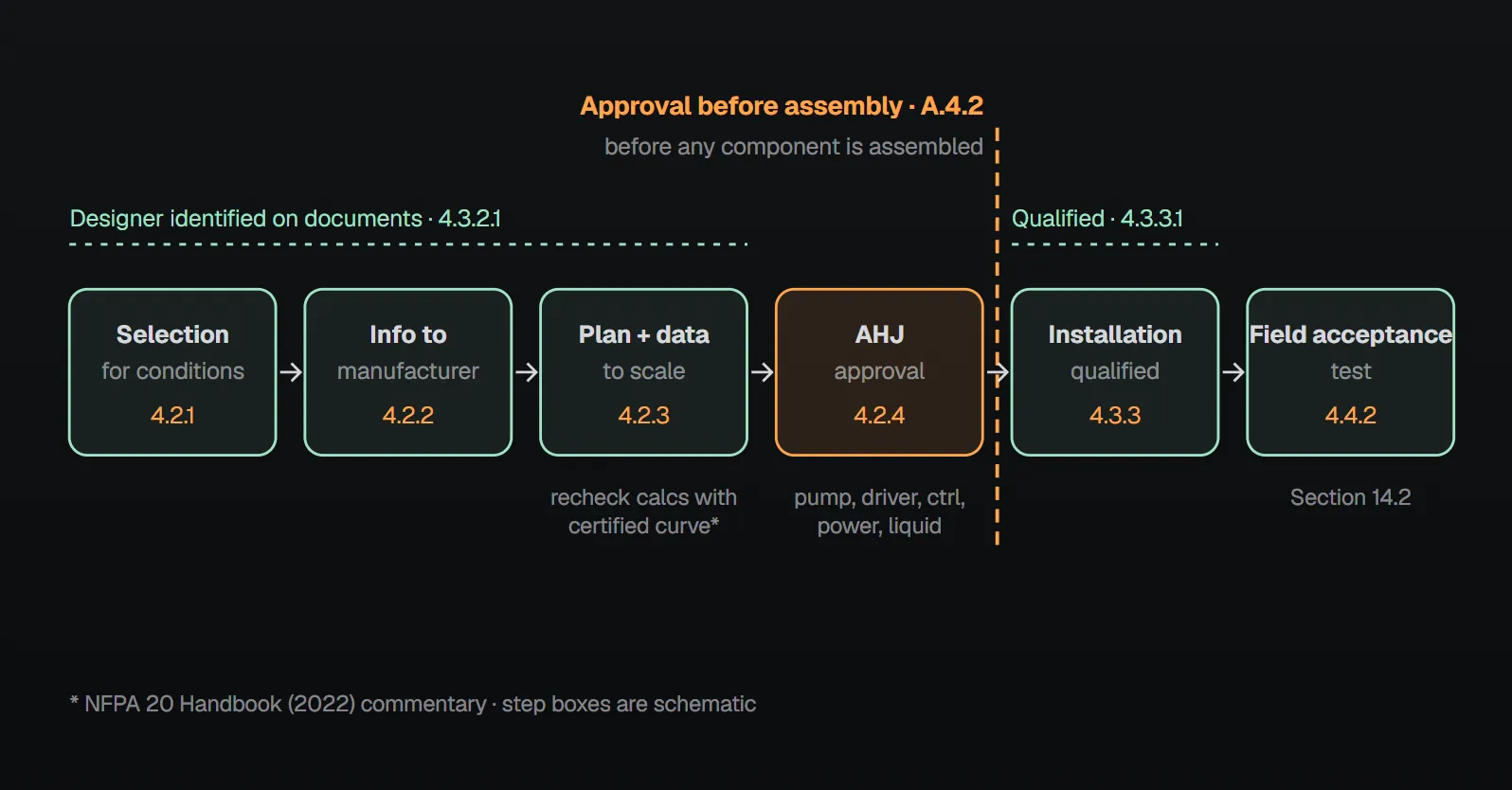
In short: the standard applies to single-stage and multistage centrifugal pumps and to positive displacement pumps of horizontal or vertical shaft design (4.1). Pumps are selected for the conditions under which they are installed and used (4.2.1); a complete plan and detailed data covering the pump, driver, controller, power supply, fittings, suction and discharge connections and liquid supply conditions is prepared for approval (4.2.3), and every item is approved by the AHJ for the specific field conditions (4.2.4). Annex A.4.2 says the approval should be obtained before any component is assembled. Means are provided for qualified personnel to determine that the pump is operating satisfactorily (4.3.1); the designer is identified on the design documents (4.3.2.1) and installers are qualified or supervised by qualified persons (4.3.3.1).
Which pumps does the standard cover?
NFPA 20 applies to centrifugal single-stage and multistage pumps of horizontal or vertical shaft design and to positive displacement pumps of horizontal or vertical shaft design (4.1). The standard defines a fire pump as a pump that provides liquid flow and pressure dedicated to fire protection (3.3.52.5). The assembled unit of fire pump, driver, controller and accessories is the “fire pump unit” (3.3.25).
Approval: what, by whom, and when?
- Selection: stationary pumps are selected based on the conditions under which they will be installed and used (4.2.1).
- Information to the manufacturer: the pump manufacturer or its authorized representative is given complete information on the liquid and power supply characteristics (4.2.2).
- Plan and data: a complete plan and detailed data describing the pump, driver, controller, power supply, fittings, suction and discharge connections and liquid supply conditions are prepared for approval (4.2.3). Plans are drawn to an indicated scale on sheets of uniform size (4.2.3.1).
- Approval: each pump, driver, controlling equipment, power supply and arrangement, and liquid supply is approved by the authority having jurisdiction for the specific field conditions encountered (4.2.4). In the standard, “approved” means acceptable to the AHJ (3.2.1).
Why before installation?
Annex A.4.2 states that, because of the unique nature of fire pump units, approval should be obtained before any specific component is assembled. The NFPA 20 Handbook (2022) commentary gives the practical reason: fire pumps are typically long-lead items, and changing the pump after it has been ordered can delay the project and add cost.
The same Handbook section adds several points. The designer should verify the pump suction and discharge pressures over the pump’s operating range; discharge pressure must meet the system demand without exposing components to pressures above their listed rating (4.2.1 commentary). The information given to the manufacturer covers whether the water supply is under positive pressure or static, environmental conditions and location, and, for electric pumps, the reliability, capacity and suitability of the power supply; where foam concentrate, foam water or seawater is pumped, the liquid characteristics are part of that information (4.2.2 commentary). A certified pump curve is not available until the pump is manufactured; if the hydraulic calculations used a generic curve, they should be reconfirmed when the certified curve arrives (4.2.3 commentary). For the certified curve and factory test see fire pump unit performance and shop test.
What must the plan show?
At a minimum, the plan shows the items from the following list that pertain to the design of the system (4.2.3.2):
| No. | Item shown on the plan (4.2.3.2) |
|---|---|
| (1) | Name(s) of owner(s) |
| (2) | Location, including street address |
| (3) | Point of compass |
| (4) | Name and address of installing contractor |
| (5) | Pump make and model number |
| (6) | Pump rating, including flow, pressure and speed |
| (7) | Suction main size, length, location, type and class or schedule of material, point of connection to the water supply, and depth to top of pipe below grade |
| (8) | Water storage tank, if applicable |
| (9) | Size and type of valves, regulators, meters and valve pits, if applicable |
| (10) | Water supply information, including flow test information if applicable: (a) location and elevation of the static and residual test gauge relative to the elevation reference point, (b) flow location, (c) static pressure, psi (bar), (d) residual pressure, psi (bar), (e) flow rate, gpm (L/min), (f) date, (g) time, (h) name of the person who conducted the test or supplied the information, (i) other sources of water supply, with pressure or elevation |
| (11) | Pump driver details, including manufacturer and horsepower |
| (12) | Voltage for electric-motor-driven pumps |
| (13) | Fuel system details for diesel-driven pumps |
| (14) | Controller manufacturer, type and rating |
| (15) | Suction and discharge pipe, fitting and valve types |
| (16) | Test connection piping and valves |
| (17) | Flowmeter details, if applicable |
| (18) | Jockey pump and controller arrangement, including sensing line details, if applicable |
Clause 4.6.1.2 adds a time limit to the flow test in item (10): unless the AHJ permits otherwise, the test must have been completed not more than 12 months before the working plans are submitted. Supply-side details: fire pump water supply adequacy.
While the pump runs: is it operating properly?
Means are provided for qualified personnel to determine that the fire pump is operating in a satisfactory manner during pump operation (4.3.1). Annex A.4.3.1 names two routes: a qualified person goes to the pump room and monitors conditions in person, or video, measurement and sensor equipment is installed in the pump room so that a qualified individual can determine satisfactory operation remotely.
The NFPA 20 Handbook (2022) commentary notes that this person does not need to be qualified to work on the pump but should be trained in its operation. When responding to a running fire pump, the person should at least be able to:
- start and stop the fire pump;
- recognize inadequate or excessive water flow through the pump packing;
- recognize abnormal operation such as excessive noise, excessive vibration, overheating, inappropriate flow through the circulation relief valve, leaking pipe or fittings, and excessive cold in the pump room;
- recognize the correct position of the control valves;
- know whom to call if the pump needs servicing.
The Handbook adds that the regularly scheduled no-flow test required by NFPA 25 is a good training opportunity for demonstrating pump operation. The rules for automated testing and remote monitoring equipment are covered separately: automated inspection, testing and monitoring.
Who may design and install?
| Topic | System designer (4.3.2) | Installer (4.3.3) |
|---|---|---|
| Basic rule | The designer is identified on the system design documents (4.3.2.1) | Installation personnel are qualified or supervised by persons qualified in the installation, inspection and testing of fire protection systems (4.3.3.1) |
| Evidence | Acceptable minimum evidence of qualifications or certification when requested by the AHJ (4.3.2.2) | Same (4.3.3.2) |
| Qualified personnel (one or more; not limited to these) | (1) factory trained and certified for fire pump system design of the specific type and brand; (2) certified by a nationally recognized fire protection certification organization acceptable to the AHJ; (3) registered, licensed or certified by a state or local authority (4.3.2.3) | The same three routes, for installation (4.3.3.3) |
| Additional evidence | The AHJ may require additional evidence of qualification or certification (4.3.2.4) | Same (4.3.3.4) |
Annex A.4.3.2.3(2) gives two example organizations offering such national certification programs and notes that NFPA has not independently verified or endorsed them or their services; A.4.3.3.3(2) refers back to the same note.
Common field errors and the reason in the sources
| Error | Rule | Reason given in the sources |
|---|---|---|
| Ordering and installing the pump or a component before approval | 4.2.4, A.4.2 | A.4.2: the unique nature of the unit; Handbook: long lead time, later changes cause delay and cost |
| Running the hydraulic calculation on a generic curve and not reconfirming it with the certified curve | 4.2.3 commentary | Handbook: to make sure system demands will be met |
| Not telling the manufacturer whether the supply is static or under positive pressure, or leaving out power supply data | 4.2.2 | Handbook: the correct pump type and performance depend on it |
| No person or remote monitoring arrangement to assess a running pump | 4.3.1 | A.4.3.1: assessment in person or remotely by video, measurement and sensors |
Checklist
- Has the manufacturer received complete liquid and power supply information (4.2.2)?
- Is the plan to scale on uniform sheets, with the relevant items of 4.2.3.2 and a flow test no more than 12 months old (4.2.3.1, 4.2.3.2, 4.6.1.2)?
- Were pump, driver, controller, power supply and liquid supply approved by the AHJ before installation (4.2.4, A.4.2)?
- Is the designer identified, and are installers qualified or qualified-supervised (4.3.2.1, 4.3.3.1)?
- Is there an in-person or remote means to assess the running pump (4.3.1, A.4.3.1)?
Frequently Asked Questions
Does NFPA 20 require a fire pump to be installed?
No. The NFPA 20 Handbook (2022) commentary explains that the need for a pump comes from the hydraulic demand of the suppression systems and the flow and pressure the water supply can provide. Where a pump is installed, its design, installation and acceptance testing follow NFPA 20, which covers horizontal and vertical shaft centrifugal and positive displacement pumps (4.1).
When should fire pump approval be obtained?
Annex A.4.2 says approval should be obtained before any specific component is assembled. Each pump, driver, controlling equipment, power supply and liquid supply is approved by the AHJ for the specific field conditions (4.2.4). Handbook (2022): pumps are long-lead items, and changes after ordering can delay the project and add cost.
What does a fire pump plan submitted for approval show?
The items of 4.2.3.2 that pertain to the design: owner, address, point of compass, installing contractor, pump make, model and rating, suction main, storage tank, valves and meters, flow test data, driver, voltage or fuel system, controller, pipe and valve types, test piping, flowmeter and jockey pump arrangement. Plans are to scale on uniform sheets (4.2.3.1).
Is remote monitoring of a running fire pump acceptable?
Clause 4.3.1 requires means for qualified personnel to determine that the pump is operating satisfactorily. Annex A.4.3.1 says this can be a qualified person monitoring in the pump room or video, measurement and sensor equipment that lets a qualified individual determine satisfactory operation remotely.
Who may design and install a fire pump system?
The designer is identified on the design documents (4.3.2.1); installers are qualified or supervised by qualified persons (4.3.3.1). Qualified personnel include at least one of: factory trained and certified, certified by a nationally recognized organization acceptable to the AHJ, or registered, licensed or certified by a state or local authority (4.3.2.3, 4.3.3.3). The AHJ may request evidence (4.3.2.2, 4.3.2.4).
SprinkCalc — Fire Sprinkler Design Across Three Standards
SprinkCalc covers hazard classification, design density and area, K-factor selection, water demand and hydraulic calculations for NFPA 13, FM Global and BS EN 12845 in a single iOS app, and exports a professional PDF report.
Download SprinkCalc on the App Store
MEP Calc — 110+ Engineering Calculators
MEP Calc bundles 110+ engineering modules in one iOS app: 21 fire calculations plus heating, cooling, HVAC, plumbing, steam and natural gas.
Download MEP Calc on the App StoreNFPA 20-2025, Standard for the Installation of Stationary Pumps for Fire Protection: 3.2.1, 3.3.25, 3.3.52.5; 4.1; 4.2.1–4.2.4, 4.2.3.1, 4.2.3.2; 4.3.1, 4.3.2.1–4.3.2.4, 4.3.3.1–4.3.3.4; 4.4.2; 4.6.1.2; Annex A.4.2, A.4.3.1, A.4.3.2.3(2), A.4.3.3.3(2) (explanatory). NFPA 20 Handbook 2022 commentary: Chapter 4 introduction; 4.2.1, 4.2.2, 4.2.3 and A.4.2 commentary; 4.3.1 and A.4.3.1 commentary.