A pump is only as reliable as its supply. That is why NFPA 20-2025 Section 4.6 looks at the source before the pump: is the supply adequate and dependable, is the water quality suitable for the pump, does a tank’s volume plus refill meet the demand for the full duration, and how is the lowest level of a well found? This article groups the rules by source type. Suction flange pressure limits and the case where the main cannot deliver 150% are covered separately: fire pump minimum suction pressure.
In short: the adequacy and dependability of the water source are of primary importance and are fully determined with due allowance for future reliability (4.6.1.1). Any source adequate in quality, quantity and pressure may supply a fire pump (4.6.2.1); where the public main is not adequate, an alternative source is provided (4.6.2.2). Adequacy is evaluated before the pump is specified and installed (4.6.2.3). A stored supply plus reliable automatic refill meets the demand for the design duration (4.6.4.1). The minimum water level of a well or wet pit is determined by pumping at not less than 150% of rated capacity (4.6.3).
Reliability: today and in the future
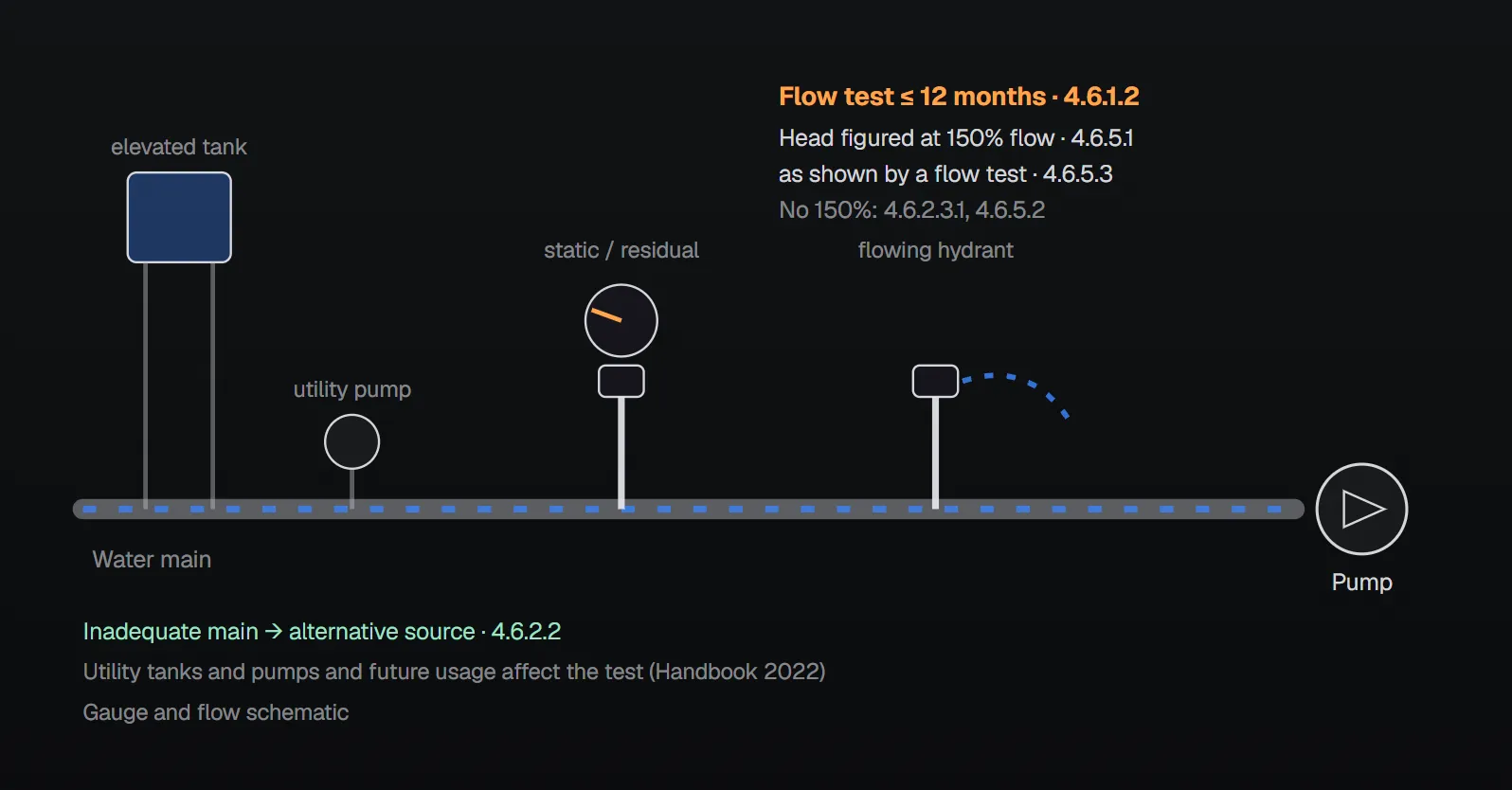
The adequacy and dependability of the source are of primary importance and are fully determined with due allowance for future reliability (4.6.1.1). Where a water flow test is used to determine adequacy, the test must have been completed not more than 12 months before the working plans are submitted, unless the AHJ permits otherwise (4.6.1.2). Annex A.4.6.1 refers to NFPA 1, 11, 13, 14, 15 and 750 for flow and pressure requirements.
The NFPA 20 Handbook (2022) commentary describes this as a complex evaluation covering life safety, economic and environmental risk, and highlights the following:
- Many utilities combine elevated tanks and pumps in the distribution system, which affects the flows and pressures measured in a flow test. Increased future usage, especially in rapidly developing areas, should be evaluated.
- These variations are taken into account so that the pump delivers enough discharge pressure under all reasonably anticipated suction conditions without exposing components to pressures above their listed rating.
- Surges are infrequent in fire pump installations but should be considered in cases such as suction from a long dead-end main, pumps upstream of large dry-pipe valves, or a relief valve malfunction; a surge analysis can be performed.
Which sources are acceptable?
Any source of water that is adequate in quality, quantity and pressure may supply a fire pump (4.6.2.1). Where the supply from a public service main is not adequate in quality, quantity or pressure, an alternative source is provided (4.6.2.2). Rules by source type:
| Source | Rule | Clause |
|---|---|---|
| Public main | Adequacy evaluated before pump specification and installation; available head figured at 150% of rated capacity and shown by a flow test. If 150% is not available, 4.6.2.3.1 and 4.6.5.2 apply | 4.6.2.3, 4.6.5.1, 4.6.5.3 |
| Factory-use water system | Running the pump at 150% of rated capacity should not create hazardous process upsets due to low water pressure | A.4.6.2 |
| Stored supply | Stored supply plus reliable automatic refill meets the demand for the design duration; a reliable replenishment method is provided | 4.6.4.1, 4.6.4.2 |
| Well or wet pit | Minimum water level determined by pumping at not less than 150% of rated capacity | 4.6.3 |
| Liquids other than water | Source supplies the maximum flow for any simultaneous demands for the required duration and number of discharges | 4.6.2.4 |
| Pump with mechanical seals | Water from a public service main, clean water in a closed-top tank, or a supply meeting the manufacturer’s water quality specification; clean water flush at positive pressure | 4.6.2.1.1, 4.6.2.1.2 |
Storage tank: volume plus refill
A stored supply plus reliable automatic refill is sufficient to meet the demand placed on it for the design duration (4.6.4.1), and a reliable method of replenishing the supply is provided (4.6.4.2). The NFPA 20 Handbook (2022) commentary explains:
- The required quantity is the system demand (gpm or L/min) multiplied by the discharge duration given by the applicable installation standard. Storage follows NFPA 22.
- Water available for fire protection is the water between the discharge connection and the overflow connection(s) of the tank.
- Where the stored supply is less than the required duration (for example a break tank), the available water is the stored fire water plus the water refilled automatically during the discharge; that refill is far larger than what is needed to fill a tank in 8 hours.
- 4.6.4.1 does not intend to require automatic refill on every fire water tank. Where the full demand is stored, automatic refill is preferable but manual filling is permitted; the refill method must be able to refill the tank within 8 hours per NFPA 22.
- For a pump fed from a tank, the system hydraulic calculations are based on the flows and pressures available after the full fire demand has been met, with the tank almost empty (4.6.5.3 commentary).
Where suction is from a break tank, the refill rate is tested and recorded at the acceptance test (14.2.6.3.5) and the refill device is operated at least five times (14.2.6.3.5.1). Break tank rules: fire pump break tank.
Water quality: raw water, salt water, mechanical seals
Annex A.4.6.4 says sources containing salt or other materials deleterious to fire protection systems should be avoided. Pumps with mechanical seals should be restricted to clean water applications; sand and debris can make the seal fail, so open tanks and open bodies of water such as retention ponds, lakes or rivers are not recommended, and the pump inlet should be under positive pressure at all times (A.4.6.2.1.1).
Handbook (2022) commentary: raw water sources can cause biological growth, clogging and corrosion in the system; ponds, lakes and rivers call for measures against corrosion, tuberculation and debris. Salt water is more corrosive than treated water and needs special pump materials; where possible the system is filled with treated water and pressure is maintained from a treated source, letting salt water in only for actual firefighting, and the system is flushed and refilled with treated water afterwards.
Annex A.4.6.4 also says that where the AHJ approves starting an engine-driven pump on loss of ac power, the supply must also meet the additional cooling water demand. The Handbook does not recommend the practice: auto-starting a diesel pump on power loss uses fuel and provides no benefit.
Common field errors and the reason in the sources
| Error | Rule | Reason given in the sources |
|---|---|---|
| Evaluating the supply after the pump is selected | 4.6.2.3 | No reason given; evaluation precedes specification and installation |
| Relying on an old or one-off flow test | 4.6.1.1, 4.6.1.2 | Handbook: utility tanks and pumps and future usage affect the test |
| Counting total tank volume instead of discharge-to-overflow volume | 4.6.4.1 commentary | Handbook: usable water lies between the discharge and overflow connections |
| Ignoring the process effect of 150% flow from a factory-use system | A.4.6.2 | Low water pressure can cause hazardous process upsets |
| Feeding a mechanical-seal pump from an open source | 4.6.2.1.1 | A.4.6.2.1.1: sand and debris can make the seal fail |
| Finding the well’s minimum level at a low flow | 4.6.3 | No reason given; pumping at not less than 150% of rated capacity |
Checklist
- Were adequacy and future dependability evaluated before pump selection (4.6.1.1, 4.6.2.3)?
- Is the flow test no more than 12 months old (4.6.1.2), and is head figured at 150% flow (4.6.5.1)?
- Is there an alternative source where the main is inadequate (4.6.2.2)?
- Does tank volume plus reliable refill cover the demand for the duration, with a replenishment method (4.6.4.1, 4.6.4.2)?
- Was the well’s minimum level found at not less than 150% flow (4.6.3)?
- Is water quality suitable for the pump’s seal type (4.6.2.1.1, A.4.6.4)?
Frequently Asked Questions
What sources can supply a fire pump?
Any source of water adequate in quality, quantity and pressure (4.6.2.1). Where the public main is not adequate in those respects, an alternative source is provided (4.6.2.2). Adequacy is evaluated before the pump is specified and installed (4.6.2.3).
How old can the flow test be?
Not more than 12 months before the working plans are submitted, unless the AHJ permits otherwise (4.6.1.2). The head available from the supply is figured at 150% of rated capacity and shown by a flow test (4.6.5.1, 4.6.5.3).
How is a fire water tank volume evaluated?
Stored supply plus reliable automatic refill must meet the demand for the design duration (4.6.4.1). NFPA 20 Handbook (2022): required quantity is demand × duration; usable water lies between the discharge and overflow connections; for a break tank, stored water plus refill during the discharge counts.
How is the minimum water level of a well determined?
The minimum water level of a well or wet pit is determined by pumping at not less than 150% of the fire pump’s rated capacity (4.6.3).
Can a pump with mechanical seals draw from a pond?
Clause 4.6.2.1.1 requires water from a public main, clean water in a closed-top tank, or a supply meeting the manufacturer’s water quality specification. Annex A.4.6.2.1.1 advises against open tanks and open bodies of water such as ponds, lakes or rivers because sand and debris can make the seal fail.
SprinkCalc — Fire Sprinkler Design Across Three Standards
SprinkCalc covers hazard classification, design density and area, K-factor selection, water demand and hydraulic calculations for NFPA 13, FM Global and BS EN 12845 in a single iOS app, and exports a professional PDF report.
Download SprinkCalc on the App Store
MEP Calc — 110+ Engineering Calculators
MEP Calc bundles 110+ engineering modules in one iOS app: 21 fire calculations plus heating, cooling, HVAC, plumbing, steam and natural gas.
Download MEP Calc on the App StoreNFPA 20-2025, Standard for the Installation of Stationary Pumps for Fire Protection: 4.6.1.1, 4.6.1.2; 4.6.2.1, 4.6.2.1.1, 4.6.2.1.2, 4.6.2.2, 4.6.2.3, 4.6.2.3.1, 4.6.2.4; 4.6.3; 4.6.4.1, 4.6.4.2; 4.6.5.1–4.6.5.3; 14.2.6.3.5, 14.2.6.3.5.1; Annex A.4.6.1, A.4.6.2, A.4.6.2.1.1, A.4.6.4 (explanatory). NFPA 20 Handbook 2022 commentary: 4.6.1, 4.6.1.1, 4.6.2.1, A.4.6.4, 4.6.4.1 and 4.6.5.3 commentary.