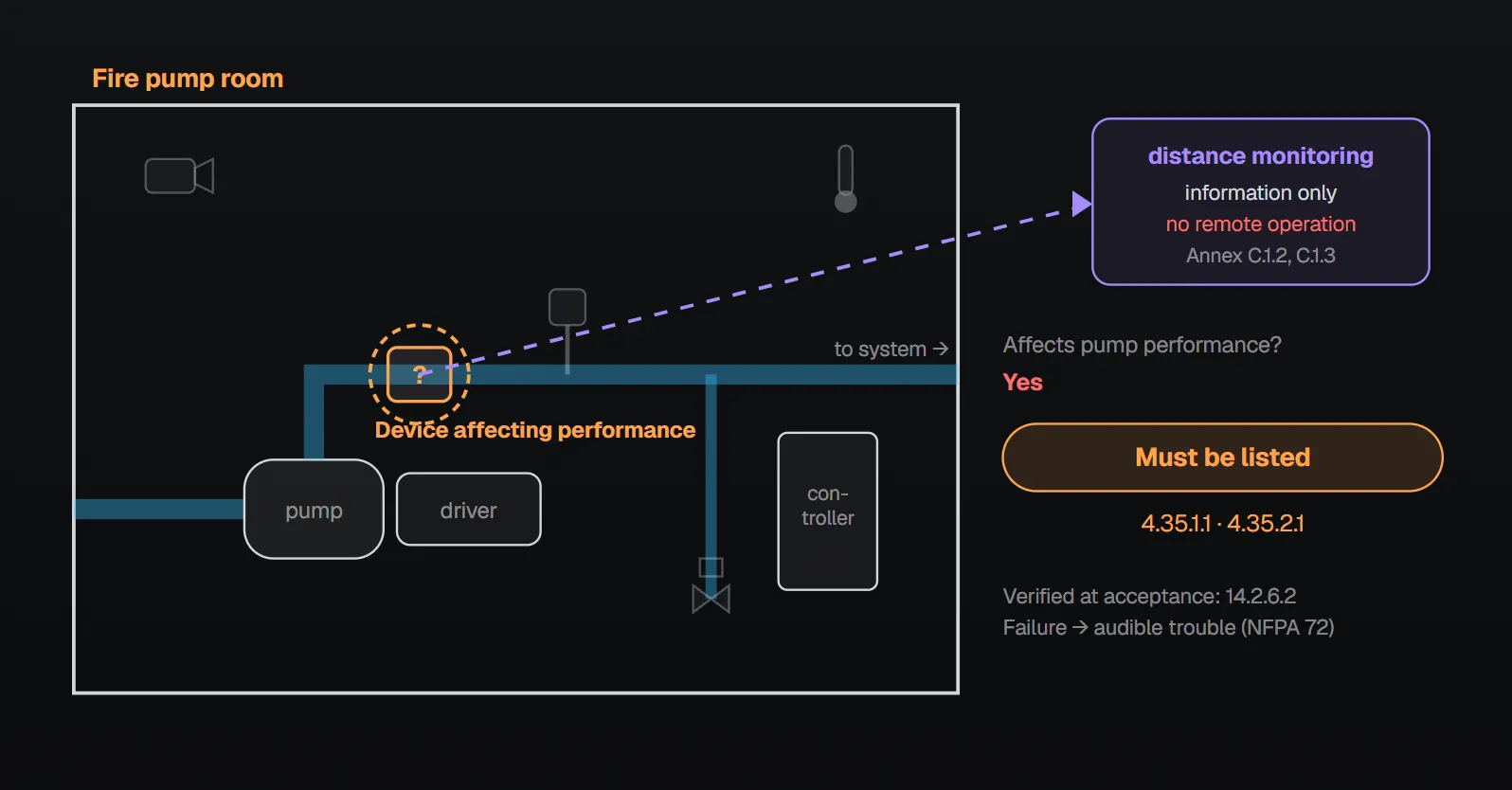
Some inspections and tests in a fire pump room can now be done remotely with electronic devices, and room temperature, pressures or valve positions can be watched from a distance. NFPA 20-2025 does not require these devices, but where they are used it sets which must be listed (4.35) and how they are verified at acceptance (14.2.6.2). Section 4.34 in the same part requires a field acceptance test of the whole installation.
In short: devices, meters and equipment used for automated inspection and testing or distance monitoring that are subjected to system pressure are listed (4.35.1.1, 4.35.2.1). Components subjected to system pressure that do not affect the fire pump’s performance need not be listed (4.35.1.2, 4.35.2.2). At acceptance their accuracy is tested; an inspection device must be as effective as a visual examination, a testing device must produce the same action the standard requires, and a failed automated inspection or test results in an audible trouble signal per NFPA 72 (14.2.6.2.1–14.2.6.2.3). A field acceptance test per Chapter 14 follows completion (4.34).
Definitions
- Automated inspection and testing: inspections and tests performed at a distance from the system or component being inspected or tested, using electronic devices or equipment installed for the purpose (3.3.5).
- Distance monitoring: monitoring various conditions of a system or component from a location distant from it, using electronic devices, meters or equipment installed for the purpose (3.3.17).
The listing rule
| Device, meter or equipment | Listing | Section |
|---|---|---|
| Used for automated inspection and testing and subjected to system pressure | Must be listed | 4.35.1.1 |
| Used for distance monitoring and subjected to system pressure | Must be listed | 4.35.2.1 |
| Subjected to system pressure but not affecting the pump’s performance | Not required | 4.35.1.2, 4.35.2.2 |
| Digital camera, automatic drain valve, pressure transducer used only for pressure monitoring (inspection and testing) | Not required | A.4.35.1 |
| External thermometer, pressure transducer used only for pressure monitoring (distance monitoring) | Not required | A.4.35.2 |
The rules begin with “where provided”: the standard does not require these devices, it only sets conditions when they are used (4.35.1.1, 4.35.2.1). The NFPA 20 Handbook (2022) commentary likewise notes that automated inspection devices are not required by the standard but may be provided to improve monitoring and make future testing easier.
Why the distinction?
Annex A.4.35.1 and A.4.35.2 give the reason: certain devices that inspect, test or monitor from a distance are not integral to the operation of the fire pump unit and do not affect system performance; they may be in the riser room or attached to the system, but they need not be listed. The Handbook (2022) commentary compares this with pressure maintenance pump components: automated components that cannot directly impact system performance are not required to be listed. It gives the control valve operation test as an example of a remote test: the valve is operated through its full range and returned to its normal position. The term and its requirements entered the standard in the 2019 edition.
Verification at acceptance
- Automated inspection and testing devices installed on the fire pump system are tested to ensure their accuracy (14.2.6.2.1).
- Automated inspection devices are proven to be as effective as a visual examination (14.2.6.2.1.1).
- Automated testing devices produce the same action the standard requires to test a device (14.2.6.2.1.2).
- Testing discharges water where required by the standard and NFPA 25 (14.2.6.2.2).
- Failure of a component or system to pass an automated inspection or test results in an audible trouble signal in accordance with NFPA 72 (14.2.6.2.3).
On completion of the entire fire pump installation a field acceptance test is conducted per the standard (4.34), using the methods in Chapter 14. For flow testing arrangements see test header and flowmeter.
Controller connectivity: Annex C (informative)
Annex C is not part of the requirements but bears directly on distance monitoring:
- Accessible information may be used for remote supervision, remote monitoring for failure forecasting or component replacement, and reliability analysis, for obtaining information only; no remote operation or remote changing of controller settings is to be permitted (C.1.2).
- Connectivity is for remote monitoring and data gathering and does not replace any of the standard’s alarm and signaling requirements (C.1.3).
- Plugging a computer, phone or memory stick into the data access port can cause electrical damage or damage to data or software; provisions should prevent such damage from stopping the pump from starting (C.4.2).
- Allowing remote starting or stopping implies outside access to the basic control software and limits or negates the effectiveness of firewalls (C.4.5.1).
For the controller itself see fire pump controller.
Field watch points (from the rules)
- Unlisted device under system pressure that affects performance: listing is required (4.35.1.1, 4.35.2.1).
- Accepting an automated test device without verification: its accuracy is tested at acceptance (14.2.6.2.1).
- Counting a test that should flow water without flowing: water is discharged where the standard and NFPA 25 require (14.2.6.2.2).
- Silent failure: a failed automated test gives an audible trouble signal (14.2.6.2.3).
- Remote setting changes: Annex C says they should not be permitted (C.1.2); connectivity does not replace alarms (C.1.3).
Checklist
- Every automated test or monitoring device under system pressure that affects performance is listed (4.35.1.1, 4.35.2.1).
- Unlisted devices are documented as not affecting performance (4.35.1.2, 4.35.2.2).
- Accuracy, equivalence to visual examination and same action proven at acceptance (14.2.6.2.1–14.2.6.2.1.2).
- Tests that require flow discharge water (14.2.6.2.2).
- Failed automated tests give an audible trouble signal per NFPA 72 (14.2.6.2.3).
- Remote access is read-only; pump and settings cannot be changed remotely (Annex C.1.2).
- Acceptance test per Chapter 14 when the installation is complete (4.34).
Frequently Asked Questions
Must an automated test device on a fire pump be listed?
Devices, meters and equipment used for automated inspection and testing that are subjected to system pressure are listed (NFPA 20-2025 4.35.1.1). Components subjected to system pressure that do not affect the pump’s performance need not be listed (4.35.1.2).
Does a pressure transducer for remote monitoring need listing?
Per Annex A.4.35.1 and A.4.35.2, a pressure transducer used only for pressure monitoring is not integral to the operation of the pump unit and need not be listed. A device under system pressure that affects pump performance is listed (4.35.2.1).
How are automated test devices verified at acceptance?
Their accuracy is tested; inspection devices must be as effective as a visual examination, testing devices must produce the same action the standard requires, water is discharged where required, and a failure gives an audible trouble signal per NFPA 72 (14.2.6.2.1–14.2.6.2.3).
Can a fire pump be started or reconfigured remotely?
Informative Annex C says accessible information is for obtaining information only and no remote operation or remote changing of controller settings is to be permitted (C.1.2); it lists remote start and stop as a security hazard (C.4.5.1).
What does 4.34 require?
On completion of the entire fire pump installation, a field acceptance test is conducted in accordance with the standard; details are in Chapter 14 (4.34).
SprinkCalc — Fire Sprinkler Design Across Three Standards
SprinkCalc covers hazard classification, design density and area, K-factor selection, water demand and hydraulic calculations for NFPA 13, FM Global and BS EN 12845 in a single iOS app, and exports a professional PDF report.
Download SprinkCalc on the App Store
MEP Calc — 110+ Engineering Calculators
MEP Calc bundles 110+ engineering modules in one iOS app: 21 fire calculations plus heating, cooling, HVAC, plumbing, steam and natural gas.
Download MEP Calc on the App StoreNFPA 20-2025, Standard for the Installation of Stationary Pumps for Fire Protection: 3.3.5, 3.3.17, 4.34, 4.35.1.1, 4.35.1.2, 4.35.2.1, 4.35.2.2, 14.2.6.2.1–14.2.6.2.3; Annex A.4.35.1, A.4.35.2; Annex C (C.1.2, C.1.3, C.4.2, C.4.5.1) (explanatory); origin and development (2019 edition). NFPA 20 Handbook 2022 commentary: commentary on 3.3.5, 4.35 and 14.2.6.2.2.