The NFPA 20 Handbook (2022) names closed or partially closed control valves as a common cause of system failure. NFPA 20-2025 Section 4.18 lists which valves in the pump assembly are supervised in which position and the four accepted ways of doing it. The section is short; this article gives the rule together with the Handbook’s reasoning.
In short: where provided, the suction valve, discharge valve, bypass valves and isolation valves on the backflow prevention device or assembly are supervised open (4.18.1). Control valves in the pipeline to the hose valve header are supervised closed (4.18.2). The four accepted methods: central station, proprietary or remote station signaling service; local signaling that sounds an audible signal at a constantly attended point; locking valves open; sealing valves with approved weekly recorded inspection where they are inside fenced enclosures under the owner’s control (4.18.1).
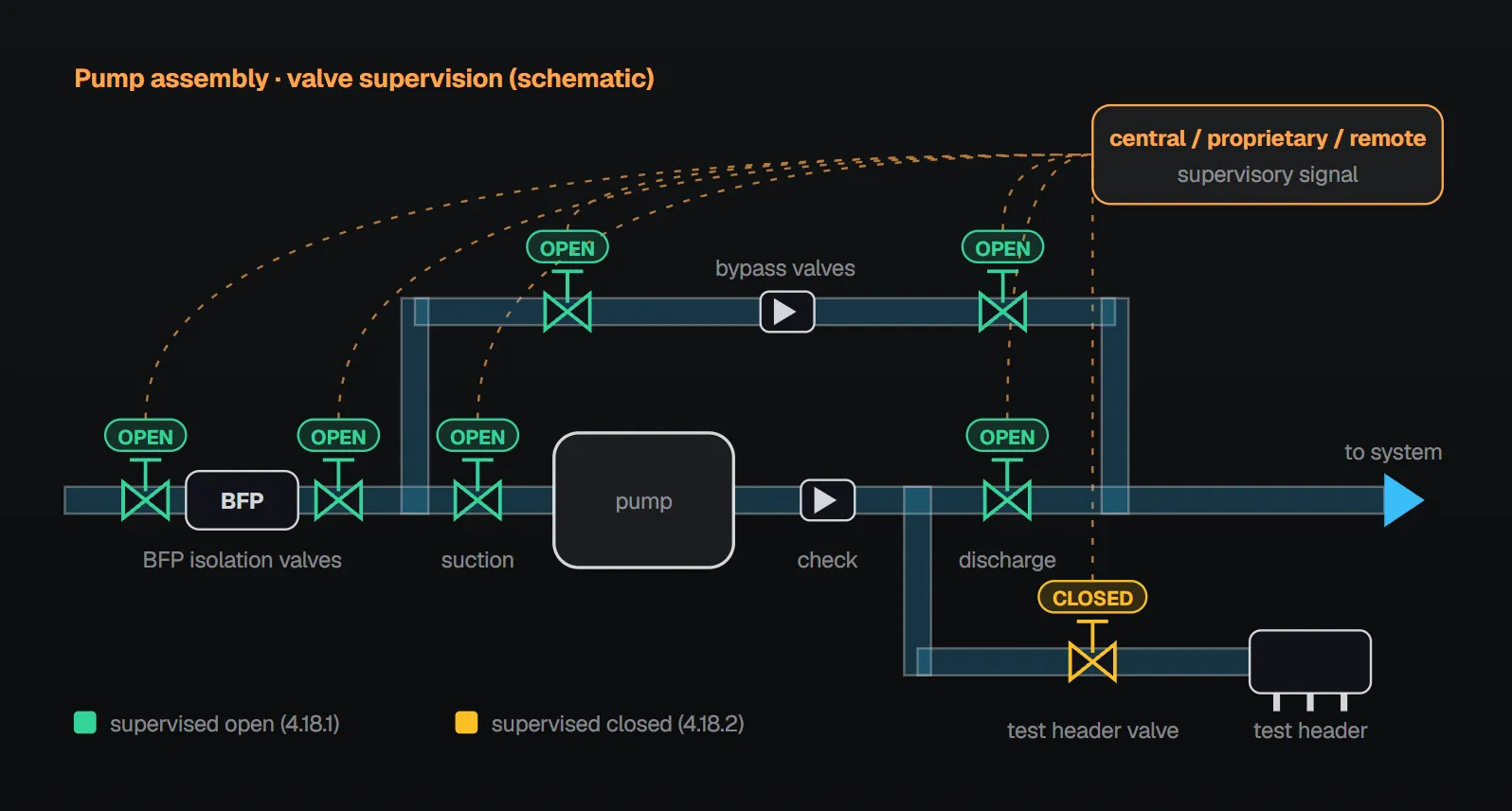
Which valve, which position?
| Valve | Supervised position | Clause |
|---|---|---|
| Suction valve | Open | 4.18.1 |
| Discharge valve | Open | 4.18.1 |
| Bypass valves | Open | 4.18.1 |
| Isolation valves on the backflow prevention device or assembly | Open | 4.18.1, A.4.18 |
| Control valves in the pipeline to the hose valve header | Closed | 4.18.2 |
The rule applies to the valves that are provided. Per Annex A.4.18, isolation valves and control valves are considered identical when used with a backflow prevention assembly. The type and location of the test header valve are in 4.22.3.3.1; see test header and flowmeter.
The four methods (4.18.1)
- Central station, proprietary or remote station signaling service.
- Local signaling service that sounds an audible signal at a constantly attended point.
- Locking valves open.
- Sealing of valves and approved weekly recorded inspection, where valves are inside fenced enclosures under the owner’s control.
Supervision closed uses one of the same methods (4.18.2). Per the Handbook (2022) commentary, the methods are listed in descending order of preference. Central station, proprietary or remote station supervision is preferred: supervisory signals received there are usually passed to the property’s maintenance staff and allow much more efficient notification of the fire department. The signal is not a fire alarm signal and needs no immediate response, but early notice that a control valve has been closed can change the fire department’s response and tactics. The same commentary stresses that NFPA 20 does not mandate this method.
Why?
- Closed valves: per the Handbook (2022) commentary, about one-third of system failures are attributed to closed or partially closed sprinkler system control valves; the four methods help keep this common failure mode to a minimum.
- Bypass: where a bypass is installed, water is expected to flow through it into the system without human intervention if the pump does not start; this only works if the control valves are open. All bypass valves are therefore supervised open (Handbook commentary).
- Test header valve: for test headers outside or where freezing is a danger, the 4.22.3.3.1 valve is normally closed and opened only for testing; it is supervised closed to prevent accidental freezing of the header (Handbook commentary).
Common field mistakes
- Reversing the contacts: the Handbook (2022) says a valve to be monitored closed must be ordered with the electrical configuration for the closed position; reversing the contacts of a valve designed for normally open service is not appropriate or acceptable.
- Unsupervised bypass or backflow preventer isolation valves: 4.18.1 lists them too.
- Test header valve left open: 4.18.2 requires supervision closed. Per the Handbook, where freezing is possible the hose header has an automatic drain valve (typically a ball drip).
- Seals outside a fenced enclosure: 4.18.1(4) applies only inside fenced enclosures under the owner’s control, with weekly recorded inspection.
Checklist
- Suction, discharge and bypass valves supervised open (4.18.1).
- Backflow preventer isolation valves supervised open (4.18.1, A.4.18).
- Test header control valve supervised closed (4.18.2).
- Method is one of the four in 4.18.1; if seals are used, fenced enclosure and weekly records exist.
- Switch on a closed-supervised valve is configured for the closed position.
Frequently Asked Questions
Which fire pump valves are supervised open?
Where provided, the suction valve, discharge valve, bypass valves and isolation valves on the backflow prevention device or assembly (NFPA 20-2025 4.18.1). Per Annex A.4.18, isolation and control valves used with a backflow preventer are considered identical.
Which valve is supervised closed?
Control valves in the pipeline to the hose valve header (4.18.2). Per the Handbook (2022) commentary the valve is normally closed, opened only for testing, and supervised closed to prevent accidental freezing of the header.
Is an electrical tamper switch mandatory?
No; 4.18.1 requires one of four methods: central, proprietary or remote station signaling, local audible signal at a constantly attended point, locking, or sealing in a fenced enclosure with weekly recorded inspection. The Handbook (2022) prefers station signaling but notes NFPA 20 does not mandate it.
Can a normally-open switch be reversed for closed supervision?
Per the Handbook (2022) commentary, no: a valve monitored closed is ordered with the electrical configuration for the closed position; reversing the contacts of a valve designed for normally open service is not acceptable.
Why are bypass valves supervised open?
Per the Handbook (2022), a bypass lets water reach the system without human intervention if the pump does not start, which only works if its control valves are open (4.18.1).
SprinkCalc — Fire Sprinkler Design Across Three Standards
SprinkCalc covers hazard classification, design density and area, K-factor selection, water demand and hydraulic calculations for NFPA 13, FM Global and BS EN 12845 in a single iOS app, and exports a professional PDF report.
Download SprinkCalc on the App Store
MEP Calc — 110+ Engineering Calculators
MEP Calc bundles 110+ engineering modules in one iOS app: 21 fire calculations plus heating, cooling, HVAC, plumbing, steam and natural gas.
Download MEP Calc on the App StoreNFPA 20-2025, Standard for the Installation of Stationary Pumps for Fire Protection: 4.18.1, 4.18.2; 4.22.3.3.1; Annex A.4.18 (explanatory). NFPA 20 Handbook 2022 commentary: Section 4.18.