NFPA 20 does not leave the rated capacity of a centrifugal fire pump open: it must be one of the values in a list. Section 4.10 gives that list (Table 4.10.2), the relationship between the greatest demand and rated capacity, and what happens above 5000 gpm. This article reproduces the table cell by cell and explains the rule with Annex A and the NFPA 20 Handbook (2022) commentary.
In short: the rated capacity of a centrifugal fire pump is one of the 21 values in Table 4.10.2, from 25 gpm (95 L/min) to 5000 gpm (18,925 L/min), and the pump is rated at net pressures of 40 psi (2.7 bar) or more (4.10.2). The greatest single demand of any fire protection system connected to the pump is less than or equal to 150 percent of rated capacity (4.10.1). Ratings over 5000 gpm (18,925 L/min) are subject to individual review by the authority having jurisdiction or a listing laboratory (4.10.3). The L/min values in the table are soft conversions (A.4.10.2).
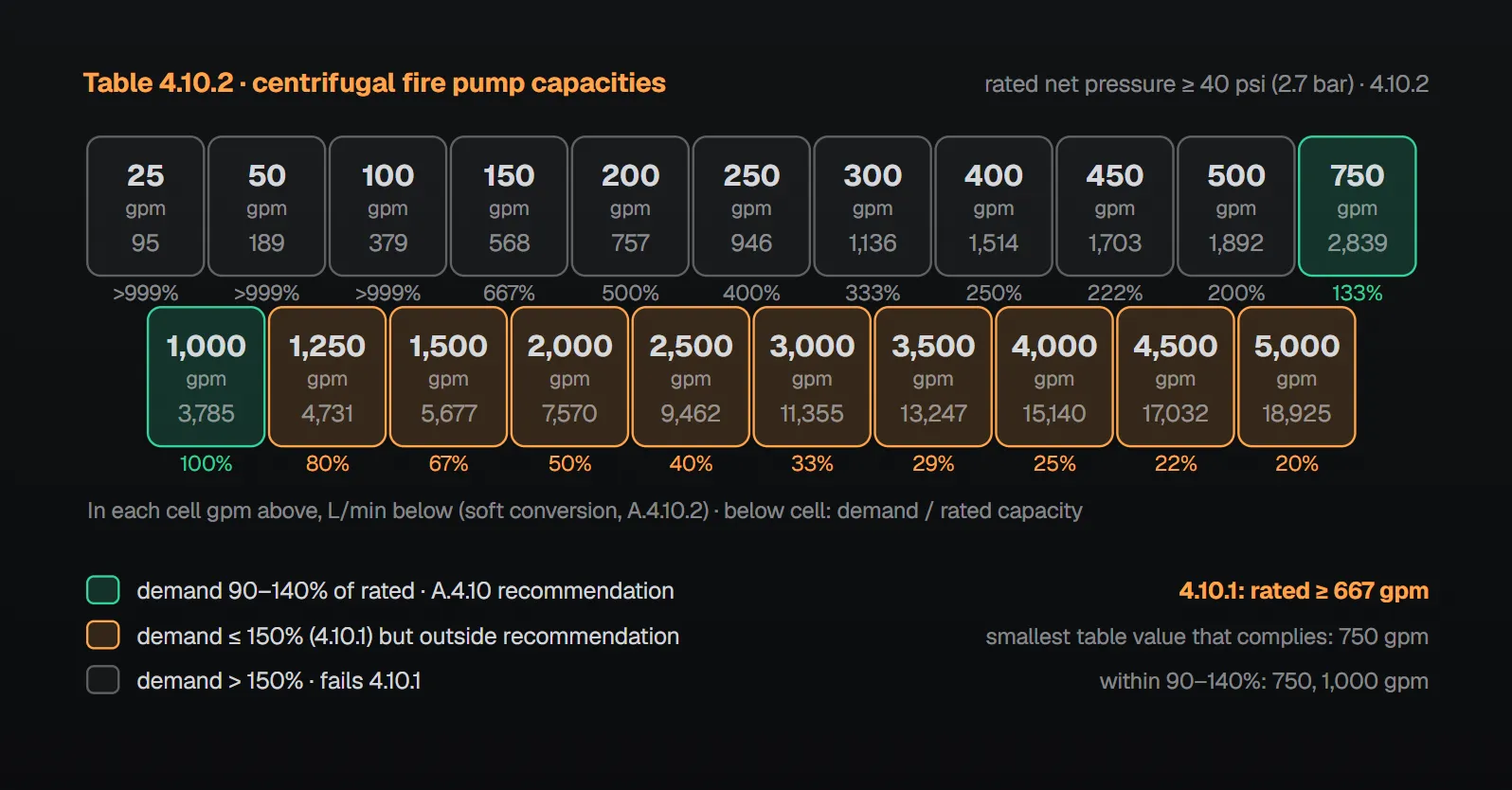
Table 4.10.2: centrifugal fire pump capacities
The table is reproduced below in the standard’s two-column-group layout. The standard lists the values in gpm and L/min together; the table has no footnotes.
| gpm | L/min | gpm | L/min |
|---|---|---|---|
| 25 | 95 | 1,000 | 3,785 |
| 50 | 189 | 1,250 | 4,731 |
| 100 | 379 | 1,500 | 5,677 |
| 150 | 568 | 2,000 | 7,570 |
| 200 | 757 | 2,500 | 9,462 |
| 250 | 946 | 3,000 | 11,355 |
| 300 | 1,136 | 3,500 | 13,247 |
| 400 | 1,514 | 4,000 | 15,140 |
| 450 | 1,703 | 4,500 | 17,032 |
| 500 | 1,892 | 5,000 | 18,925 |
| 750 | 2,839 |
Annex A.4.10.2 explains that countries using the metric system do not appear to have standardized flow ratings for pump capacities, so the L/min values in the table are soft conversions of the gpm values.
What the rules say
- A centrifugal fire pump is selected so that the greatest single demand for any fire protection system connected to the pump is less than or equal to 150 percent of the pump’s rated capacity (4.10.1).
- Centrifugal fire pumps have one of the rated capacities in gpm (L/min) in Table 4.10.2 and are rated at net pressures of 40 psi (2.7 bar) or more (4.10.2).
- Centrifugal fire pumps with ratings over 5000 gpm (18,925 L/min) are subject to individual review by either the authority having jurisdiction or a listing laboratory (4.10.3).
Why: Annex A and the Handbook
Annex A.4.10 gives two recommendations: at capacities over 140 percent of rated, pump performance can be adversely affected by suction conditions; application at less than 90 percent of rated capacity is not recommended. The same annex says pump selection should not be confused with operating conditions: with proper suction conditions the pump can operate at any point on its curve from shutoff to 150 percent of rated capacity.
The NFPA 20 Handbook (2022) commentary expands on this range. A demand between 90 and 140 percent of rated capacity shows the pump is neither oversized nor operating at its maximum output. The Handbook notes that some insurance companies limit pump sizing to 120 percent of rated capacity and some municipalities limit the maximum system demand to 100 percent; the intent is to avoid running the pump at or near its overload point, which over time can compromise performance. After years of service a pump may not reach 150 percent; a pump selected on its 150 percent performance would eventually show a deficiency. A demand below 90 percent means the pump is too large for the system, with higher power supply demand, excessive cost and more water used during testing.
For the curve itself, the churn ceiling and the head floor at 150 percent flow, see pump curve: churn and 150 percent.
What does “greatest single demand” mean?
The Handbook (2022) gives two “ask the AHJ” examples for this clause:
- Required flow higher than the selected pump’s rated flow: allowed; a fire pump can satisfy any point on its curve up to its overload point, 150 percent of rated flow.
- One pump serving several buildings on a campus: acceptable as long as the greatest single demand of the systems it serves is met. Systems designed to operate simultaneously count as a single demand for this clause. Where the greatest single demand exceeds what a single listed pump can provide, pumps arranged in parallel are permitted.
Common mistakes (from the sources)
- Selecting the pump on its 150 percent performance: the Handbook (2022) warns that a worn pump may not reach 150 percent, so this choice eventually leads to a deficiency.
- An oversized pump: a demand below 90 percent of rated is not recommended by Annex A.4.10; the Handbook lists power demand, cost and test water as the consequences.
- Counting simultaneous systems as separate demands: the Handbook treats them as one demand.
Checklist
- Rated capacity is one of the Table 4.10.2 values (4.10.2).
- Rated net pressure is at least 40 psi (2.7 bar) (4.10.2).
- Greatest single demand does not exceed 150% of rated capacity; simultaneous systems summed as one demand (4.10.1, Handbook).
- Demand preferably within 90–140% of rated capacity (A.4.10).
- Suction conditions assessed for operation above 140% (A.4.10); see fire pump minimum suction pressure.
- Ratings over 5000 gpm (18,925 L/min) reviewed by the AHJ or a listing laboratory (4.10.3).
Frequently Asked Questions
What are the standard fire pump capacities in NFPA 20?
The 21 values in Table 4.10.2: 25, 50, 100, 150, 200, 250, 300, 400, 450, 500, 750, 1,000, 1,250, 1,500, 2,000, 2,500, 3,000, 3,500, 4,000, 4,500 and 5,000 gpm. A centrifugal fire pump’s rated capacity is one of them (NFPA 20-2025 4.10.2).
Can the system demand exceed the pump’s rated capacity?
Yes, as long as the greatest single demand is less than or equal to 150 percent of rated capacity (4.10.1). Annex A.4.10 adds that above 140 percent suction conditions can affect performance and that application below 90 percent is not recommended.
Why are the L/min values in the table not round numbers?
Annex A.4.10.2 explains that there are no standardized metric pump ratings, so the L/min values are soft conversions of the gpm values; for example 1,000 gpm is listed as 3,785 L/min and 1,500 gpm as 5,677 L/min.
Can a fire pump larger than 5000 gpm be used?
Centrifugal fire pumps rated over 5000 gpm (18,925 L/min) are subject to individual review by the authority having jurisdiction or a listing laboratory (4.10.3). The Handbook (2022) also notes that pumps in parallel are permitted when the demand exceeds a single listed pump.
Is there a minimum rated net pressure?
Yes. Centrifugal fire pumps are rated at net pressures of 40 psi (2.7 bar) or more (4.10.2).
SprinkCalc — Fire Sprinkler Design Across Three Standards
SprinkCalc covers hazard classification, design density and area, K-factor selection, water demand and hydraulic calculations for NFPA 13, FM Global and BS EN 12845 in a single iOS app, and exports a professional PDF report.
Download SprinkCalc on the App Store
MEP Calc — 110+ Engineering Calculators
MEP Calc bundles 110+ engineering modules in one iOS app: 21 fire calculations plus heating, cooling, HVAC, plumbing, steam and natural gas.
Download MEP Calc on the App StoreNFPA 20-2025, Standard for the Installation of Stationary Pumps for Fire Protection: 4.10.1, 4.10.2, 4.10.3, Table 4.10.2; Annex A.4.10, A.4.10.2 (explanatory). NFPA 20 Handbook 2022 commentary: Section 4.10 (A.4.10 commentary and two “ask the AHJ” examples).