The job does not end at the acceptance test: a fire pump system is maintained for its whole life, its components get replaced, and each replacement is tested again. NFPA 20-2025 Section 14.3 lists the documents handed to the building owner, 14.4 names the standard for periodic maintenance, and 14.5 sets which test is needed when components are replaced.
In short: the building owner receives one set of record drawings and one copy of the completed test report; the manufacturer of each major component supplies one set of instruction manuals (14.3.1–14.3.3). Special tools needed for routine maintenance are available for inspection by the authority having jurisdiction at the acceptance test (14.3.5). Periodic inspection, testing and maintenance follow NFPA 25 (14.4). Replacing a critical path component calls for a new acceptance test (14.5.2.6); results meet or exceed the nameplate performance (14.5.2.7.2).
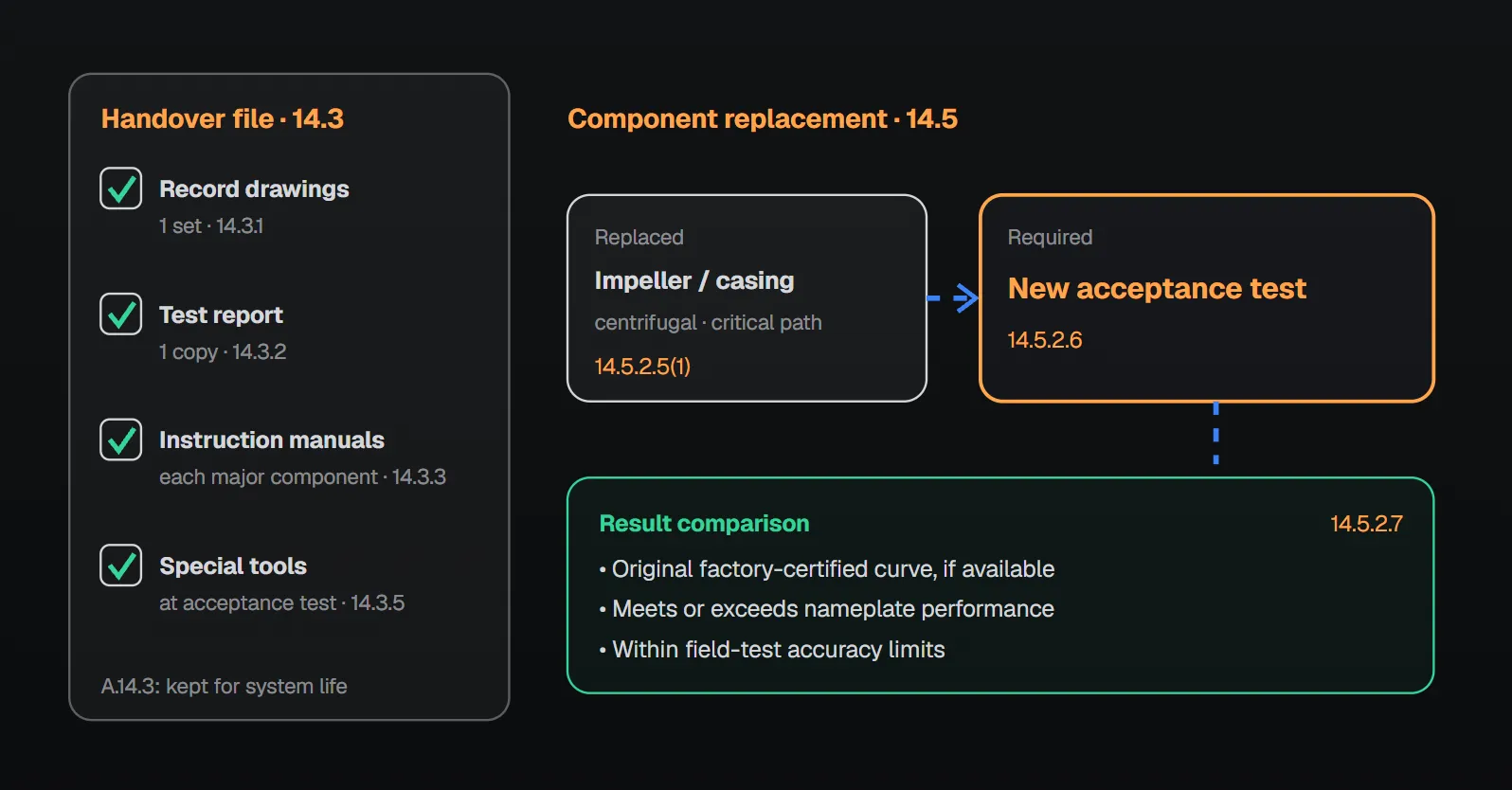
Handed to the building owner
| Document or equipment | Rule | Clause |
|---|---|---|
| Record drawings | One set, to the building owner | 14.3.1 |
| Completed test report | One copy, to the building owner | 14.3.2 |
| Instruction manuals | One set for every major component, supplied by that component’s manufacturer | 14.3.3 |
| Special tools and testing devices | Those needed for routine maintenance, available for inspection by the AHJ at the field acceptance test | 14.3.5 |
The manual contains (14.3.4):
- A detailed explanation of the operation of the component
- Instructions for routine maintenance
- Detailed instructions concerning repairs
- Parts list and parts identification
- Schematic electrical drawings of controller, transfer switch and fire pump control panels
- List of recommended spare parts and lubricants
Annex A.14.3 states the intent to retain the record drawing, equipment manual and completed test report for the life of the fire pump system. Stocking spare parts for critical items that are not readily available should be considered (A.14.3.3), and recommended spare parts and lubricants should be stored on site to minimize system impairment (A.14.3.4(6)).
NFPA 20 Handbook (2022) commentary: the manual is ordinarily submitted by the installing contractor for review and approval by the owner or the owner’s representative (usually the project engineer), multiple copies are kept on file, it is available at the acceptance test, and before final acceptance it is used to train operating personnel.
Periodic inspection, testing and maintenance
NFPA 20 says it in one sentence: fire pumps are inspected, tested and maintained in accordance with NFPA 25 (14.4). Frequencies and acceptance criteria live in NFPA 25; as this is an NFPA 20 series, those values are not repeated here. The Handbook (2022) notes that the acceptance test forms the baseline for later NFPA 25 performance tests, including the water supply characteristics. For the annual test itself see the NFPA 25 performance test article.
Component replacement: centrifugal pumps
- When a critical path component of centrifugal pump equipment is replaced, changed or modified, a field/on-site retest is performed (14.5.2.1).
- Components of fire pumps, controllers and drivers are replaced by factory-authorized representatives or qualified persons acceptable to the AHJ (14.5.2.2).
- When an ECM on an electronic fuel management–controlled engine is replaced, the new ECM carries the same software programming as the original (14.5.2.3).
- Replacement testing follows Table 8.6.1 of NFPA 25 (14.5.2.4). Replacement parts maintain the listing of the component whenever possible (14.5.2.4.1); where that is not possible, or the component was not originally listed for fire protection, the parts meet or exceed the quality of the parts replaced (14.5.2.4.2).
| Equipment | Critical path component |
|---|---|
| Fire pump | (a) Impeller, casing · (b) Gear drives |
| Fire pump controller (electric or diesel) | Total replacement |
| Electric motor, steam turbine or diesel engine driver | (a) Electric motor replacement · (b) Steam turbine replacement or rebuild · (c) Steam regulator or source upgrade · (d) Engine replacement or engine rebuild |
After a replacement, change or modification of any of these, the pump manufacturer, a factory-authorized representative or qualified persons acceptable to the AHJ conduct a new acceptance test (14.5.2.6). Field retest results are compared with the original factory-certified test curve whenever it is available; they meet or exceed the nameplate performance characteristics and stay within the field-testing accuracy limits stated elsewhere in the standard (14.5.2.7.1, 14.5.2.7.2).
Component replacement: positive displacement pumps
| Replaced | Required | Clause |
|---|---|---|
| Critical path component (as defined in 14.5.2.5) | Field test of the pump | 14.5.1.1 |
| Component that does not affect performance (e.g. shaft) | Only a functional test to ensure proper installation and reassembly | 14.5.1.2 |
| Component that affects performance (rotors, plungers, etc.) | Retest by the pump manufacturer, a designated representative or qualified persons acceptable to the AHJ | 14.5.1.3 |
| Water mist positive displacement pumping unit | The retest includes the pump unit as a whole | 14.5.1.3.1 |
Results are compared with the manufacturer’s original factory-certified test curve whenever it is available and meet or exceed the nameplate performance within the field-testing accuracy limits (14.5.1.4.1, 14.5.1.4.2).
Why?
- Keeping the records for life: Annex A.14.3 sets this as the intent; the Handbook (2022) wants the manual kept on file for future reference and used to train personnel.
- Spare parts on site: per Annex A.14.3.4(6), to minimize system impairment. The Handbook (2022) also says major components should be returned to service as quickly as possible when impairment occurs.
- Same software in the ECM: per Annex A.14.5.2.3, fire pump engines have features that standard industrial engines lack; standard industrial ECM programming can reduce power to self-protect the engine during a fire, or fail to accelerate the pump to rated speed at rated flow.
- Who replaces: Handbook (2022) commentary recommends that replacements on a listed pump, controller or driver be made by the manufacturer’s factory-trained representative, with parts from the original equipment manufacturer listed for fire pump service; where parts are no longer available, the equipment should be replaced with new listed and approved components. The retest should equal or exceed the original factory-certified curve, the controller starting and trip curves and the material specifications.
Neither the standard nor the Handbook gives a separate field-error example for these clauses.
Checklist
- Were record drawings (one set) and the completed test report (one copy) given to the building owner? (14.3.1, 14.3.2)
- Does each major component manual cover the six items of 14.3.4? (14.3.3, 14.3.4)
- Are special tools for routine maintenance available at the acceptance test? (14.3.5)
- Is periodic maintenance planned per NFPA 25? (14.4)
- After a critical path component replacement, was a new acceptance test performed and compared with the nameplate? (14.5.2.6, 14.5.2.7)
- If the ECM was replaced, does it carry the same software? (14.5.2.3)
For the acceptance test itself see the field acceptance test article; for the shop test and certified curve see the shop test article.
Frequently Asked Questions
What documents does the building owner receive after acceptance?
One set of record drawings, one copy of the completed test report, and one set of instruction manuals for every major component from that component’s manufacturer (NFPA 20-2025 14.3.1–14.3.3). Per Annex A.14.3 they are retained for the life of the system.
What must the instruction manual contain?
A detailed explanation of operation, routine maintenance instructions, repair instructions, a parts list, schematic electrical drawings of the controller and transfer switch, and a list of recommended spare parts and lubricants (14.3.4).
Which standard governs fire pump maintenance?
NFPA 20 refers periodic inspection, testing and maintenance to NFPA 25 (14.4). Frequencies and criteria are in NFPA 25.
Which replacements require a new acceptance test?
Critical path components: impeller and casing, gear drives, total controller replacement, electric motor replacement, steam turbine replacement or rebuild, steam regulator or source upgrade, engine replacement or rebuild (14.5.2.5). A new acceptance test is conducted (14.5.2.6).
What if the diesel engine ECM is replaced?
The replacement ECM carries the same software programming as the original (14.5.2.3). Per Annex A.14.5.2.3, standard industrial programming can reduce power to self-protect the engine during a fire or fail to bring the pump to rated speed.
SprinkCalc — Fire Sprinkler Design Across Three Standards
SprinkCalc covers hazard classification, design density and area, K-factor selection, water demand and hydraulic calculations for NFPA 13, FM Global and BS EN 12845 in a single iOS app, and exports a professional PDF report.
Download SprinkCalc on the App Store
MEP Calc — 110+ Engineering Calculators
MEP Calc bundles 110+ engineering modules in one iOS app: 21 fire calculations plus heating, cooling, HVAC, plumbing, steam and natural gas.
Download MEP Calc on the App StoreNFPA 20-2025, Standard for the Installation of Stationary Pumps for Fire Protection: 14.3.1–14.3.5; 14.4; 14.5.1.1–14.5.1.4.2; 14.5.2.1–14.5.2.7.2; Annex A.14.3, A.14.3.3, A.14.3.4(6), A.14.5.2.3 (explanatory). NFPA 20 Handbook 2022 commentary: Chapter 14 introduction, 14.3.4 and 14.5.2 commentary.