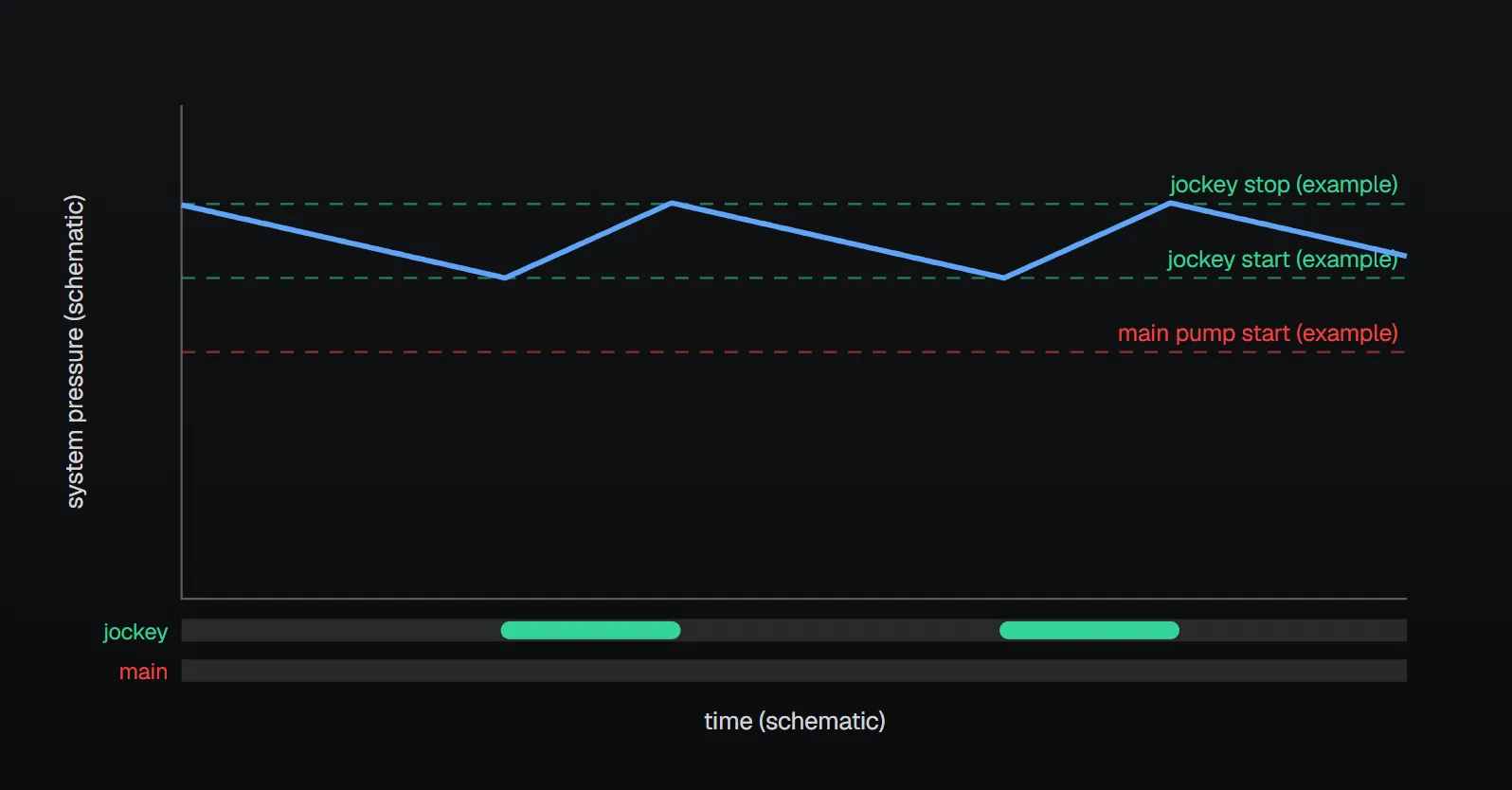
In most installations the fire pump starts on its own when pressure drops. So that small leaks and normal pressure fluctuations do not start the main pump every time, a separate means of holding pressure is needed; usually this is a jockey pump (also called a pressure maintenance or make-up pump, A.3.3.52.11). NFPA 20-2025 Section 4.27 covers how large it is, how it is connected and what it is exempt from. Pressure settings are not covered here; see fire pump pressure settings at commissioning.
In short: a pressure-actuated fire pump needs a means to maintain system pressure: a jockey pump, a water mist positive displacement pumping unit per 8.5.7.2, or another approved means that is not the main fire pump (4.27.1). The jockey replenishes allowable leakage and normal pressure drops (4.27.2.2) and its capacity is not less than any normal leakage rate (4.27.3). Where it serves only aboveground sprinkler and standpipe piping, it should flow less than a single sprinkler (A.4.27.2.2). Except as permitted in Chapter 8, the primary or standby fire pump may not be used as a jockey pump (4.27.7).
When is it needed?
The rule applies to pressure-actuated fire pumps and offers three options; the third is explicitly a means “that is not the main fire pump” (4.27.1). Annex A.4.27 recommends a jockey pump where a uniform or relatively high pressure is wanted, and notes that a domestic pump in a dual-purpose water system can maintain pressure. Annex A.4.27.5 adds that a jockey pump is usually required with automatically controlled pumps.
The NFPA 20 Handbook (2022) commentary explains why: the nature of the supply or leakage in the piping causes pressure fluctuations that can start the fire pump even though no sprinkler or standpipe valve has opened. Fire pumps are not intended to run for short periods to maintain pressure. A jockey pump also reduces the likelihood of pressure surges and the false waterflow alarms they cause.
How large should it be?
- Sized to replenish allowable leakage and normal pressure drops (4.27.2.2).
- Rated capacity not less than any normal leakage rate (4.27.3).
- Discharge pressure sufficient to maintain the desired system pressure (4.27.4).
Annex A.4.27.2.2 says sizing needs a thorough analysis of the type and size of the system served. A jockey on a large underground main is larger than one on a small aboveground system: NFPA 24 permits some leakage in underground mains, while aboveground piping must be tight when new. Where the jockey serves only aboveground sprinkler and standpipe piping it should flow less than a single sprinkler; the main pump must start and run (giving a pump running signal) whenever a sprinkler opens, which will not happen if the jockey is too large. The same annex gives a guideline used successfully: select a pump that makes up the allowable leakage in 10 minutes or 1 gpm (3.8 L/min), whichever is larger.
The Handbook (2022) commentary also gives a rule of thumb for jockey pumps supplying underground piping: 1% of fire pump rated capacity, at the fire pump rated pressure plus 10 psi (0.68 bar). Its example, a 1000 gpm (3785 L/min), 100 psi (6.9 bar) fire pump, gives a 10 gpm (37.8 L/min), 110 psi (7.58 bar) jockey. For older underground systems with excessive leakage, capacity is increased based on the leakage rate.
Protection against excess pressure
Where a centrifugal jockey pump’s total discharge pressure at shutoff exceeds the working pressure rating of the fire protection equipment, or a turbine vane (peripheral) pump is used, a relief valve sized to prevent overpressuring the system is installed on the jockey discharge (4.27.5.1). Running period timers are not used on jockey pumps that can exceed the system working pressure (4.27.5.2). Annex A.4.27.5 calls a centrifugal jockey preferable.
Per the Handbook (2022) commentary, a positive displacement jockey that fails to shut off keeps building pressure until the motor seizes or something breaks, and since jockey pumps are generally not electrically supervised, no one is warned. A running period timer can keep the pump running after the pressure demand is satisfied and cause significant discharge through the relief valve.
Connection and piping
- Suction and discharge piping is steel, including packaged prefabricated systems (4.27.6.1).
- An isolation valve on the suction side to isolate the pump for repair (4.27.6.3); a check valve and an isolation valve in the discharge (4.27.6.4).
- Indicating valves where needed to make the pump, check valve and fittings accessible for repair (4.27.6.5; Figure A.4.27.6.5).
- The pressure sensing line follows Section 4.32 (4.27.6.6): the jockey controller has its own individual line (4.32.1), connected between the jockey’s discharge check valve and discharge isolation valve (4.32.2). Details in pressure sensing line.
- Isolation valves serving the jockey pump need not be supervised (4.27.6.7).
Annex A.4.27.5 notes that jockey suction can come from the tank filling line, so system pressure can be held even when the tank is empty for repairs. Annex A.4.16.9 adds that where a backflow preventer is on the pump discharge, the jockey discharge and sensing lines must be located so that no cross-connection is created through the jockey pump.
What is not required?
- The jockey need not be listed but must be approved (4.27.2, 4.27.2.1); its valves and components need not be listed (4.27.6.2).
- Its controller is listed but need not be listed for fire pump service (4.27.8).
- No alternate or standby power is required (4.27.9). Jockey supply conductors may not be connected to the fire pump controller (10.3.4.6).
The Handbook (2022) commentary gives the reason: a jockey failure does not prevent the system from performing in an emergency; it eventually causes the fire pump to run. Plans show the jockey pump and controller arrangement, including sensing line details (4.2.3.2(18)).
Relation to settings
The jockey acts before the main pump; the Handbook (2022) commentary describes the pressure maintenance means as holding system pressure above the fire pump start setting. How jockey stop, jockey start and fire pump start points are chosen is illustrated in Annex A.14.2.6(4). For values and a worked example see fire pump pressure settings at commissioning.
Common field mistakes
- Oversized jockey: the main pump does not start when a sprinkler opens (A.4.27.2.2).
- Holding pressure with the main pump: except as permitted in Chapter 8, primary and standby pumps may not serve as jockey pumps (4.27.7).
- Timer on a high-pressure jockey: prohibited (4.27.5.2).
- Feeding the jockey from the fire pump controller: prohibited (10.3.4.6).
- Shared sensing line: each controller has its own (4.32.1).
Checklist
- A pressure maintenance means is provided; not the main pump (4.27.1, 4.27.7).
- Capacity covers leakage and normal drops and is not less than normal leakage (4.27.2.2, 4.27.3); below one sprinkler on aboveground systems (A.4.27.2.2).
- Relief valve where shutoff pressure exceeds equipment rating or a peripheral pump is used (4.27.5.1).
- Steel pipe; suction isolation valve, discharge check and isolation valves (4.27.6.1, 4.27.6.3, 4.27.6.4).
- Own sensing line, connected between check valve and isolation valve (4.32.1, 4.32.2).
- Jockey approved, controller listed, not fed from the fire pump controller (4.27.2.1, 4.27.8, 10.3.4.6).
Frequently Asked Questions
Is a jockey pump mandatory?
A pressure-actuated fire pump needs a means to maintain system pressure. It can be a jockey pump, a water mist positive displacement unit per 8.5.7.2, or another approved means that is not the main fire pump (NFPA 20-2025 4.27.1).
How is jockey pump flow selected?
To replenish allowable leakage and normal pressure drops, and not less than any normal leakage rate (4.27.2.2, 4.27.3). On aboveground sprinkler and standpipe piping only, less than one sprinkler is recommended; as a guideline, the larger of the allowable leakage made up in 10 minutes or 1 gpm (3.8 L/min) (A.4.27.2.2).
Must a jockey pump be listed?
No, it must be approved (4.27.2, 4.27.2.1). Its controller is listed but need not be listed for fire pump service (4.27.8).
Does a jockey pump need a relief valve?
Yes, where a centrifugal jockey’s shutoff pressure exceeds the working pressure rating of the equipment or a turbine vane (peripheral) pump is used; the valve goes on the jockey discharge (4.27.5.1).
Can the jockey be fed from the fire pump controller?
No. Jockey supply conductors may not be connected to the fire pump controller (10.3.4.6), and the jockey needs no alternate or standby power (4.27.9).
SprinkCalc — Fire Sprinkler Design Across Three Standards
SprinkCalc covers hazard classification, design density and area, K-factor selection, water demand and hydraulic calculations for NFPA 13, FM Global and BS EN 12845 in a single iOS app, and exports a professional PDF report.
Download SprinkCalc on the App Store
MEP Calc — 110+ Engineering Calculators
MEP Calc bundles 110+ engineering modules in one iOS app: 21 fire calculations plus heating, cooling, HVAC, plumbing, steam and natural gas.
Download MEP Calc on the App StoreNFPA 20-2025, Standard for the Installation of Stationary Pumps for Fire Protection: 4.2.3.2(18); 4.27.1–4.27.9; 4.32.1, 4.32.2; 10.3.4.6; Annex A.3.3.52.11, A.4.16.9, A.4.27, A.4.27.2.2, A.4.27.5, Figure A.4.27.6.5, A.14.2.6(4) (explanatory). NFPA 20 Handbook 2022 commentary: Section 4.27.