Where pipe passes through the wall, ceiling or floor of the fire pump room, the building and the pipe may not move the same way. NFPA 20-2025 has two separate sections for this: Section 4.19 for movement such as settlement and vibration, and Section 4.30 for earthquakes. This article summarises both with clause numbers.
In short: a clearance is provided around pipes passing through walls, ceilings or floors of the pump room enclosure (4.19). The hole is nominally 2 in. (50 mm) larger than the pipe (4.19.1); with a pipe sleeve, a sleeve nominally 2 in. (50 mm) larger than the pipe’s nominal diameter is acceptable (4.19.2). No clearance is required where flexible couplings are within 1 ft (305 mm) of each side (4.19.3). Where required, the clearance is filled with flexible material compatible with the pipe that maintains the enclosure’s fire resistance rating (4.19.5). Where earthquake protection is required, Section 4.30 applies (4.19.4): pump, driver and controller are attached to their foundations to resist seismic loads, high-centre-of-gravity pumps are braced above that centre, and pipe is protected per NFPA 13 (4.30.3).
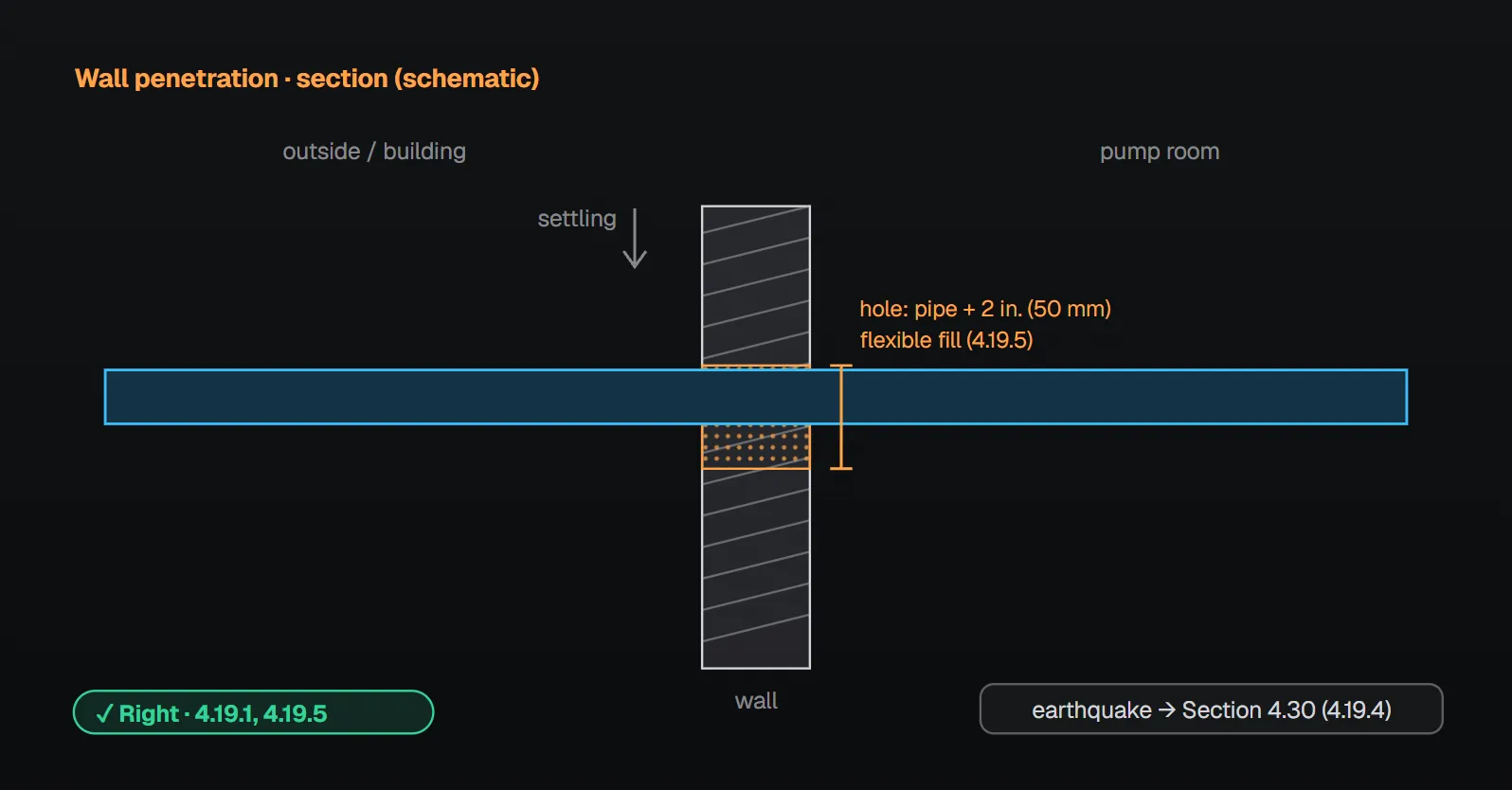
Clearance at penetrations (4.19)
| Case | Rule | Clause |
|---|---|---|
| General | Clearance around pipes passing through walls, ceilings or floors of the pump room enclosure | 4.19 |
| Hole | Hole diameter nominally 2 in. (50 mm) larger than the pipe | 4.19.1 |
| Sleeve | Sleeve nominal diameter 2 in. (50 mm) larger than the pipe’s nominal diameter is acceptable | 4.19.2 |
| Flexible couplings | No clearance required with flexible couplings within 1 ft (305 mm) of each side of the wall, ceiling or floor | 4.19.3 |
| Earthquake | Where earthquake protection is required, Section 4.30 applies | 4.19.4 |
| Fill | Where required, flexible material compatible with the piping that maintains the required fire resistance rating | 4.19.5 |
The 2 in. hole rule of 4.19.1 applies unless one of the options in 4.19.2 through 4.19.4 is met.
Why? (Annex A.4.19)
Per Annex A.4.19, pipe breakage caused by movement can be greatly lessened, and in many cases prevented, by increasing flexibility between major parts of the piping. One part should never be held rigidly while another is free to move without provision for relieving the strain. Flexibility comes from flexible couplings at critical points and clearances at walls and floors. Fire pump suction and discharge pipes are treated like sprinkler risers for the portion within a building (NFPA 13).
The same annex recommends: holes through pump room fire walls packed with mineral wool or other suitable material held by pipe collars on each side; pipes through foundation or pit walls into the ground with clearance, but watertight holes; space around pipes through pump room walls or pump house floors may be filled with asphalt mastic. The movement addressed by Section 4.19 is settling of the system and possible vibration while the pump runs; the section does not address anticipated earthquake forces.
Earthquake protection (4.30)
- Where water-based fire protection systems are to be protected against earthquake damage, 4.30.2 and 4.30.3 apply (4.30.1).
- Loads: horizontal seismic loads per NFPA 13, ASCE/SEI 7, local, state or international codes, or other sources acceptable to the authority having jurisdiction (4.30.2). Per A.4.30.2, NFPA 13 is a simplified approach developed to coincide with ASCE/SEI 7 and current building codes.
- Pump, driver, controller: attached to their foundations with materials capable of resisting applicable seismic loads (4.30.3.1).
- High centre of gravity: pumps such as vertical in-line pumps are mounted at their base and braced above their centre of gravity (4.30.3.2). Per A.4.30.3.2, the top bracing connects to the pump above its centre of gravity; the other end can connect to the floor or the pump’s mounting structure.
- Pipe and fittings: protected per NFPA 13 (4.30.3.3); 4.15.6.2 also ties seismic protection of piping to NFPA 13 Chapter 18. Per A.4.30.3.3, diesel exhaust piping can be secured using NFPA 13 criteria.
- Appurtenances: seismic protection, including trim pieces, where essential for post-earthquake operation of the pump (4.30.3.4); for smaller diameter trim lines, restraint is sufficient (4.30.3.4.1). Per A.4.30.3.4.1, hangers that offer lateral restraint should be sufficient on these lines.
Annex A.4.15.6 notes that NFPA 13 does not address fire pumps, controllers, drivers, fuel tanks (including trim), test header piping, relief valve piping or exhaust mufflers. The rule for pump, driver and controller is 4.30.3.1. More generally, 4.14.1 requires the pump, driver, controller, water supply and power supply to be protected against interruption of service from adverse conditions including earthquake; see pump room heat, ventilation and drainage.
The NFPA 20 Handbook (2022) commentary notes that post-earthquake fires are relatively common, so pump installations need to function during and after a seismic event. Per the same commentary, fire protection systems are generally designed for horizontal forces equal to one-half of their weight (0.5 g); some building codes allow lower values, more active areas need larger horizontal and vertical forces, and those factors come from the building code.
Common field mistakes
- Pipe held rigid at the penetration with the other side free: A.4.19 says this should not happen without strain relief; without flexible couplings, the 4.19.1 clearance is needed.
- Rigid fill, or fill that breaks the fire rating: 4.19.5 calls for flexible, compatible fill that keeps the rating.
- Treating the 4.19 clearance as seismic protection: A.4.19 says the section does not address earthquake forces; Section 4.30 applies (4.19.4).
- Vertical in-line pump anchored at the base only: 4.30.3.2 also requires bracing above the centre of gravity.
- Unrestrained trim lines needed after an earthquake: contrary to 4.30.3.4.
Checklist
- Each penetration has a hole or sleeve nominally 2 in. (50 mm) larger, or flexible couplings within 1 ft (305 mm) of each side (4.19.1–4.19.3).
- Clearance filled with flexible, compatible, fire-rated material (4.19.5).
- Where seismic protection applies, loads determined per 4.30.2 (4.30.1, 4.30.2).
- Pump, driver and controller anchored for seismic loads; high-centre-of-gravity pump braced above it (4.30.3.1, 4.30.3.2).
- Pipe protected per NFPA 13; essential trim lines restrained (4.30.3.3, 4.30.3.4).
Frequently Asked Questions
How large must the hole in the pump room wall be?
The hole is nominally 2 in. (50 mm) larger than the pipe (NFPA 20-2025 4.19.1). With a sleeve, a sleeve nominally 2 in. (50 mm) larger than the pipe’s nominal diameter is acceptable (4.19.2).
Is clearance needed with flexible couplings?
No clearance is required where flexible couplings are within 1 ft (305 mm) of each side of the wall, ceiling or floor (4.19.3).
What is the clearance filled with?
Where required, flexible material compatible with the piping that maintains the enclosure’s fire resistance rating (4.19.5). Annex A.4.19 cites mineral wool held by pipe collars at fire walls and asphalt mastic at walls and floors.
Is the 4.19 clearance enough for earthquakes?
No. Per A.4.19 the section covers settlement and vibration, not earthquake forces. Where earthquake protection is required, Section 4.30 applies (4.19.4): foundation anchoring, top bracing for high-centre-of-gravity pumps and pipe protection per NFPA 13.
Where do seismic loads come from?
NFPA 13, ASCE/SEI 7, local, state or international codes, or other sources acceptable to the authority having jurisdiction (4.30.2). The Handbook (2022) notes general design for horizontal force of half the weight (0.5 g), with factors from the building code.
SprinkCalc — Fire Sprinkler Design Across Three Standards
SprinkCalc covers hazard classification, design density and area, K-factor selection, water demand and hydraulic calculations for NFPA 13, FM Global and BS EN 12845 in a single iOS app, and exports a professional PDF report.
Download SprinkCalc on the App Store
MEP Calc — 110+ Engineering Calculators
MEP Calc bundles 110+ engineering modules in one iOS app: 21 fire calculations plus heating, cooling, HVAC, plumbing, steam and natural gas.
Download MEP Calc on the App StoreNFPA 20-2025, Standard for the Installation of Stationary Pumps for Fire Protection: 4.14.1; 4.15.6.2; 4.19–4.19.5; 4.30.1–4.30.3.4.1; Annex A.4.15.6, A.4.19, A.4.30.2, A.4.30.3.2, A.4.30.3.3, A.4.30.3.4.1 (explanatory). NFPA 20 Handbook 2022 commentary: Sections 4.19 and 4.30.