Today’s fire pump controllers store pressure and alarm records; many can export that data or connect to a network. NFPA 20-2025 Annex C explains how to get data out of the pump room safely and in a common way. The annex is informational, not mandatory; per the Handbook (2022) it was added in the 2016 edition.
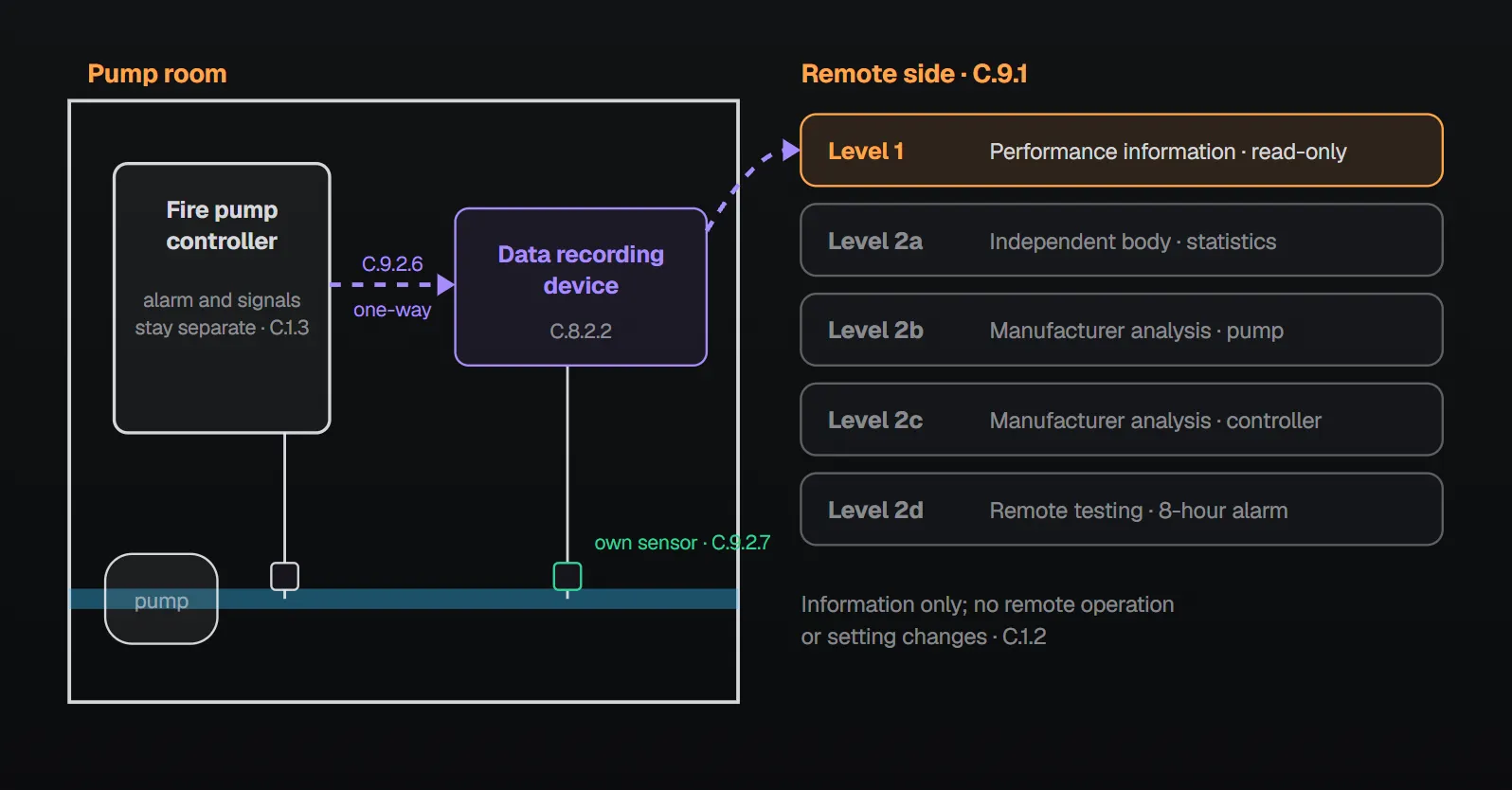
In short: connectivity is for obtaining information only: no remote operation or remote changing of controller settings (C.1.2), and remote starting or stopping is prohibited (C.7). It does not replace the standard’s alarm and signaling requirements (C.1.3). Any single protection method can be compromised, so multiple methods are combined (C.5). Access is split into levels, a stand-alone recording device only downloads from the controller and does not share its sensors (C.9.1, C.9.2.6, C.9.2.7).
How the annex is organized
| Section | Topic |
|---|---|
| C.1 | Scope: data storage and access beyond the minimum controller data storage requirements; access methods, security, accessible information and its use, standardization |
| C.2 | General definitions (C.2.1–C.2.27) |
| C.3 | Possible configurations: stand-alone and permanently connected controllers |
| C.4 | Security concerns |
| C.5 | Risk mitigation methods |
| C.6 | Standardization of parameters |
| C.7 | Remote control |
| C.8 | Data recording/reporting system configuration |
| C.9 | Recommended requirements and data tables |
Per Annex C.1.6, local or remote access to controller data has existed for over 20 years, but each manufacturer used proprietary means; the annex grows out of the need to extend access with some commonality. Standardization means access to a defined common set of data in any compliant controller; controllers may also hold proprietary data beyond that set (C.1.5).
Two configurations
- Stand-alone controller: no permanent wired or wireless connection; almost all modern controllers are like this, and user intervention is required to read or download (C.3.1.1, C.3.1.2). Access ports such as a serial port carry accidental or malicious hazards; stored data, access circuitry or fire protection firmware could be corrupted (C.3.1.3–C.3.1.5).
- Permanently connected controller: private permanently wired methods, publicly accessible wired or wireless connections (usually addressed by the premise owner’s IT department) and permanent wireless or cellular connections (C.3.2.1–C.3.2.3).
Security concerns
- Controllers are critical to life safety and property protection; their embedded processors are subject to damage or derangement if program code or data is compromised (C.4.1).
- Plugging a computer, phone or memory stick into the data port could cause electrical, data or software damage; provisions should keep such damage from preventing the pump from starting (C.4.2). Inadvertent threats include accidentally altering the controller while connected, induced surges from nearby lightning, and local, wide-area or internet network problems (C.4.2.1).
- Devices with a routable address are discovered within minutes of connecting to the internet and are constantly scanned (C.4.3). Computers and web pages are frequently infected (C.4.4).
- Allowing remote starting or stopping gives the outside world access to the basic control software and limits or negates any firewalls (C.4.5.1). At a single installation: disabling pump starting, false starting or false/reset weekly test time (both causing a fire alarm), a disabled controller; at multiple installations, doing these simultaneously could hamper fire departments and emergency call centers (C.4.5.2, C.4.5.3).
- Attacks are easier if the attacker knows the controller software; listed routes include corruption of the manufacturer’s network, compromised or faux service personnel and employees’ personal devices (C.4.6).
Risk mitigation
Any single method can be, and is, compromised; using multiple methods reduces the likelihood of a successful attack (C.5). A risk assessment includes at least the likelihood and frequency of a hazard; the method of Article 708 of NFPA 70 is cited as an example (C.5.1). Protection means: password protection with minimum requirements, encryption, a software firewall and a hardware firewall, i.e. separate processors for data access and pump control (C.5.3). Passwords are easily compromised, comprehensive ones take longer (C.5.4); anything below 128-bit encryption is cracked in minutes by a determined attacker (C.5.5). Other methods: nonstandard ports (limited help, encryption is vital), call-back on dial-up links, limiting access to specific addresses (white list), protecting controller software and source code, limiting copies and access to software, and effective encryption of code (C.5.7).
Recommended requirements
| Recommendation | Clause |
|---|---|
| Remote starting and/or stopping is prohibited | C.7 |
| The controller may have a read-only connection to a network, with information downloaded from it | C.8.1.2 |
| Additional monitoring and reporting take place outside the controller on a data recording device; control functions there should not have the potential to prevent the pump from operating | C.8.2.2, C.8.2.3 |
| Separate access protocols per level: Level 1 read-only performance information; 2a statistical analysis by an independent body; 2b manufacturer analysis of the pump; 2c manufacturer analysis of the controller; 2d remote testing (alarm if the pump is not restored to automatic within 8 hours) | C.9.1 |
| All recorded information is protected per C.9.1 or other appropriate security | C.9.2.1 |
| Equipment information is recorded on the controller at installation (Table C.9.2.2) | C.9.2.2 |
| Continuously monitored information is time-stamped every 24 hours and whenever it changes more than 5 percent from the previous record (Table C.9.2.3) | C.9.2.3 |
| Test information is recorded when the test record button is pushed; maintenance information at the time of maintenance (Tables C.9.2.4, C.9.2.5) | C.9.2.4, C.9.2.5 |
| A stand-alone pump room data recording device is limited to one-way (download only) communication with the controller | C.9.2.6 |
| The same transducer does not report to both the controller and a data recording device | C.9.2.7 |
An event record is triggered by events in the event tables, by voltage and current changes exceeding Δ percent during a pump run, by pressure every hour and by pressure changes exceeding Δ percent, with Δ adjustable up to 5 percent (C.8.1.4). Eleven selectable failure modes (water supply inadequate, electric power supply, pipe/fitting/valve, controller, pump running condition, pump running operation, relief valve, diesel engine, diesel engine system, component, other) and eleven components (impeller, shaft, bearings, electric motor, diesel engine, batteries, controller, circuit board, relief valve, check valve, control valve) are recommended (C.9.2.8, C.9.2.9). The data address structure is in Tables C.9.2.10.1(a)–(m): electric, diesel and jockey pump controllers, event logs, pump performance curves and the diesel engine; electric and diesel controller data share the same addresses. Annex C also names specific interfaces and protocols for this; they are not named in this article.
Why?
The annex carries its own reasoning: the controller is critical to life safety and an outside connection opens the door to accidental or intentional interference (C.4.1, C.4.5.1). The Handbook (2022) adds that modern controllers can download data to external devices and many can connect to external servers over the building network or a cellular link, which raises the question of controller security.
Checklist
- Is the connection for monitoring and data gathering only, with remote start, stop and setting changes disabled? (C.1.2, C.7)
- Are the standard’s alarm and signaling requirements met independently of the connection? (C.1.3)
- Are multiple protection methods combined? (C.5, C.5.3)
- Is the data recording device one-way, with its own sensors? (C.9.2.6, C.9.2.7)
- For remote testing, is there an alarm if the pump is not back in automatic within 8 hours? (C.9.1)
For listing of automated testing and monitoring devices see the automated testing and distance monitoring article; for the controller itself see the controller article.
Frequently Asked Questions
Can a fire pump be started or stopped remotely?
Per Annex C, no: remote starting and/or stopping is prohibited (C.7); accessible information is for obtaining information only, with no remote operation or setting changes (C.1.2).
Does remote monitoring replace alarm signaling?
No. Connectivity is for remote monitoring and data gathering and does not replace the standard’s alarm and signaling requirements (C.1.3).
Which access levels does Annex C recommend?
Level 1 read-only performance information; 2a statistical analysis by an independent body; 2b and 2c manufacturer analysis of pump and controller; 2d remote testing with an alarm if the pump is not back in automatic within 8 hours (C.9.1).
How does a data recording device connect to the controller?
A stand-alone device communicates one-way (download only) and does not share the transducers that report to the controller (C.9.2.6, C.9.2.7). Its control functions must not be able to prevent the pump from operating (C.8.2.3).
Is Annex C mandatory?
No, it is informational. Per the Handbook (2022) it was added in the 2016 edition.
SprinkCalc — Fire Sprinkler Design Across Three Standards
SprinkCalc covers hazard classification, design density and area, K-factor selection, water demand and hydraulic calculations for NFPA 13, FM Global and BS EN 12845 in a single iOS app, and exports a professional PDF report.
Download SprinkCalc on the App Store
MEP Calc — 110+ Engineering Calculators
MEP Calc bundles 110+ engineering modules in one iOS app: 21 fire calculations plus heating, cooling, HVAC, plumbing, steam and natural gas.
Download MEP Calc on the App StoreNFPA 20-2025, Standard for the Installation of Stationary Pumps for Fire Protection: Annex C (informational) C.1.1–C.1.6, C.2, C.3.1.1–C.3.2.3, C.4.1–C.4.6, C.5–C.5.7, C.6, C.7, C.8.1.2, C.8.1.4, C.8.2.2, C.8.2.3, C.9.1, C.9.2.1–C.9.2.9, Table C.9.2.10.1(a). NFPA 20 Handbook 2022 commentary: Chapter 12 introduction (addition of Annex C and controller security).