Two numbers drive a foam design: how much foam solution is applied to each unit of area per minute (the application rate) and how long it lasts (the discharge time). NFPA 11-2024 gives the two together and, in most tables, links them. This article explains what the rate means, how it changes with the hazard and when the time may be reduced, clause by clause.
In short: the rate is given in mm/min or L/min·m², which are the same unit. Fixed-roof tanks with Type II outlets need at least 4.1 mm/min (0.10 gpm/ft²), monitors and handlines 6.5 mm/min (0.16 gpm/ft²) with a factor of at least 1.5, floating roofs 12.2 mm/min above the seal and 20.4 mm/min below it. A higher rate shortens the time for some hazards in proportion, never below 70% of the table time, and never below 7 minutes for foam-water sprinklers.
What the rate means: mm/min = L/min·m²
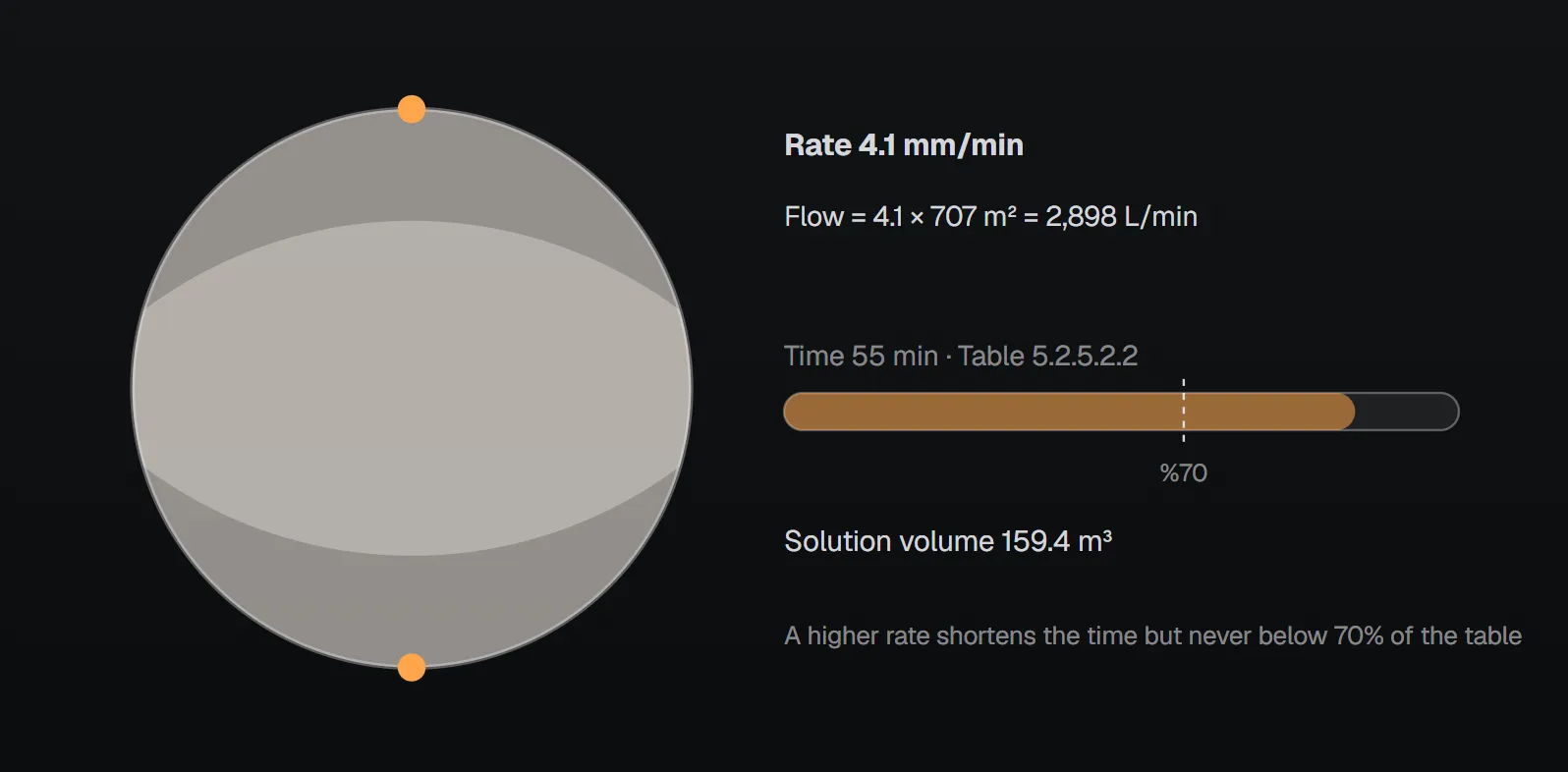
The note under the NFPA 11 tables states that L/min·m² is equivalent to mm/min. So 4.1 mm/min means 4.1 litres of foam solution per square metre per minute. In the US column it is gpm/ft² (4.1 mm/min ≈ 0.10 gpm/ft²). This keeps the calculation simple: the solution flow is the rate times the protected area. For a 30 m tank with about 706.9 m² of surface, 4.1 mm/min means about 2,898 L/min of solution.
The rate is for solution, not for foam volume. The concentrate percentage in the solution (for example 3%) is a separate decision, and concentrate consumption follows that percentage (4.3.2.5.1).
Minimum rate and time by hazard
| Hazard and method | Minimum rate | Minimum time | Time reduction | Source |
|---|---|---|---|---|
| Fixed roof · Type II outlet | 4.1 mm/min (0.10) | 30 / 55 / 55 min | Yes, ≥ 70% | Table 5.2.5.2.2 · 5.2.5.2.3 |
| Fixed roof · subsurface | 4.1 mm/min, max 8.1 | 30 / 55 / 55 min | Yes, ≥ 70% | Table 5.2.6.5.1 · 5.2.6.5.3 |
| Fixed roof · monitor / handline | 6.5 mm/min (0.16) × ≥ 1.5 | 50 / 65 / 65 min | No clause | Table 5.2.4.2.2 · 5.2.4.2.1.2 |
| Floating roof · top of seal | 12.2 mm/min (0.3) | 20 min | Yes, ≥ 70% | Table 5.3.5.3.1 · 5.3.5.3.4 |
| Floating roof · below the seal | 20.4 mm/min (0.5) | 10 min | No clause | Table 5.3.5.3.6.1 |
| Indoor tank | 6.5 mm/min | Table 5.2.5.2.2 | Yes, ≥ 70% | 5.5.3.1–5.5.3.3 |
| Dike · low-level / monitor | 4.1 / 6.5 mm/min | Class I 30 · Class II 20 min | No clause | Table 5.7.3.2 |
| Rack and nondiked spill | AFFF/FFFP 4.1 · protein/FP/SFFF 6.5 | 15 min | No clause | Tables 5.6.5.3.1 · 5.8.1.2 |
| Foam-water sprinklers | ≥ 6.5 mm/min | 10 min | Yes, ≥ 7 min | 6.5.2.2.1 · 6.5.2.3 |
The three fixed-roof times are for hydrocarbons with a flash point of 38–60 °C (100–140 °F), for liquids below 38 °C or heated above their flash point, and for crude petroleum. Where the table says “no clause”, NFPA 11 has no provision allowing a proportional reduction and the time is the table value.
Why the rate changes with the method
A fixed Type II outlet is a device fixed to the tank that delivers foam onto the burning liquid, partially submerging the foam and producing restricted agitation of the surface (3.3.3.3). Monitors and handlines throw it from a distance; NFPA 11 asks for foam losses due to wind and other ambient conditions to be considered when determining the solution flow (5.2.4.2.1.1) and requires the rate to be increased by a factor of at least 1.5 for them (5.2.4.2.1.2). The 6.5 mm/min table value therefore becomes at least 9.75 mm/min in the calculation. At loading racks, where more than 25 mm (1 in.) of fuel can accumulate, the rate for AFFF/FFFP also rises to 6.5 mm/min (5.6.5.3.2).
On floating roofs the foam is not applied to the whole surface but to the narrow seal annulus between the shell and the foam dam. Because the area is small, the rate is high and the time short: 12.2 mm/min for 20 min above the seal, 20.4 mm/min for 10 min below it.
Reducing the time: the 70% rule
Where the available apparatus delivers more than the minimum rate, the time on a fixed-roof tank may be reduced in proportion, but not below 70% of the table time (5.2.5.2.3). The same idea applies to subsurface injection (5.2.6.5.3, with the foam velocity also within 5.2.6.2.3), to top-of-seal floating roof protection (5.3.5.3.4) and to indoor tanks (5.5.3.3). The arithmetic is simple: new time = table time × minimum rate / applied rate, but not less than 0.7 times the table time.
Example: a liquid with a flash point below 38 °C needs 55 min at 4.1 mm/min. At an applied rate of 5.0 mm/min, 55 × 4.1 / 5.0 ≈ 45.1 min. At 8.0 mm/min the arithmetic gives 28.2 min, but the floor is 0.7 × 55 = 38.5 min, so 38.5 min is used. Because of this floor, pushing the rate very high does not reduce the total solution; it increases it.
Duration for foam-water sprinklers
In Chapter 6 the solution discharges for 10 minutes: over the entire system area for deluge and spray systems, over the design area for wet, dry and preaction systems (6.5.2.3.1). Where actual discharge exceeds the minimum, the time may be reduced in proportion, but never below 7 minutes (6.5.2.3.2). The density comes from the applicable occupancy standard but may not be below 6.5 mm/min (6.5.2.2.1). More in foam-water sprinkler design area, spacing and duration.
When is a higher rate needed?
Table values are minimums. The floating roof rates apply unless listings for specific products require higher rates (5.3.5.3.3, 5.3.5.3.6.3). Annex A.6.5.2.2 (explanatory) notes that for some ignitible liquids manufacturers might recommend considerably higher densities, generally from fire tests on a particular fuel, and that these should be considered in the design. For polar liquids and for foam-water systems using SFFF the rate is already left to the manufacturer (Table 5.2.5.3.4, 6.5.2.2.1.1).
Every outlet must deliver the minimum
The rate is not a system average; each fixed outlet is sized to deliver at least the minimum application rate (5.2.5.1.2.2; 5.2.6.2.5 for subsurface). On floating roofs the largest spacing between outlets is limited by the table: above the seal 12.2 m (40 ft) with a 305 mm (12 in.) dam and 24.4 m (80 ft) with a 600 mm (24 in.) dam (Table 5.3.5.3.1). These limits make sure the foam reaches every point within the table time.
Frequently Asked Questions
What does 4.1 mm/min mean?
4.1 litres of foam solution per square metre per minute. Per the NFPA 11 table notes L/min·m² equals mm/min; the US equivalent is 0.10 gpm/ft² (Table 5.2.5.2.2).
Why is the monitor rate multiplied by 1.5?
Foam thrown by monitors and handlines loses some to wind and ambient conditions (5.2.4.2.1.1); NFPA 11 requires a factor of at least 1.5 for this (5.2.4.2.1.2). The 6.5 mm/min table value becomes at least 9.75 mm/min.
How much can a higher rate shorten the time?
In proportion, but on fixed-roof tanks, subsurface injection, top-of-seal protection and indoor tanks never below 70% of the table time (5.2.5.2.3, 5.2.6.5.3, 5.3.5.3.4, 5.5.3.3). For foam-water sprinklers the floor is 7 minutes (6.5.2.3.2).
Is there a maximum rate for subsurface injection?
Yes. The note to Table 5.2.6.5.1 sets a maximum of 8.1 mm/min (0.20 gpm/ft²); foam velocity entering the tank may also not exceed 3 m/s (10 ft/s) for Class IB liquids and 6 m/s (20 ft/s) for others (5.2.6.2.3).
Where can the time not be reduced?
NFPA 11 has no proportional-reduction provision for tank protection by monitors and handlines, below-the-seal application, dikes, loading racks or nondiked spills; the table time applies.
SprinkCalc — Fire Sprinkler Design Across Three Standards
SprinkCalc covers hazard classification, design density and area, K-factor selection, water demand and hydraulic calculations for NFPA 13, FM Global and BS EN 12845 in a single iOS app, and exports a professional PDF report.
Download SprinkCalc on the App Store
MEP Calc — 110+ Engineering Calculators
MEP Calc bundles 110+ engineering modules in one iOS app: 21 fire calculations plus heating, cooling, HVAC, plumbing, steam and natural gas.
Download MEP Calc on the App StoreNFPA 11-2024, Standard for Low-, Medium-, and High-Expansion Foam: 3.3.3.3, 4.3.2.5.1; 5.2.4.2.1.1–5.2.4.2.1.2, Table 5.2.4.2.2; 5.2.5.1.2.2, Table 5.2.5.2.2, 5.2.5.2.3; 5.2.6.2.3, 5.2.6.2.5, Table 5.2.6.5.1, 5.2.6.5.3; Table 5.3.5.3.1, 5.3.5.3.3, 5.3.5.3.4, Table 5.3.5.3.6.1, 5.3.5.3.6.3; 5.5.3; Table 5.6.5.3.1, 5.6.5.3.2; Table 5.7.3.2; Table 5.8.1.2; 6.5.2.2.1, 6.5.2.2.1.1, 6.5.2.3; Annex A.6.5.2.2 (explanatory).