A foam-water sprinkler design rests on four numbers: density, area, duration and sprinkler spacing. NFPA 11-2024 Chapter 6 gives the minimums and in many places defers to the applicable occupancy standard. This article goes through 6.5.2 and 6.5.6 in order, clears up a common confusion (NFPA 13 area adjustments) and ends with a worked example.
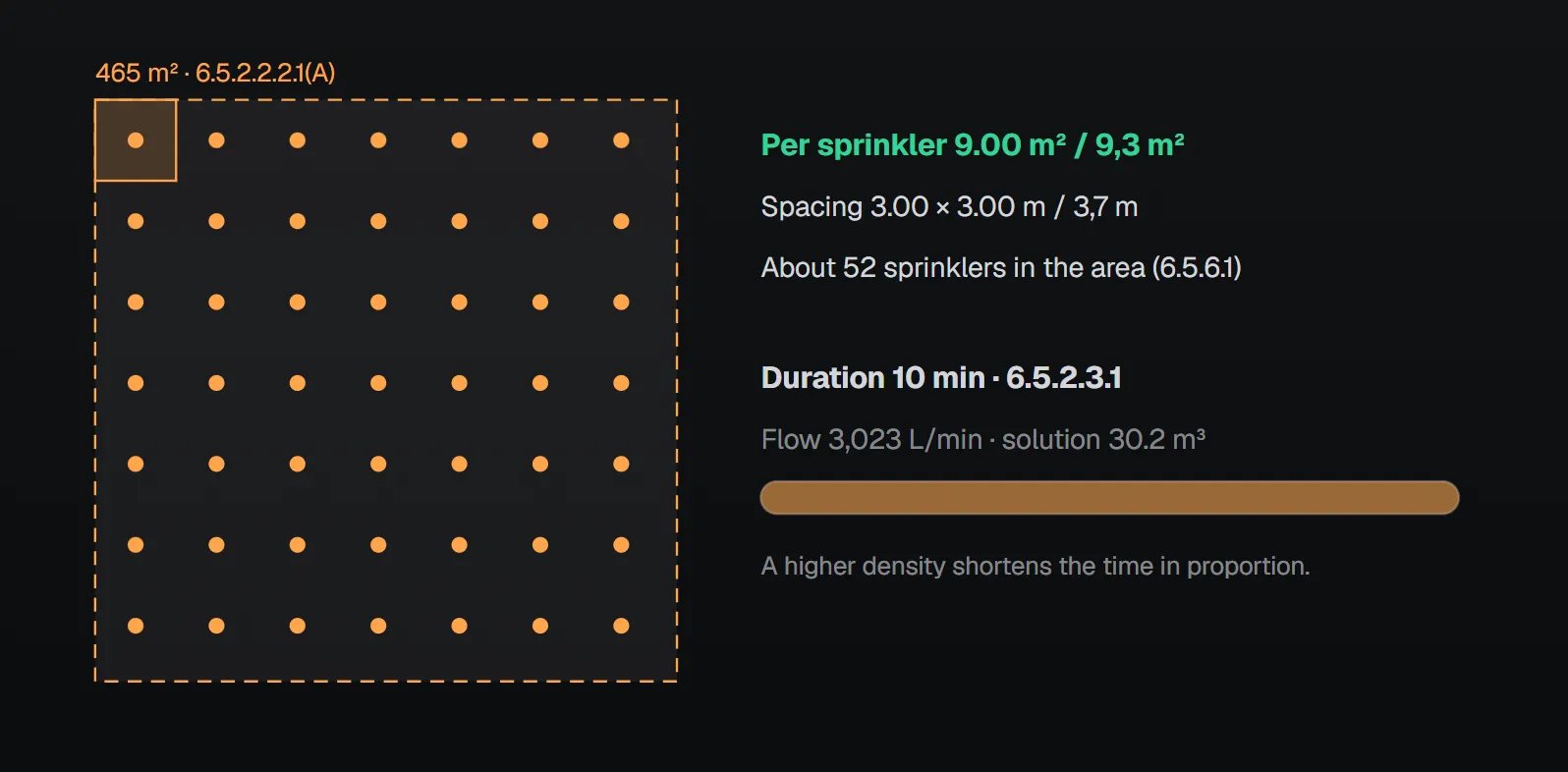
In short: density follows the occupancy standard but is at least 6.5 mm/min (0.16 gpm/ft²) (6.5.2.2.1). Wet, dry and preaction systems use a 465 m² (5000 ft²) design area (6.5.2.2.2.1). Foam solution discharges for 10 min, over the entire system area for deluge (6.5.2.3.1). With higher actual discharge the time shortens in proportion, never below 7 min (6.5.2.3.2). At most 9.3 m² (100 ft²) per sprinkler and 3.7 m (12 ft) spacing (6.5.6.1).
Density: the occupancy standard, but at least 6.5
The design density follows the applicable occupancy standard for water or foam-water systems, but is never less than 0.16 gpm/ft² (6.5 mm/min) (6.5.2.2.1). The standard prints the metric value as “6.5 mm/m²”; the tables and other clauses of the same chapter show the unit is mm/min. With SFFF the application rate is set from Annex H and the manufacturer’s recommendations (6.5.2.2.1.1); NFPA 11 gives no number there.
Annex A.6.5.2.2 (explanatory) notes that for some ignitible liquids manufacturers might recommend considerably higher densities, generally from fire tests on a particular fuel, that these should be considered in the design, and that some hazards might need minimum discharge pressures to compensate for effects such as wind. So 0.16 gpm/ft² is a floor, not a target.
Area: 5000 ft², but for which system?
The area depends on the system type:
- Wet, dry and preaction: the total design area is 465 m² (5000 ft²) (6.5.2.2.2.1(A)). Where the occupancy standard specifies a different design area, that governs (6.5.2.2.2.1(B)).
- Deluge and spray: all devices are open, so the calculation covers the entire system area (6.5.2.3.1).
Annex A.6.5.2.2.2.1(A) (explanatory) draws an important line: the design area can only be modified by occupancy standards. The remote area modifiers of NFPA 13, such as increases for dry-pipe or double-interlock systems and sloped ceilings or reductions for quick-response sprinklers, are not intended to be applied to any NFPA 11 system. A dry foam-water system therefore does not get a “+30%” area adjustment; the area is 5000 ft² or whatever the occupancy standard says.
For hydraulic calculation the water supply meets 6.2.3 (6.5.2.2.3). The water supply also meets the fixed system demand plus 946 L/min (250 gpm) for inside and outside hose streams for at least 60 minutes, unless the occupancy standard says otherwise (4.2.2.3.1).
Duration: 10 minutes, at least 7
The foam solution is designed to discharge for 10 minutes at the 6.5.2.2.1 density: over the entire system area for deluge and spray systems, over the design area for wet, dry and preaction systems (6.5.2.3.1). After the foam, the system discharges water until manually shut off (6.2.3.2).
Where actual discharge exceeds the minimum, the foam time may be reduced in proportion, but never below 7 minutes (6.5.2.3.2). Arithmetic: time = 10 × required density / actual density, at least 7 min. With 6.5 mm/min required and an actual average of 8.0 mm/min from the hydraulic calculation, 10 × 6.5 / 8.0 ≈ 8.1 min. At 10.0 mm/min the arithmetic gives 6.5 min; the floor makes it 7 min.
Spacing: 100 ft² and 12 ft
The area per sprinkler may not exceed 9.3 m² (100 ft²), and the spacing between sprinklers on a branch line or between branch lines may not exceed 3.7 m (12 ft) (6.5.6.1). In buildings whose primary structural members are 7.6 m (25 ft) apart, line-to-line spacing may be 3.8 m (12 ft 6 in.) where the density is ≥0.25. The standard prints this threshold without a unit; since the chapter’s density unit is gpm/ft², it reads as 0.25 gpm/ft² (about 10.2 mm/min) — confirm with the AHJ in practice.
Where the occupancy standard specifies a different spacing, it governs (6.5.6.2); for foam-water preaction systems 6.5.8 also takes precedence (6.5.6.3). More stringent occupancy criteria govern in all cases except 6.5.2.6.2, 6.5.2.2.2.1(B) and 6.5.6.2 (6.5.1.2).
| Criterion | Value | Clause |
|---|---|---|
| Minimum density | 6.5 mm/min (0.16 gpm/ft²) | 6.5.2.2.1 |
| Design area (wet/dry/preaction) | 465 m² (5000 ft²) | 6.5.2.2.2.1(A) |
| Calculation area (deluge/spray) | Entire system area | 6.5.2.3.1 |
| Foam duration | 10 min; at least 7 min with higher discharge | 6.5.2.3.1, 6.5.2.3.2 |
| Area per sprinkler | max 9.3 m² (100 ft²) | 6.5.6.1 |
| Spacing on and between lines | max 3.7 m (12 ft) | 6.5.6.1 |
| Deluge pipe sizing | max 20% above specified flow per sprinkler | 6.5.10.1.1.1 |
| Water supply | system + 946 L/min (250 gpm) hose, at least 60 min | 4.2.2.3.1 |
Hydraulic calculation
Deluge piping is hydraulically designed for uniform foam and water distribution and to allow for loss of head in the supply piping (6.5.10.1.1). Pipe sizes are adjusted for a maximum variation of 20% above the specified discharge rate per sprinkler or nozzle (6.5.10.1.1.1). Hydraulic calculations for piping carrying water or foam solution follow NFPA 13 (6.5.10.1.3), and solution piping is sized as if carrying plain water (6.5.10.1.3.1). Friction loss in concentrate piping uses the Darcy-Weisbach formula with the concentrate’s actual density and its viscosity at the lowest anticipated storage temperature (6.5.10.1.4).
Example: a 400 m² deluge foam-water system
A loading rack is protected by a deluge foam-water system covering an entire system area of 400 m² (about 4300 ft²); the occupancy standard asks for no more than 6.5 mm/min. Sprinklers are on a 3.0 m × 3.0 m grid: 9.0 m² per sprinkler (≤ 9.3 m²), spacings ≤ 3.7 m. Roughly 400 / 9 → 45 sprinklers. Solution flow 6.5 × 400 = 2,600 L/min; at least 6.5 × 9 = 58.5 L/min per sprinkler and, with the 20% limit, at most about 70.2 L/min. Duration 10 min; solution 26,000 L, and 780 L of concentrate at 3%. How the reserve is provided is agreed with the AHJ (6.2.4). Because the system keeps discharging water at the same flow after the foam (6.2.3.2), the water supply must give at least 2,600 + 946 = 3,546 L/min for 60 min (4.2.2.3.1).
The foam-water sprinkler calculator does the same with clause references; for device types and ratings see sprinkler types and temperature ratings.
Frequently Asked Questions
What is the design area of a foam-water sprinkler system?
465 m² (5000 ft²) for wet, dry and preaction systems, unless the occupancy standard specifies another (6.5.2.2.2.1). Deluge and spray systems are calculated over the entire system area (6.5.2.3.1).
Is the area increased by 30% for a dry foam-water system?
No. Per Annex A.6.5.2.2.2.1(A), NFPA 13’s increases for dry-pipe, double-interlock and sloped ceilings and its reduction for quick-response sprinklers are not applied to NFPA 11 systems; only occupancy standards change the area.
Can the foam time be shorter than 10 minutes?
Where actual discharge exceeds the minimum it may be reduced in proportion, but never below 7 minutes (6.5.2.3.2).
What is the maximum foam-water sprinkler spacing?
At most 9.3 m² (100 ft²) per sprinkler and 3.7 m (12 ft) on and between lines. In buildings with primary members 7.6 m (25 ft) apart, line spacing may be 3.8 m (12 ft 6 in.) at a density of ≥0.25 (6.5.6.1).
Which standard governs the hydraulic calculation?
NFPA 11 refers the calculation of piping carrying water or foam solution to NFPA 13 (6.5.10.1.3); on deluge systems the flow per sprinkler may vary by at most 20% above the specified rate (6.5.10.1.1.1).
SprinkCalc — Fire Sprinkler Design Across Three Standards
SprinkCalc covers hazard classification, design density and area, K-factor selection, water demand and hydraulic calculations for NFPA 13, FM Global and BS EN 12845 in a single iOS app, and exports a professional PDF report.
Download SprinkCalc on the App Store
MEP Calc — 110+ Engineering Calculators
MEP Calc bundles 110+ engineering modules in one iOS app: 21 fire calculations plus heating, cooling, HVAC, plumbing, steam and natural gas.
Download MEP Calc on the App StoreNFPA 11-2024, Standard for Low-, Medium-, and High-Expansion Foam: 4.2.2.3.1; 6.2.3.2, 6.2.4; 6.5.1.2; 6.5.2.2.1, 6.5.2.2.1.1, 6.5.2.2.2.1, 6.5.2.2.3, 6.5.2.3.1, 6.5.2.3.2; 6.5.6.1–6.5.6.3; 6.5.10.1.1, 6.5.10.1.1.1, 6.5.10.1.3, 6.5.10.1.3.1, 6.5.10.1.4; Annex A.6.5.2.2, A.6.5.2.2.2.1(A) (explanatory).