The normal source of an electric fire pump is arranged per 9.2. NFPA 20-2025 Section 9.3 decides when a second, independent source (alternate power) is needed, what it may be and how it is connected. Alternate power is a power source independent of the primary power supply (3.3.48.1).
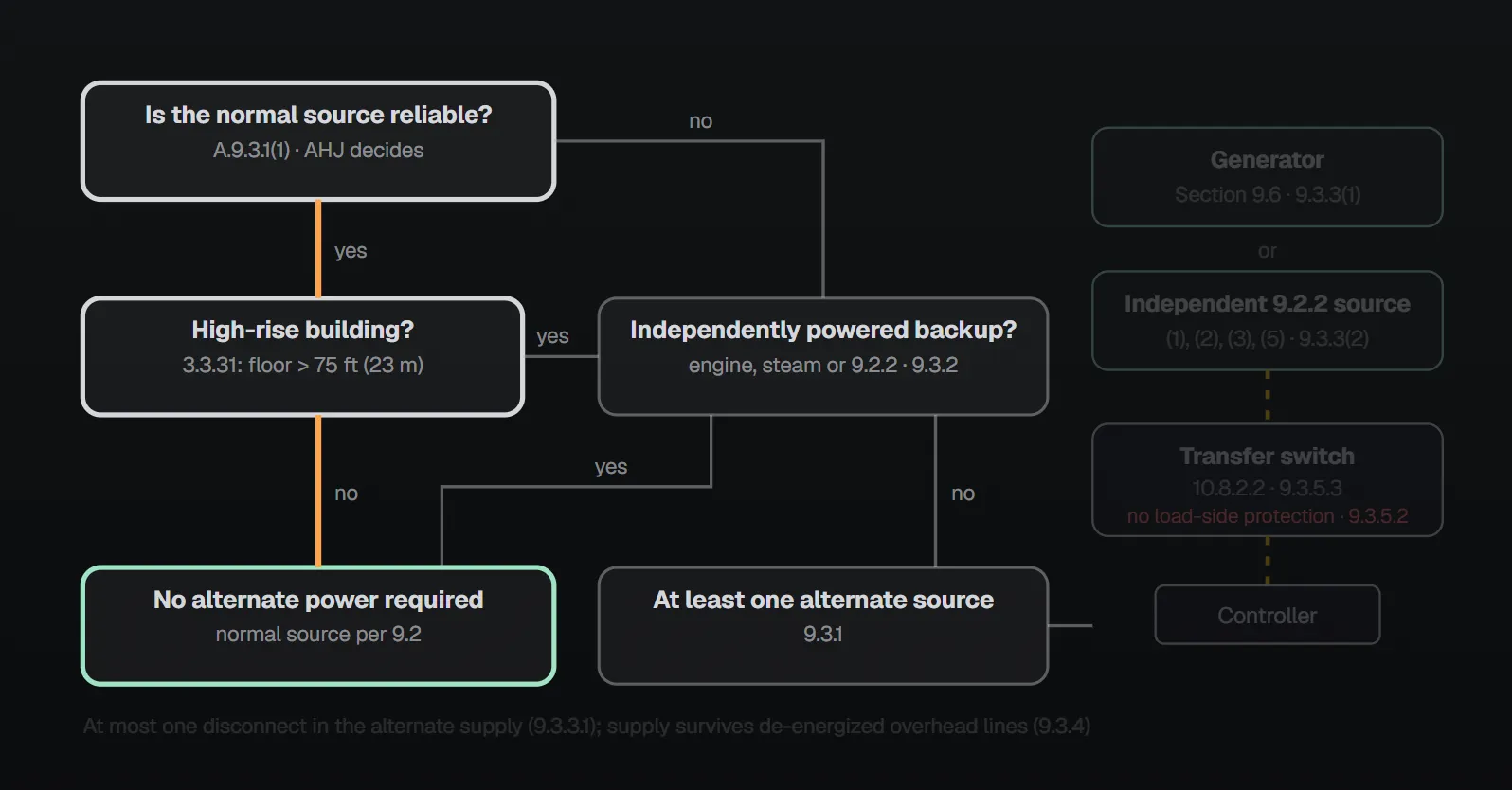
In short: at least one alternative source of power is provided where the normal source is not reliable or the building is a high-rise (9.3.1). It is not required where a backup engine-driven, steam turbine-driven or independently powered electric fire pump is installed (9.3.2). The alternate source is a generator per 9.6, or a 9.2.2(1), (2), (3) or (5) source independent of the normal source (9.3.3), with no more than one disconnect and overcurrent device (9.3.3.1). It is not disrupted when overhead lines are de-energized for fire department operations (9.3.4), and no protective devices go on the load side of the transfer switch (9.3.5.2).
When is it required? (9.3.1, 9.3.2)
Unless the arrangement of 9.3.2 is installed, at least one alternative source of power is provided when either condition exists (9.3.1):
- The normal source of power is not reliable (9.3.1(1)).
- The power is for a high-rise building (9.3.1(2)). A high-rise building has the floor of an occupiable story more than 75 ft (23 m) above the lowest level of fire department vehicle access (3.3.31).
An alternate source for the primary fire pump is not required where a backup engine-driven, backup steam turbine-driven or backup electric motor-driven fire pump with an independent power source meeting 9.2.2 is installed per the standard (9.3.2).
Per the NFPA 20 Handbook (2022), since the 2019 edition the need for alternate power depends only on high-rise designation, no longer on height beyond the pumping capacity of fire department apparatus. The Handbook notes that an electric pump design without backup power can be approved if the source is found reliable and the building is not a high-rise.
What is a reliable source? (A.9.3.1(1))
The standard sets no number for reliability; Annex A.9.3.1(1) lists the characteristics of a reliable source and leaves the decision to the authority having jurisdiction:
| Characteristic of a reliable source | Annex A reasoning |
|---|---|
| (1) The source power plant has had no shutdown longer than 10 continuous hours in the year before plan submittal | NFPA 25 requires special undertakings such as fire watches when a water-based system is out of service for more than 10 hours. If the plant has been intentionally shut down for more than 10 hours, a backup source is reasonable. |
| (2) Outages from generation or transmission failures are not routine in the area | The standard does not require the normal source to be infallible, nor a backup source for every electric fire pump. |
| (3) The normal source is not supplied by overhead conductors outside the protected facility | Fire departments will not operate aerial apparatus near live overhead lines, so power may have to be shut off. Utilities may also cut overhead conductors physically; an unidentified pump feeder could be cut by mistake. |
| (4) Only the disconnects and overcurrent devices permitted by 9.2.3 are in the normal source | Disconnection and overcurrent tripping should occur only in the controller. Unanticipated devices not meeting 9.2.2 make the source not reliable, and a backup source is necessary. |
Annex A notes that the routings in Figure A.9.2 are typical, other configurations are acceptable, and the reliability of a service is left to the authority having jurisdiction. The Handbook (2022) advises confirming reliability with the AHJ on every project and paying special attention to supplies brought in by overhead lines.
What can the alternate source be? (9.3.3)
| Source | Clause | Note |
|---|---|---|
| A generator installed per Section 9.6 | 9.3.3(1) | An on-site standby generator is not constantly producing power, so it is an alternate, not a normal, source (3.3.48.3). |
| One of the sources of 9.2.2(1), (2), (3) or (5), with power provided independent of the normal source | 9.3.3(2) | Handbook (2022): “independent” means not derived from the service that provides the normal source; for example two service connections from separate substations fed by different lines. |
Where the alternate source uses arrangement 9.2.2(1), (2), (3) or (5), no more than one disconnecting means and associated overcurrent device is installed in the supply to the controller, per 9.2.3.1 through 9.2.3.4.1 (9.3.3.1). The disconnect rules of the normal supply (lockable both ways, remote, 1 in. (25 mm) marking, supervision, protection carrying locked rotor current) therefore apply here too.
Connection rules (9.3.4, 9.3.5)
- The alternate supply is arranged so that pump power is not disrupted when overhead lines are de-energized for fire department operations (9.3.4). Handbook (2022): it is not run through overhead lines near the building.
- Where the alternate source consists of two or more sources and one is a dedicated feeder derived from a utility service separate from the normal source’s, the disconnect, overcurrent device and conductors need not meet Section 9.2 and may be installed per NFPA 70 (9.3.5.1). Handbook (2022): reliability of power at the controller then increases significantly.
- No protective devices are installed on the load side of the power transfer switch (9.3.5.2). Handbook (2022): the exception is the circuit breaker in the controller.
- The power transfer switch is installed per 10.8.2.2 (9.3.5.3).
Common field mistakes
- High-rise with no alternate source and no backup pump: contrary to 9.3.1(2) and 9.3.2.
- Normal and “alternate” supplies from the same service: 9.3.3(2) requires independence.
- Assuming an overhead-line supply is reliable: A.9.3.1(1)(3) does not count it as a reliable characteristic.
- Extra disconnects or fuses in the normal supply: per A.9.3.1(1)(4) the source is then not reliable.
- Protection between the transfer switch and the controller: prohibited by 9.3.5.2.
Checklist
- Is the building a high-rise per 3.3.31?
- Does the normal source show the four characteristics of A.9.3.1(1); has the AHJ accepted it as reliable?
- Is there an independently powered backup pump (9.3.2)?
- Is the alternate source a generator (9.6) or a 9.2.2 source independent of the normal source (9.3.3)?
- No more than one disconnect in the alternate supply, per 9.2.3.1–9.2.3.4.1 (9.3.3.1).
- Supply survives de-energized overhead lines; no protection on the transfer switch load side (9.3.4, 9.3.5.2).
Frequently Asked Questions
Does every electric fire pump need a generator?
No. Per NFPA 20-2025 9.3.1, alternate power is required where the normal source is not reliable or the building is a high-rise. Annex A.9.3.1(1) states the standard does not intend to require a backup source for every electric fire pump.
Who decides whether the normal source is reliable?
The authority having jurisdiction. Annex A.9.3.1(1) lists the characteristics: no shutdown longer than 10 continuous hours in the prior year, no routine outages in the area, no overhead conductors from outside the facility, and only the disconnects and protection permitted by 9.2.3.
Is alternate power needed if there is a backup diesel pump?
No alternate source is required for the primary pump where a backup engine-driven, steam turbine-driven or independently powered electric fire pump meeting 9.2.2 is installed per the standard (9.3.2).
Can a second utility connection be the alternate source?
Yes, if it is one of the 9.2.2(1), (2), (3) or (5) sources and is independent of the normal source (9.3.3(2)). The Handbook (2022) explains independence as not derived from the service providing the normal source.
Can a fuse be installed after the transfer switch?
No. Protective devices are not installed on the load side of the power transfer switch (9.3.5.2); the Handbook (2022) notes the exception is the controller’s circuit breaker. The transfer switch is installed per 10.8.2.2 (9.3.5.3).
SprinkCalc — Fire Sprinkler Design Across Three Standards
SprinkCalc covers hazard classification, design density and area, K-factor selection, water demand and hydraulic calculations for NFPA 13, FM Global and BS EN 12845 in a single iOS app, and exports a professional PDF report.
Download SprinkCalc on the App Store
MEP Calc — 110+ Engineering Calculators
MEP Calc bundles 110+ engineering modules in one iOS app: 21 fire calculations plus heating, cooling, HVAC, plumbing, steam and natural gas.
Download MEP Calc on the App StoreNFPA 20-2025, Standard for the Installation of Stationary Pumps for Fire Protection: 3.3.31, 3.3.48.1, 3.3.48.3; 9.3.1–9.3.5.3; Annex A.9.3.1(1) (explanatory). NFPA 20 Handbook 2022 commentary: Section 9.3.