All fire pump power supplies comply with the voltage drop requirements of Section 9.4 (9.1.6). NFPA 20-2025 sets the rule at two points for two conditions: at the controller line terminals while the motor starts, and at the contactor load terminals while the motor runs at 115 percent load.
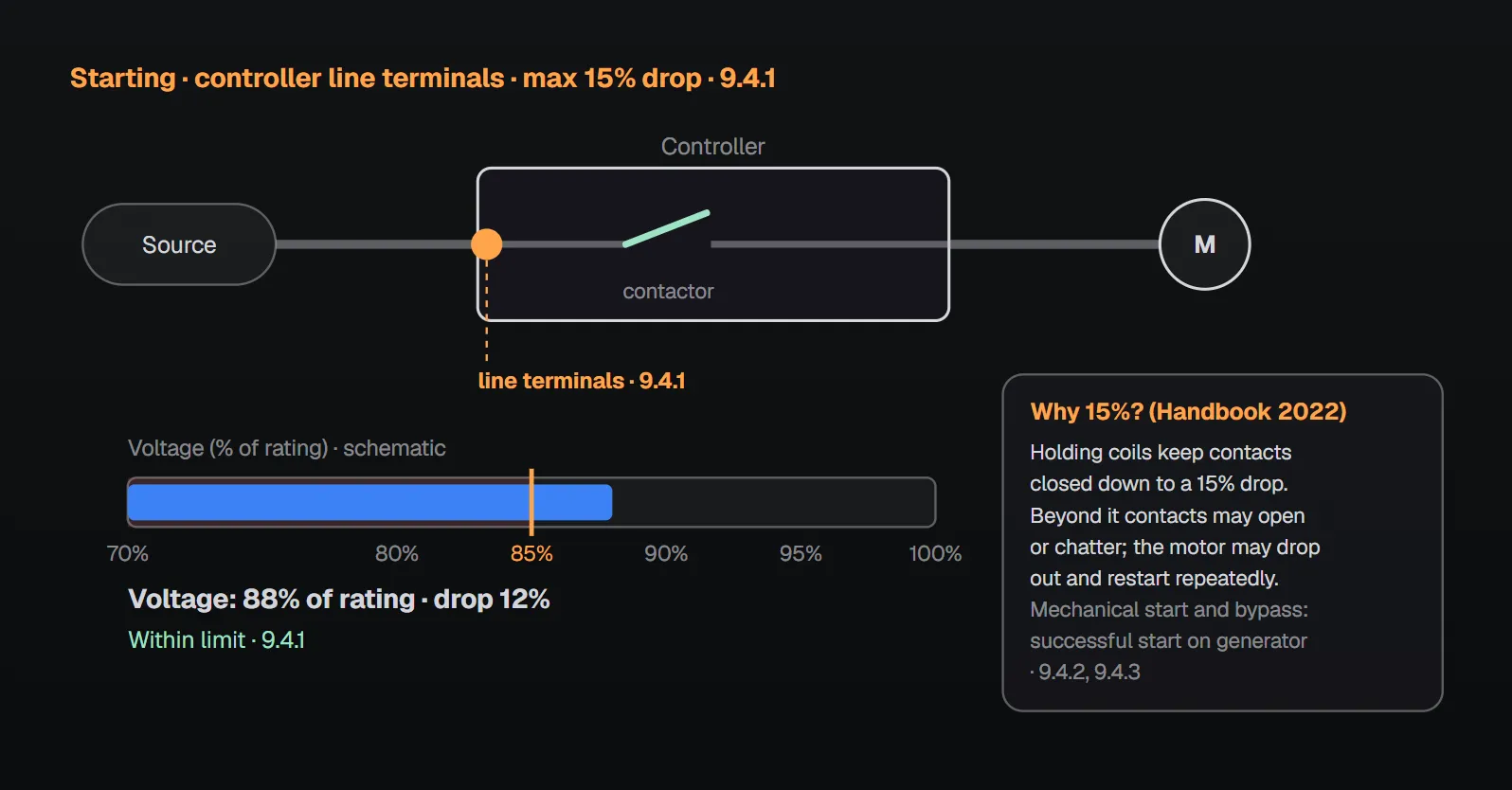
In short: under motor-starting conditions the voltage at the controller line terminals does not drop more than 15 percent below normal (controller-rated voltage) (9.4.1). Emergency-run mechanical starting and the bypass mode of a variable speed pressure limiting control are exempt, provided a successful start is demonstrated on the standby generator (9.4.2, 9.4.3); the emergency-run mechanical control of a self-regulating variable speed fire pump unit is not (9.4.2.1). With the motor at 115 percent of full-load current, the voltage at the contactor load terminals does not drop more than 5 percent below the motor voltage rating (9.4.4). Controller-to-motor wiring uses the listed raceways and cables; motor terminal box connections use a listed means, and twist-on, insulation-piercing and soldered connectors are prohibited (9.4.4.1–9.4.4.3).
What the rule says
| Condition | Measuring point | Limit | Clause |
|---|---|---|---|
| Motor starting | Controller line terminals | No more than 15 percent below normal (controller-rated voltage) | 9.4.1 |
| Emergency-run mechanical starting | — | 9.4.1 does not apply; successful start demonstrated on the standby generator system (see 10.5.3.2) | 9.4.2 |
| Emergency-run mechanical control of a self-regulating variable speed fire pump unit | Controller line terminals | 9.4.1 applies | 9.4.2.1 |
| Bypass mode of a variable speed pressure limiting control (see 10.10.3) | — | 9.4.1 does not apply; successful start demonstrated on the standby gen-set | 9.4.3 |
| Motor running at 115 percent of full-load current | Load terminals of the contactor(s) the motor is connected to | No more than 5 percent below the motor voltage rating | 9.4.4 |
Why 15 percent? (Handbook 2022)
Per the NFPA 20 Handbook (2022) commentary, the limit prevents abnormal operation of the motor switching contactor. Holding coils of ac magnetic devices are required to keep the contacts closed when the coil voltage drops up to 15 percent, and the coil runs on the controller supply voltage. If the voltage drops more during starting, the contacts may open, the motor disconnects, the voltage recovers, the motor restarts and the cycle repeats; keeping the pump running becomes difficult and repeated starting can damage the motor. Some contactors chatter instead, which can cause arcing, contact damage and coil burnout.
The exemptions and why
- Emergency-run mechanical starting (9.4.2): the Handbook (2022) notes that the most common controller field failure is a burnt-out contactor coil, and the mechanical operator closes the contactor directly. With reduced voltage controllers, mechanical starting applies full line voltage, so the drop usually exceeds 15 percent. Since the 2019 edition a successful start on the standby generator must be demonstrated; the generator must be able to start the motor.
- Self-regulating variable speed fire pump unit (9.4.2.1): operating its emergency-run mechanical control can drop the voltage below 85 percent at the controller and inhibit its operation (A.9.4.2.1), so 9.4.1 applies.
- Bypass mode of a variable speed pressure limiting control (9.4.3): Handbook (2022): if a start cannot be shown on the generator, the bypass mode is of no use when normal power fails.
The 5 percent running limit (9.4.4)
Per the Handbook (2022), the measurement is taken at the contactor in the controller rather than at the motor for ease; the drop in the motor leads is included, but the controller-to-motor run is usually short. At lower voltage the motor draws more current to deliver the same mechanical power. Handbook example: at a 1.15 service factor and 95 percent voltage, current is 1.15 ÷ 0.95 ≈ 1.21, that is 121 percent of full-load current; winding heating grows with the square of current, 1.21² ≈ 1.46, or 46 percent more heating. For service factor rules see the motor article.
Wiring and connections (9.4.4.1–9.4.4.3)
- Wiring from the controller to the pump motor is in rigid metal conduit, intermediate metal conduit, electrical metallic tubing, liquidtight flexible metal conduit, liquidtight flexible nonmetallic conduit Type LFNC-B, listed Type MC cable with an impervious covering, or Type MI cable (9.4.4.1).
- Electrical connections at motor terminal boxes are made with a listed means of connection (9.4.4.2).
- Twist-on, insulation-piercing and soldered wire connectors are not permitted for this purpose (9.4.4.3).
Conductor and transformer sizing (A.9.4)
Per Annex A.9.4, conductor sizing is normally based on Article 430 of NFPA 70, but larger sizes could be required to comply with 695.7 of NFPA 70 (Section 9.4 of NFPA 20). Transformer sizing is per 695.5(A) of NFPA 70, with larger sizes possibly required for 695.7. The Handbook (2022) notes that starting drop is harder to calculate than running drop: running power factor is about 0.85, while the motor impedance at starting has a power factor of 0.30 to 0.40, and source, transformers and wiring are combined vectorially. This article gives no calculation method; the limits are those of 9.4.
Common field mistakes
- Sizing conductors on full-load current only: A.9.4 warns that larger sizes may be needed for the 9.4 limits.
- Measuring at the motor terminals: 9.4.1 defines the controller line terminals, 9.4.4 the contactor load terminals.
- Never trying the mechanical start on the generator: the 9.4.2 and 9.4.3 exemptions depend on a demonstrated successful start.
- Twist-on or soldered connectors at the motor: prohibited by 9.4.4.3.
Checklist
- During starting, voltage at the controller line terminals ≥ 85 percent of rated (9.4.1).
- Successful start on the standby generator shown for mechanical start and bypass mode (9.4.2, 9.4.3).
- Self-regulating variable speed unit: the mechanical control also within 15 percent (9.4.2.1).
- At 115 percent load, voltage at the contactor load terminals ≥ 95 percent of motor rating (9.4.4).
- Controller-to-motor wiring of a 9.4.4.1 type; listed terminal connections, no prohibited connectors (9.4.4.2, 9.4.4.3).
Frequently Asked Questions
What is the voltage drop limit for a fire pump?
Per NFPA 20-2025 9.4.1, during motor starting the voltage at the controller line terminals does not drop more than 15 percent below controller-rated voltage. Per 9.4.4, with the motor at 115 percent of full-load current, the voltage at the contactor load terminals does not drop more than 5 percent below the motor rating.
Why 15 percent?
Per the NFPA 20 Handbook (2022), contactor holding coils keep the contacts closed down to a 15 percent drop. Beyond that the contacts may open or chatter; the motor can drop out and restart repeatedly, damaging contacts and motor.
Does the 15 percent limit apply to emergency-run mechanical starting?
No; 9.4.1 does not apply provided a successful start is demonstrated on the standby generator system (9.4.2). Exception: 9.4.1 does apply to the mechanical control of a self-regulating variable speed fire pump unit (9.4.2.1), which can pull the controller below 85 percent and inhibit it (A.9.4.2.1).
Where is voltage drop measured?
The starting limit at the controller line terminals (9.4.1), the running limit at the load terminals of the contactor the motor is connected to (9.4.4). The Handbook (2022) says the contactor was chosen for ease of measurement and includes the drop in the motor leads.
Which connectors are prohibited at the motor terminal box?
Twist-on, insulation-piercing and soldered wire connectors (9.4.4.3); connections use a listed means (9.4.4.2). Controller-to-motor wiring uses one of the raceways or cables in 9.4.4.1.
SprinkCalc — Fire Sprinkler Design Across Three Standards
SprinkCalc covers hazard classification, design density and area, K-factor selection, water demand and hydraulic calculations for NFPA 13, FM Global and BS EN 12845 in a single iOS app, and exports a professional PDF report.
Download SprinkCalc on the App Store
MEP Calc — 110+ Engineering Calculators
MEP Calc bundles 110+ engineering modules in one iOS app: 21 fire calculations plus heating, cooling, HVAC, plumbing, steam and natural gas.
Download MEP Calc on the App StoreNFPA 20-2025, Standard for the Installation of Stationary Pumps for Fire Protection: 9.1.6; 9.4.1–9.4.4.3; Annex A.9.4, A.9.4.2.1 (explanatory). NFPA 20 Handbook 2022 commentary: Section 9.4.