In a packaged fire pump assembly the pump, driver, controller and other accessories are assembled on a common base at a packaging facility and shipped to site as a unit. The unit may be an open skid or a prefabricated pump house. NFPA 20-2025 adds rules for these assemblies in Section 4.31; the rest of the standard still applies in full.
In short: components are affixed to a steel framing structure, welders are qualified, the assembly is listed for fire pump service, the system designer referenced in 4.3.2 engineers it, and plans and data sheets are submitted to the authority having jurisdiction (4.31.1). All requirements of the standard apply, including 4.14 through 4.19 (4.31.3). Supports and restraints against transit damage and marked lifting points (4.31.4, 4.31.5); on site, seismic protection, re-inspection of piping connections, anchoring and grouting, and a solid floor graded for drainage (4.31.6–4.31.9). The assembly is hydrostatically tested by the packaging facility (14.1.2.2).
What is a packaged assembly?
The standard defines it as fire pump unit components assembled at a packaging facility and shipped as a unit to the installation site. The listed components in the package (where this standard requires listing) are the pump, driver, controller and other accessories identified by the packager, assembled onto a base with or without an enclosure (3.3.52.13). The NFPA 20 Handbook (2022) illustrates a skid-mounted package and a package inside a prefabricated pump house.
At the factory and in design
A packaged assembly, with or without an enclosure, meets all of the following (4.31.1):
- The components are assembled and affixed onto a steel framing structure.
- Welders are qualified per Section 9 of the ASME Boiler and Pressure Vessel Code or AWS D1.1/D1.1M, Structural Welding Code — Steel.
- The assembly is listed for fire pump service.
- The total assembly is engineered and designed by a system designer as referenced in 4.3.2.
- All plans and data sheets are submitted to and reviewed by the authority having jurisdiction, with copies of the stamped approved submittals used in the assembly and kept for record.
Electrical components, clearances and wiring meet the minimum requirements of the applicable NFPA 70 articles (4.31.2). Packaged and prefabricated skids meet all requirements of the standard, including pump room protection, piping, suction, discharge, valve supervision and protection against pipe movement in Sections 4.14 through 4.19 (4.31.3). For system designer identification and qualifications see approval and operation.
Hydrostatic test at the factory
Packaged assemblies, including pump houses and pump skids, are hydrostatically tested by the packaging facility in accordance with 14.1.2.1 (14.1.2.2): at not less than 200 psi (13.8 bar) or 50 psi (3.4 bar) in excess of the maximum pressure to be maintained in the system, whichever is greater (14.1.2.1), held without loss for 2 hours (14.1.2.1.1), with loss determined by a drop in gauge pressure or visual leakage (14.1.2.1.2). Leakage and pressure loss through the packing glands are permitted; the system is continuously repressurized to make up for packing leakage; no other leakage or pressure drop is permitted (14.1.2.2.1–14.1.2.2.3).
Shipping and lifting
- Careful consideration is given to the possible effects of component damage during shipment to site (4.31.4).
- Structural integrity is maintained with minimal flexing and movement (4.31.4.1), and supports and restraints are installed to prevent damage and breakage in transit (4.31.4.2).
- The correct lifting points are marked for safe rigging (4.31.5).
On site
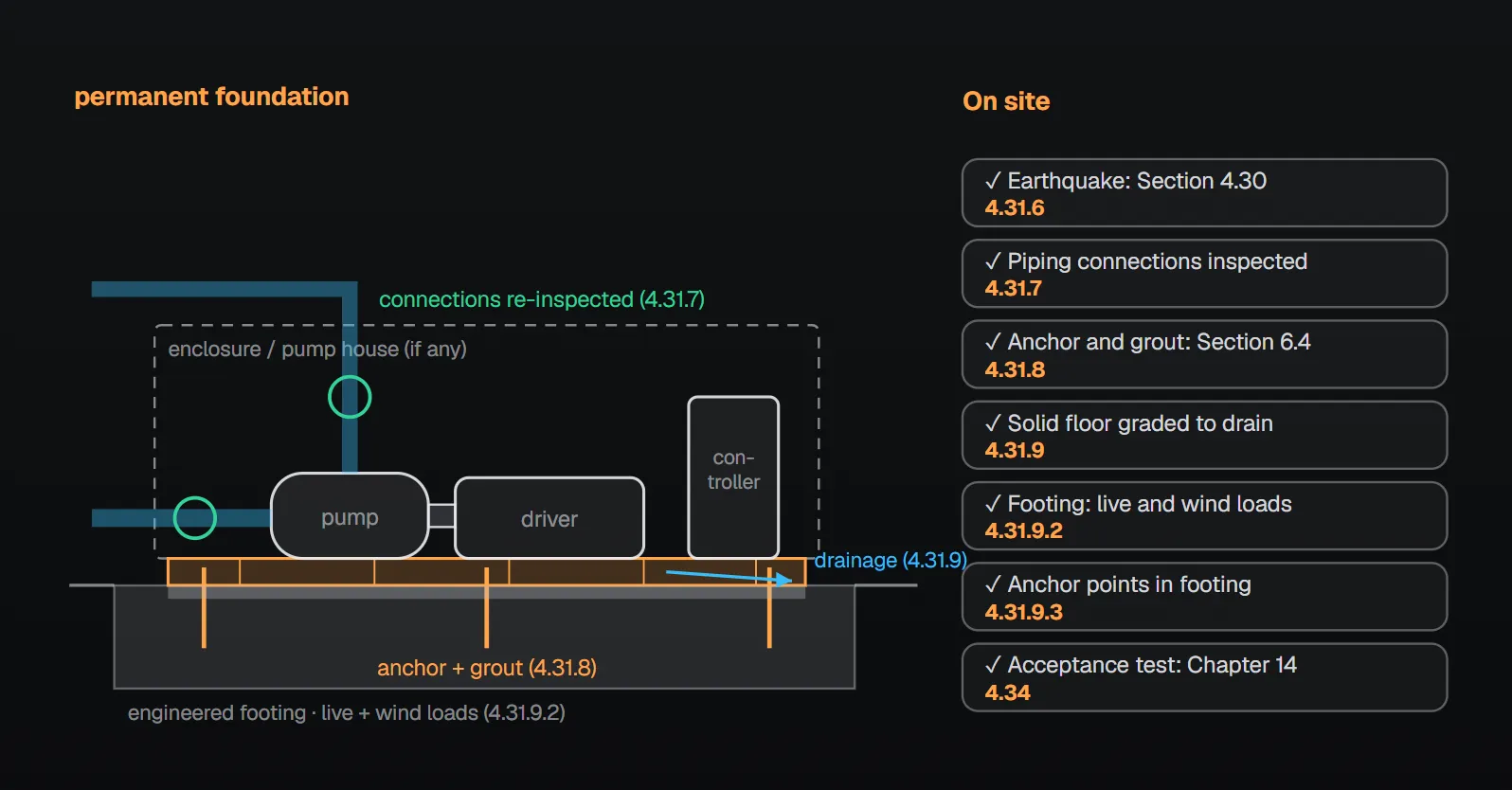
- Earthquake: pump houses and skids meet Section 4.30 (4.31.6); see pipe penetrations and earthquake protection.
- Piping connections: after the pump house or skid is set on its permanent foundation, suction and discharge piping is thoroughly inspected, including all flanged and mechanical connections per manufacturers’ recommendations (4.31.7).
- Anchoring and grouting: units are anchored and grouted in accordance with Section 6.4 (4.31.8). Section 6.4 requires the base plate to be securely attached to a solid foundation so shaft alignment is ensured, a foundation substantial enough for permanent rigid support, and the base plate set level (6.4.3–6.4.5).
- Pump house floor: solid construction graded to provide proper drainage for the pump components (4.31.9). It may be grouted per 4.31.8 or installed after the house is set, per 4.31.10 (4.31.9.1).
- Footing: the structural frame sits on an engineered footing designed for the live loads of the unit and the applicable wind loading (4.31.9.2), with the anchor points needed to secure the package (4.31.9.3).
- Steel plate floor: a highly skid-resistant, solid structural plate floor with grout holes is permitted where corrosion protection and drainage for incidental spillage or leakage are provided (4.31.10).
Figure A.4.31.9: typical foundation detail (explanatory)
Per the notes to the figure referenced by Annex A.4.31.9: the drawing shows the minimum number of anchor bolts for most skids, the installing contractor sets actual bolt size and type, and some building codes may require more. Estimated package weight is 80 to 100 lb/ft² (about 390–485 kg/m²), plus 30 lb/ft² (about 145 kg/m²) for packages with a building. One additional anchor bolt is added for each additional 10 ft (3 m) of skid length, and skids over 12 ft (3.7 m) wide need an additional bolt. After the package is mounted, the structural opening is filled with concrete to form a finished floor, with full grouting between footings and all steel beams. The detail shows a minimum ¾ in. (19 mm) anchor bolt with a 4 in. × 4 in. × ½ in. (102 mm × 102 mm × 12.7 mm) steel anchor plate and a footer sized for at least 1000 lb per linear ft (about 1475 kg/m).
Why these rules?
The standard states a reason only in the shipping rule: the effects of component damage during shipment (4.31.4). Neither Annex A nor the Handbook (2022) gives a separate rationale for the other paragraphs; the Handbook section carries only an illustration and the rule text. So this article sets out the rules only.
Acceptance
On completion of the entire fire pump installation an acceptance test is conducted in accordance with the standard (4.34), as detailed in Chapter 14 (see performance test). The sample contractor’s material and test certificate in Annex A (Figure A.14.1.3(a)) asks three questions for a package or skid: is it properly anchored to a concrete foundation, is the structural foundation frame filled with concrete to form a finished floor, and is a floor drain installed?
Field watch points (from the rules)
- Trusting the factory test and skipping connections: flanged and mechanical connections are re-inspected once the unit sits on its permanent foundation (4.31.7).
- Unanchored or ungrouted unit: anchoring and grouting per Section 6.4 are required (4.31.8).
- Undrained pump house floor: the floor is graded for drainage (4.31.9); a plate floor needs drainage and corrosion protection (4.31.10).
- Unmarked lifting points: correct lifting points are marked (4.31.5).
Checklist
- Assembly listed for fire pump service, on a steel frame, with qualified welders (4.31.1).
- Designer per 4.3.2; plans and data sheets reviewed by the authority having jurisdiction (4.31.1).
- Electrical per NFPA 70 and the whole standard, including 4.14 through 4.19 (4.31.2, 4.31.3).
- Hydrostatic test at the packaging facility (14.1.2.2).
- Transit supports and marked lifting points (4.31.4.2, 4.31.5).
- Seismic protection per Section 4.30 (4.31.6).
- Piping connections inspected after setting on the foundation (4.31.7).
- Anchoring and grouting per Section 6.4; floor graded to drain; footing for live and wind loads (4.31.8, 4.31.9, 4.31.9.2).
- Acceptance test per Chapter 14 when the installation is complete (4.34).
Frequently Asked Questions
What is a packaged fire pump assembly?
Fire pump unit components assembled at a packaging facility and shipped as a unit to site; the pump, driver, controller and accessories identified by the packager are assembled onto a base with or without an enclosure (NFPA 20-2025 3.3.52.13).
Must a packaged assembly be listed?
Yes. The assembly is listed for fire pump service; it is also on a steel frame, built by qualified welders, engineered by the system designer referenced in 4.3.2, and its plans are reviewed by the authority having jurisdiction (4.31.1).
Do the other NFPA 20 rules still apply to a package?
Yes. Packaged and prefabricated skids meet all requirements of the standard, including Sections 4.14 through 4.19 (4.31.3); electrical work follows NFPA 70 (4.31.2) and seismic protection follows Section 4.30 (4.31.6).
Is a packaged assembly tested at the factory?
The packaging facility performs a hydrostatic test per 14.1.2.1: at least 200 psi (13.8 bar) or 50 psi (3.4 bar) above maximum pressure, held 2 hours without loss; packing gland leakage is permitted, other leakage is not (14.1.2.2–14.1.2.2.3). A field acceptance test per Chapter 14 follows installation (4.34).
How is a packaged pump house fixed to its foundation?
It is anchored and grouted per Section 6.4 (4.31.8); the frame sits on an engineered footing for live and wind loads with the necessary anchor points (4.31.9.2, 4.31.9.3), and the floor is solid and graded to drain (4.31.9). Figure A.4.31.9 gives a typical foundation detail.
SprinkCalc — Fire Sprinkler Design Across Three Standards
SprinkCalc covers hazard classification, design density and area, K-factor selection, water demand and hydraulic calculations for NFPA 13, FM Global and BS EN 12845 in a single iOS app, and exports a professional PDF report.
Download SprinkCalc on the App Store
MEP Calc — 110+ Engineering Calculators
MEP Calc bundles 110+ engineering modules in one iOS app: 21 fire calculations plus heating, cooling, HVAC, plumbing, steam and natural gas.
Download MEP Calc on the App StoreNFPA 20-2025, Standard for the Installation of Stationary Pumps for Fire Protection: 3.3.52.13, 4.3.2, 4.31.1–4.31.10, 4.34, 6.4.3–6.4.5, 14.1.2.1–14.1.2.1.2, 14.1.2.2–14.1.2.2.3; Annex A.4.31.9, Figure A.4.31.9, Figure A.14.1.3(a) (explanatory). NFPA 20 Handbook 2022 commentary: Section 4.31 (skid and pump house illustration; no further rationale).