Foam-water sprinkler and spray systems discharge foam-water solution and then water through the same piping. NFPA 11-2024 Chapter 6 clearly limits which devices may be used and which temperature rating the sprinklers must have. This article covers the system types, the split between air-aspirating and non-air-aspirating devices, the ceiling and intermediate-level ratings, and the glass-bulb and fusible-link colour codes, using the standard’s own tables.
In short: systems are wet pipe, dry pipe, deluge or preaction (6.2.2). Air-aspirating devices may be used only on deluge and spray systems; on wet, dry and preaction systems devices are automatic and non-air-aspirating (6.4.2.2, 6.4.2.3). Roof or ceiling sprinklers are rated 121–149 °C (250–300 °F) and intermediate-level ones 57–77 °C (135–170 °F), unless ambient conditions require a higher rating there (6.5.7).
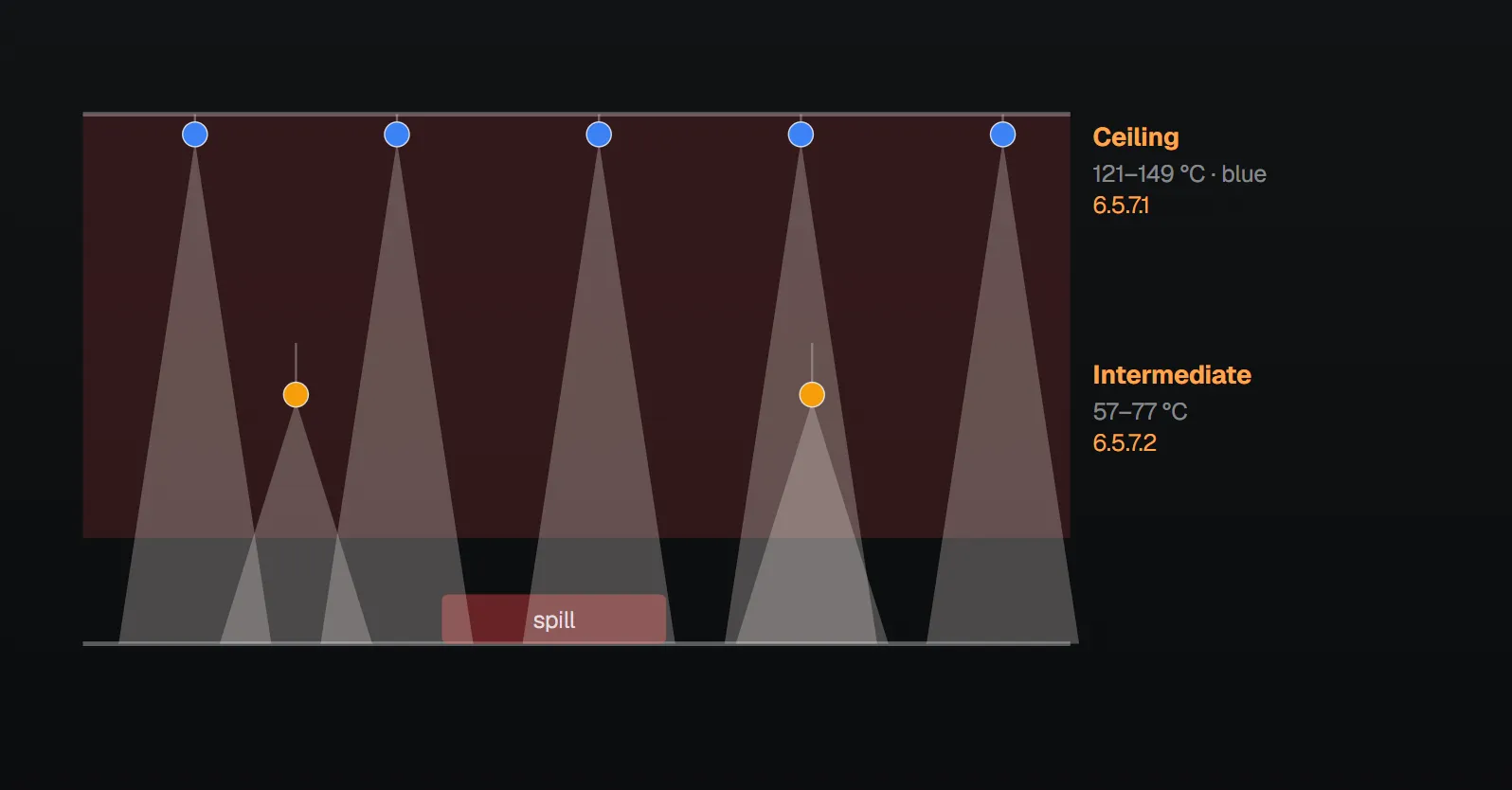
Four system types
NFPA 11 defines a foam-water sprinkler system as a piping network that employs automatic or open sprinklers to discharge a foam solution (3.3.16.2.1) and lists four types (6.2.2):
| Type | How it works | Devices | Definition |
|---|---|---|---|
| Deluge | Open devices; a detection system in the same area opens the valve | Air-aspirating or not | 3.3.16.2.1.1 |
| Wet pipe | Automatic sprinklers; piping preprimed with foam-water solution | Automatic, non-air-aspirating | 3.3.16.2.1.5, 6.2.5.1 |
| Dry pipe | Automatic sprinklers; air or nitrogen under pressure, a sprinkler opening lets the dry pipe valve open | Automatic, non-air-aspirating | 3.3.16.2.1.2 |
| Preaction | Automatic sprinklers; air in the piping and a supplemental detection system in the same area | Automatic, non-air-aspirating | 3.3.16.2.1.3 |
A spray system is a piping network that discharges foam solution through open or automatic water spray nozzles (3.3.16.2.1.4). Deluge and preaction systems have automatic and auxiliary manual tripping (6.2.1.1); manual operation only is permitted for deluge systems where acceptable to the AHJ (6.2.1.2). Wet pipe systems are preprimed with foam-water solution, unless the concentrate manufacturer recommends otherwise and the AHJ approves (6.2.5.1, 6.2.5.2). Annex A.6.2.5 (explanatory) notes that most closed-head test work was done with preprimed systems or with solution discharged in under a minute; where only water is in the piping, the designer and the AHJ should satisfy themselves that the solution delay is acceptable. The same annex notes that manufacturers generally do not recommend prepriming with alcohol-type concentrates.
Air-aspirating or not?
An air-aspirating discharge device is specially designed to aspirate and mix air into the foam solution to generate foam, then discharge it in a specific pattern (3.3.2.1). Foam-water sprinklers and foam-water spray nozzles belong here. A standard sprinkler is non-air-aspirating.
- Deluge and spray systems: air-aspirating devices (foam-water sprinklers, spray nozzles) or non-air-aspirating devices (standard sprinklers) may be used (6.4.2.2).
- Wet, dry and preaction systems: devices are automatic in operation and non-air-aspirating (6.4.2.3).
- In every case: discharge devices and foam concentrates are listed for use together (6.4.2.1), and all components including the concentrate are listed for the intended use (6.4.1.1).
Only alcohol-type foam is used on fires in water-soluble and polar solvents (6.1.3.4). Annex A.6.1.3.4 (explanatory) mentions that several AFFF and FFFP concentrates have been listed with standard sprinklers for nonmiscible hydrocarbons; in all cases the agent follows its listing.
Temperature rating: ceiling and intermediate level
NFPA 11 limits the rating of foam-water sprinklers by location:
- Roof or ceiling: 121–149 °C (250–300 °F) (6.5.7.1). In the tables below this is the “high” class with a blue code.
- Intermediate level: 57–77 °C (135–170 °F), unless ambient conditions require a higher rating (6.5.7.2). This range is “ordinary”.
The rule matters only for automatic sprinklers; open devices on a deluge system have no operating element.
Glass-bulb and fusible-link colour codes
The two tables given for the spare sprinkler cabinet show, for each rating, the maximum ceiling temperature, the class and the colour code. For glass-bulb sprinklers the table gives the bulb colour; for fusible-link sprinklers, the colour code.
| Max ceiling temperature | Rating | Class | Bulb colour · Table 6.4.11.3(a) |
|---|---|---|---|
| 38 °C (100 °F) | 57 °C (135 °F) | Ordinary | Orange |
| 49 °C (120 °F) | 68 °C (155 °F) | Ordinary | Red |
| 66 °C (150 °F) | 79 °C (175 °F) | Intermediate | Yellow |
| 66 °C (150 °F) | 93 °C (200 °F) | Intermediate | Green |
| 107 °C (225 °F) | 121–149 °C (250–300 °F) | High | Blue |
| 149 °C (300 °F) | 163–191 °C (325–375 °F) | Extra high | Purple |
| 191 °C (375 °F) | 204–246 °C (400–475 °F) | Very extra high | Black |
| 246 °C (475 °F) | 260–302 °C (500–575 °F) | Ultra high | Black |
| 329 °C (625 °F) | 343 °C (650 °F) | Ultra high | Black |
| Max ceiling temperature | Rating | Class | Colour code · Table 6.4.11.3(b) fusible link |
|---|---|---|---|
| 38 °C (100 °F) | 57–77 °C (135–170 °F) | Ordinary | Uncoloured or black |
| 66 °C (150 °F) | 79–107 °C (175–225 °F) | Intermediate | White |
| 107 °C (225 °F) | 121–149 °C (250–300 °F) | High | Blue |
| 149 °C (300 °F) | 163–191 °C (325–375 °F) | Extra high | Red |
| 191 °C (375 °F) | 204–246 °C (400–475 °F) | Very extra high | Green |
| 246 °C (475 °F) | 260–302 °C (500–575 °F) | Ultra high | Orange |
| 329 °C (625 °F) | 343 °C (650 °F) | Ultra high | Orange |
Colour alone does not identify the rating: the same colour means different things in the two tables (red is 68 °C on a glass bulb and 163–191 °C on a fusible link), so it is read together with the sprinkler type.
Spare sprinkler cabinet
At least six spare sprinklers are kept on the premises so that operated or damaged sprinklers can be replaced promptly (6.4.11.1). The spares correspond to the types and ratings installed (6.4.11.2), and the cabinet is kept where the temperature never exceeds the maximum ceiling temperature in the tables for each sprinkler inside (6.4.11.3). The number depends on the total on site (6.4.11.5):
- Under 300 sprinklers: at least 6
- 300 to 1000 sprinklers: at least 12
- Over 1000: at least 24
One wrench as specified by the manufacturer is kept for each type (6.4.11.6), and a list of the installed sprinklers is posted in the cabinet: identification number or manufacturer, model, K-factor, deflector type, thermal sensitivity and pressure rating; general description; quantity of each type; date of the list (6.4.11.7, 6.4.11.7.1). Annex A.6.4.11.1 (explanatory) notes that spares are required per facility rather than per building or system.
Check it with the calculator
The foam-water sprinkler calculator checks the device type for the system (6.4.2), whether the chosen rating suits the location (6.5.7), the colour code and maximum ceiling temperature (Table 6.4.11.3) and the number of spares (6.4.11.5). For design area, spacing and duration see the companion article.
Frequently Asked Questions
Where may air-aspirating foam-water sprinklers be used?
Only on deluge and spray systems (NFPA 11-2024 6.4.2.2). Wet, dry and preaction foam-water systems use automatic, non-air-aspirating devices (6.4.2.3).
What temperature rating do foam-water sprinklers need?
121–149 °C (250–300 °F) at the roof or ceiling and 57–77 °C (135–170 °F) at an intermediate level; a higher intermediate rating is allowed where ambient conditions require it (6.5.7.1, 6.5.7.2).
What colour is a 250–300 °F sprinkler?
Blue on both glass-bulb and fusible-link sprinklers, class “high”, with a maximum ceiling temperature of 107 °C (225 °F) (Tables 6.4.11.3(a) and (b)).
How many spare sprinklers are kept?
At least 6 under 300 sprinklers on site, 12 for 300–1000 and 24 above 1000, matching the installed types and ratings (6.4.11.2, 6.4.11.5).
Why is a wet foam-water system preprimed?
NFPA 11 requires wet pipe systems to be preprimed with foam-water solution (6.2.5.1), unless the manufacturer recommends otherwise and the AHJ approves (6.2.5.2). Per Annex A.6.2.5 most closed-head testing used preprimed systems or solution arriving within 1 minute.
SprinkCalc — Fire Sprinkler Design Across Three Standards
SprinkCalc covers hazard classification, design density and area, K-factor selection, water demand and hydraulic calculations for NFPA 13, FM Global and BS EN 12845 in a single iOS app, and exports a professional PDF report.
Download SprinkCalc on the App Store
MEP Calc — 110+ Engineering Calculators
MEP Calc bundles 110+ engineering modules in one iOS app: 21 fire calculations plus heating, cooling, HVAC, plumbing, steam and natural gas.
Download MEP Calc on the App StoreNFPA 11-2024, Standard for Low-, Medium-, and High-Expansion Foam: 3.3.2.1, 3.3.16.2.1–3.3.16.2.1.5; 6.1.3.4; 6.2.1, 6.2.2, 6.2.5; 6.4.1.1, 6.4.2.1–6.4.2.3; 6.4.11.1–6.4.11.7.1, Tables 6.4.11.3(a), 6.4.11.3(b); 6.5.7.1, 6.5.7.2; Annex A.6.1.3.4, A.6.2.5, A.6.4.11.1 (explanatory).