NFPA 11 treats foam concentrate not as a single product but as a "type": chemical composition, use percentage, minimum usable temperature and the fuels on which it works together define the type (3.3.12). The type decides which proportioner, discharge device and application rate apply. This article sets out the concentrate types defined in NFPA 11-2024, how they differ and the selection rules, using nothing but the standard's own text.
Quantity, the 24-hour reserve and storage tank rules are covered in concentrate supply and proportioning and are not repeated here. Annex A material is explanatory, not mandatory; it is cited below as "Annex".
Concentrate, solution, foam: three different things
The standard keeps three terms apart. Concentrate is the liquid foaming agent as it arrives from the manufacturer (3.3.11). Solution is that concentrate mixed homogeneously with water in the correct proportion (3.3.15). Foam is what you get when air is worked into the solution: a stable mass of bubbles lighter than oil or water (3.3.9). The percentage of concentrate in the solution is the concentration (3.3.1).
Foams are grouped by expansion (Annex A.3.3.9): low expansion up to 20, medium expansion from 20 to 200 and high expansion from 200 to about 1000.
Low-expansion concentrate types (3.3.11)
The table puts the Chapter 3 definitions next to the typical use percentages given in Annex A. The percentage column is mostly explanatory; what binds a project is the product listing and the manufacturer's specification (4.3.1.3).
| Type | What NFPA 11 says it is | Typical use percentage | Aqueous film | With dry chemical |
|---|---|---|---|---|
| Protein | Mainly protein hydrolysate, with additives against freezing, corrosion, bacterial decomposition and for viscosity control (3.3.11.7) | 3–6 % (Annex A.3.3.11.7) | Not in the definition | Compatible with certain agents (Annex A.3.3.11.7) |
| Fluoroprotein (FP) | Very similar to protein, with a synthetic fluorinated surfactant additive (3.3.11.5); resists fuel pickup (Annex A.3.3.11.5) | 3 or 6 % (Annex A.3.3.11.5) | Not in the definition | Compatible (Annex A.3.3.11.5) |
| FFFP | A protein concentrate that uses fluorinated surfactants to form an aqueous film (3.3.11.3) | 3–6 % (Annex A.3.3.11.3) | Yes (3.3.6) | Compatible with certain agents (Annex A.3.3.11.3) |
| AFFF | Fluorinated surfactants plus foam stabilisers; an aqueous film that suppresses hydrocarbon vapour (3.3.11.2) | Usually 1, 3 or 6 % (3.3.11.2) | Yes (3.3.6) | Compatible, suitable for combined use (Annex A.3.3.11.2) |
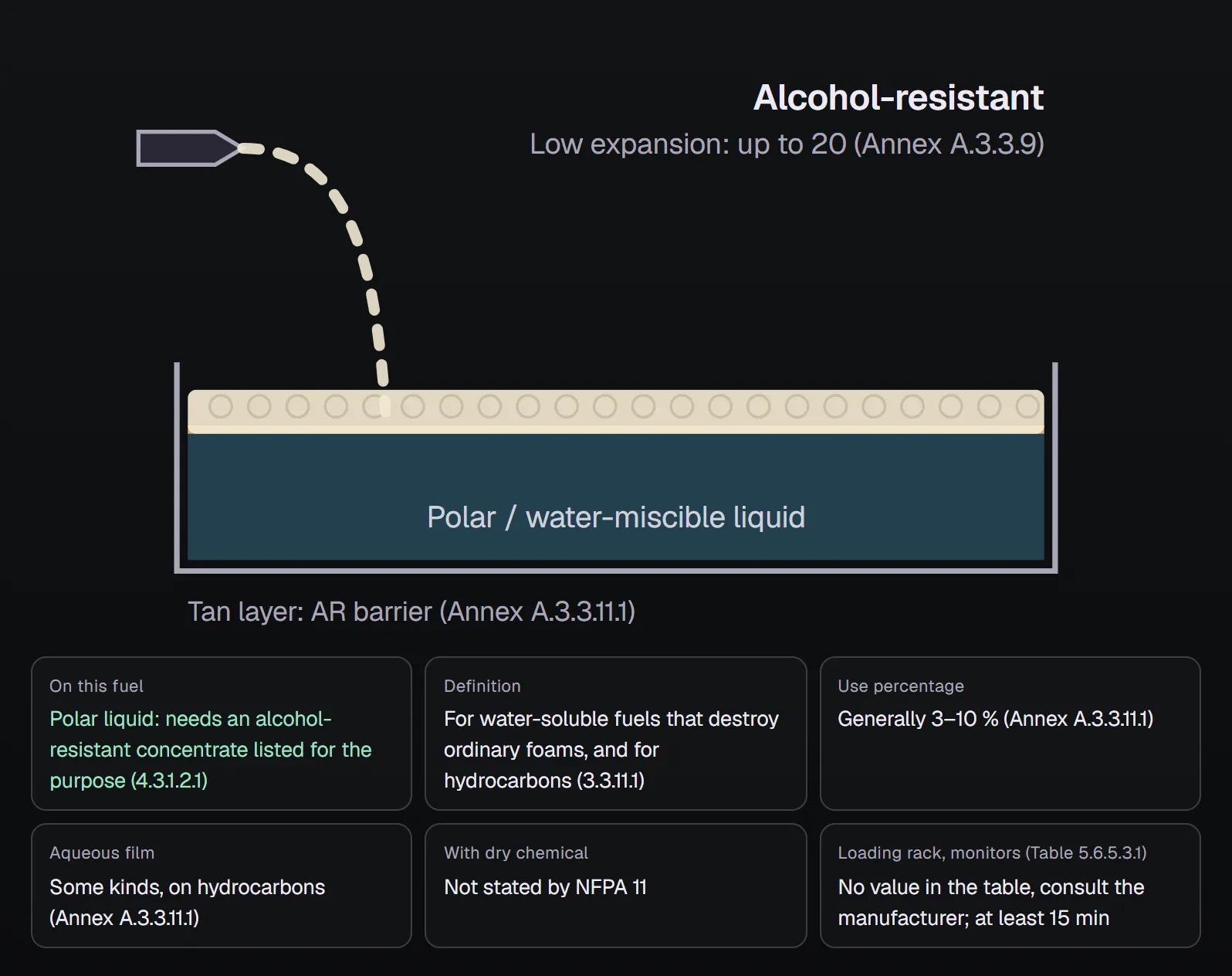
| Alcohol-resistant (AR) | For water-soluble fuels that destroy ordinary foams, and for hydrocarbons (3.3.11.1) | Generally 3–10 % (Annex A.3.3.11.1) | Some kinds can on hydrocarbons (Annex A.3.3.11.1) | Not stated |
| SFFF | A blend of hydrocarbon surfactants, not formulated to contain PFAS (3.3.11.8) | Not given by NFPA 11; see the listing | Not in the definition | Not stated |
| Other synthetic | Hydrocarbon surfactant based; listed as a wetting agent, foaming agent or both (3.3.11.9.1) | See the listing | Not in the definition | Not stated |
Film formation is measurable: a spreading coefficient above zero over cyclohexane (3.3.6, 3.3.29). The standard also gives a general term, "film-forming foam": any concentrate that forms an aqueous film on hydrocarbons at its nominal use concentration (3.3.11.4). The umbrella term "synthetic concentrate" covers everything based on foaming agents other than hydrolysed protein, including AFFF, medium- and high-expansion concentrates and other synthetics (3.3.11.9).
Annex A.3.3.11.1 names three general kinds of alcohol-resistant concentrate: protein or fluoroprotein based with an alcohol-insoluble barrier in the bubble structure, gelled synthetics, and gelled fluoroprotein. The gelled kinds can also form a film on hydrocarbons.
The fuel decides: the polar liquid rule (4.3.1.2)
The concentrate must be listed for the specific ignitible liquid being protected (4.3.1.2). Water-miscible and polar ignitible liquids are protected only by alcohol-resistant concentrates listed for that purpose (4.3.1.2.1). The reason sits in the definition itself: such fuels destroy ordinary foams, AFFF, SFFF and FFFP (3.3.11.1). Some concentrates suit both hydrocarbons and polar liquids (Annex A.4.3.1.2).
Watch fuel blends. Annex material says recent SFFF testing suggests that any gasoline with at least 10 percent ethanol should be treated as a polar solvent for foam selection (Annex A.5.2.4.3.1). The same paragraph limits effective monitor or hose application of alcohol-resistant foam on spill fires to liquid depths not exceeding 25 mm (1 in.).
Type changes the application rate
Some NFPA 11 tables tie the minimum application rate directly to the concentrate type. Loading racks protected by foam monitor nozzles are a clear example (Table 5.6.5.3.1):
| Foam type | Minimum application rate | Minimum discharge time | Product loaded |
|---|---|---|---|
| Protein, fluoroprotein and SFFF* | 6.5 L/min·m² (0.16 gpm/ft²) | 15 min | Hydrocarbons |
| AFFF, FFFP, alcohol-resistant AFFF or FFFP | 4.1 L/min·m² (0.10 gpm/ft²) | 15 min | Hydrocarbons |
| Alcohol-resistant foams* | No value in the table | 15 min | Liquids requiring alcohol-resistant foam |
* Table footnote: consult the manufacturer for listings on specific products.
The film-forming types enter the table at the lower rate for the same rack, while SFFF sits on the same row as protein and fluoroprotein. For rack and dike rules see dikes, spills and loading racks; for your own numbers use the NFPA 11 design criteria calculator.
Foam quality is also judged differently by type. In the explanatory table for acceptance of foam-water sprinkler and spray systems, protein and fluoroprotein foam have an expansion of 3:1 to 8:1 and a minimum 25 percent drainage time of 15 s, while AFFF at the same expansion has 60 s (Annex Table A.12.9.3.1).
SFFF: what the standard says and what it does not
- Definition: based on hydrocarbon surfactants and not formulated to contain PFAS (3.3.11.8). The Annex warns that PFAS contamination can still turn up in SFFF from equipment previously used with fluorinated concentrates or from the environment (Annex A.3.3.11.8).
- Expansion: research testing showed expansion ratios of 7 to 10 to be critical for SFFF extinguishing ability; the concentrate or equipment manufacturer may need to confirm acceptable operating parameters (Annex A.4.3.1.1).
- Air aspiration: testing suggests some SFFF has to be air-aspirated, using nozzles with an air-aspiration factor of at least 8 to 10 (Annex A.5.2.4.2.1).
- Rate: where SFFF is used in foam-water sprinkler and spray systems, the application rate is set from Annex H and the manufacturer's recommendations (6.5.2.2.1.1). This is mandatory text.
- Annex H: explanatory and free of design values. It only notes that testing has been carried out by three kinds of organisation (manufacturers and research bodies, user organisations, research or standards-writing bodies) and lists further sources (H.1).
- Combined use: separately generated SFFF foam may be applied to a fire in sequence or together with the other low-expansion foams (4.4.1.3).
In practice. NFPA 11-2024 gives SFFF no use percentage and no general application rate of its own. Where a table carries a value (for example Table 5.6.5.3.1) that value applies; elsewhere the product listing and the manufacturer's design data govern. For the wider picture on moving away from fluorinated foam see AFFF to F3 foam transition.
Medium- and high-expansion concentrates (3.3.11.6, 7.8)
These concentrates are usually derived from hydrocarbon surfactants and, in specially designed equipment, give foam-to-solution volume ratios from 20:1 up to about 1000:1 (3.3.11.6). The equipment can be air-aspirating or blower-fan type (Annex A.3.3.11.6). The concentrate must be listed for use with that equipment (7.8.1.1), and its performance under the installation conditions has to be established by test (7.8.1.2); quality tests are described in Annex G (7.8.1). For system design see high-expansion foam.
No mixing, and compatibility
- Different types of concentrate are never mixed in storage. The 2024 edition states this in two places (4.3.1.1.2, 4.4.1.1).
- Different brands of the same type may be mixed only where the manufacturer proves compatibility with data and the AHJ accepts it (4.3.1.1.2, 4.4.1.2).
- The Annex asks for more than chemical compatibility: hardware listings are specific about pressure, flow range and materials, the blend should perform no worse than either component, and the application method should match. If one component is listed at a higher rate, the design rate may have to rise, above all with rate-sensitive alcohol-resistant foams (Annex A.4.3.1.1.2, Annex A.4.4.1.1).
- Where foam is used with dry chemical, both manufacturers confirm mutual compatibility (4.4.2.1) and the limits of each agent alone still apply (4.4.2.2). Not every expanded foam suits every dry chemical (Annex A.4.4.2).
- Storage vessels are marked with the concentrate type and its intended concentration (4.3.2.4.3); replacement concentrate must also be listed for use with the system components (4.3.1.1.1).
Concentrate on ships (Chapter 11)
In NFPA 11-2024, Chapter 11 covers marine applications and sets its own concentrate rules. Concentrate must be approved (11.1.4). Approval for hydrocarbons uses a test equivalent to the 9.3 m² (100 ft²) method in Annex F, with four consecutive fire tests, two in sea water and two in fresh water (11.1.4.1, 11.1.4.2). Concentrate for polar solvent systems is also approved for polar solvents (11.1.4.3). Only one type of concentrate is carried on board (11.11.9), and proportioning is by the balanced pressure method with a dedicated concentrate pump (11.12.1), although other systems acceptable to the AHJ are permitted (11.12.2).
Selection checklist
- Is the protected liquid a hydrocarbon, or water-miscible or polar? If polar, an alcohol-resistant concentrate listed for that purpose (4.3.1.2.1).
- Is the concentrate listed with the system's proportioner and discharge devices (4.1.2, 4.3.1.1)?
- Does the listing state the use percentage, minimum usable temperature and effective fuels (3.3.12, 4.3.1.3)? Is storage within the listed temperature limits (4.3.2.4.2)?
- Does the relevant table give a rate by foam type, or do you need the listing and manufacturer's data?
- Is there another concentrate type on site? If so, separate tank and separate marking (4.4.1.1, 4.3.2.4.3).
Frequently Asked Questions
Which foam concentrate types does NFPA 11 define?
Chapter 3 defines alcohol-resistant, AFFF, FFFP, film-forming, fluoroprotein, medium- and high-expansion, protein, SFFF and synthetic concentrates, including other synthetics (3.3.11.1 to 3.3.11.9.1). A type covers chemical composition, use percentage, minimum usable temperature and effective fuels (3.3.12).
Can AFFF be used on a polar liquid such as alcohol?
No. Water-miscible and polar liquids are protected only by alcohol-resistant concentrates listed for that purpose (4.3.1.2.1). Such fuels destroy ordinary foams, AFFF, SFFF and FFFP (3.3.11.1).
Does NFPA 11 give an application rate for SFFF?
Not a general one. In foam-water sprinkler and spray systems the rate comes from Annex H and the manufacturer's recommendations (6.5.2.2.1.1), and Annex H contains no design values. In the loading rack table SFFF shares the 6.5 L/min·m² row with protein and fluoroprotein, with a footnote referring to the manufacturer (Table 5.6.5.3.1).
Can different brands of concentrate be mixed in one tank?
Different types are never mixed (4.4.1.1). Different brands of the same type may be mixed only when the manufacturer proves compatibility with data and the AHJ accepts it (4.3.1.1.2, 4.4.1.2).
At what percentages is AFFF used?
By definition AFFF is usually diluted to a 1, 3 or 6 percent solution (3.3.11.2). The listed percentage governs, and consumption is calculated on the percentage used in the design (4.3.2.5.1).
SprinkCalc — Fire Sprinkler Design Across Three Standards
SprinkCalc covers hazard classification, design density and area, K-factor selection, water demand and hydraulic calculations for NFPA 13, FM Global and BS EN 12845 in a single iOS app, and exports a professional PDF report.
Download SprinkCalc on the App Store
MEP Calc — 110+ Engineering Calculators
MEP Calc bundles 110+ engineering modules in one iOS app: 21 fire calculations plus heating, cooling, HVAC, plumbing, steam and natural gas.
Download MEP Calc on the App StoreNFPA 11-2024, Standard for Low-, Medium-, and High-Expansion Foam: 3.3.1, 3.3.6, 3.3.9, 3.3.11–3.3.12 (pp. 11-10, 11-11); 3.3.15 (p. 11-11); 3.3.29 (p. 11-12); 4.1.2 (p. 11-13); 4.3.1, 4.3.2.4 (p. 11-14); 4.3.2.5.1, 4.4 (p. 11-15); Table 5.6.5.3.1 (p. 11-28); 6.5.2.2.1.1 (p. 11-33); 7.8.1 (p. 11-38); 11.1.4 (p. 11-47); 11.11.9, 11.12.1–11.12.2 (p. 11-50); Annex A.3.3.9–A.3.3.11.9.1 (pp. 11-58, 11-59); Annex A.4.3.1.1–A.4.3.1.1.2 (p. 11-69); Annex A.4.3.1.2, A.4.4.1.1, A.4.4.2 (p. 11-70); Annex A.5.2.4.2.1–A.5.2.4.3.1 (p. 11-77); Annex Table A.12.9.3.1 (p. 11-105); Annex H.1 (p. 11-136). Annex A and Annex H are explanatory; the binding text is the standard itself and the decision of the authority having jurisdiction.