When does a diesel pump controller start the engine, how does it crank, and who may stop it and when? NFPA 20-2025 Section 12.7 answers these questions. Controller location and indicators are in the diesel engine controller article; the electric counterpart (10.5) is in electric fire pump starting and stopping.
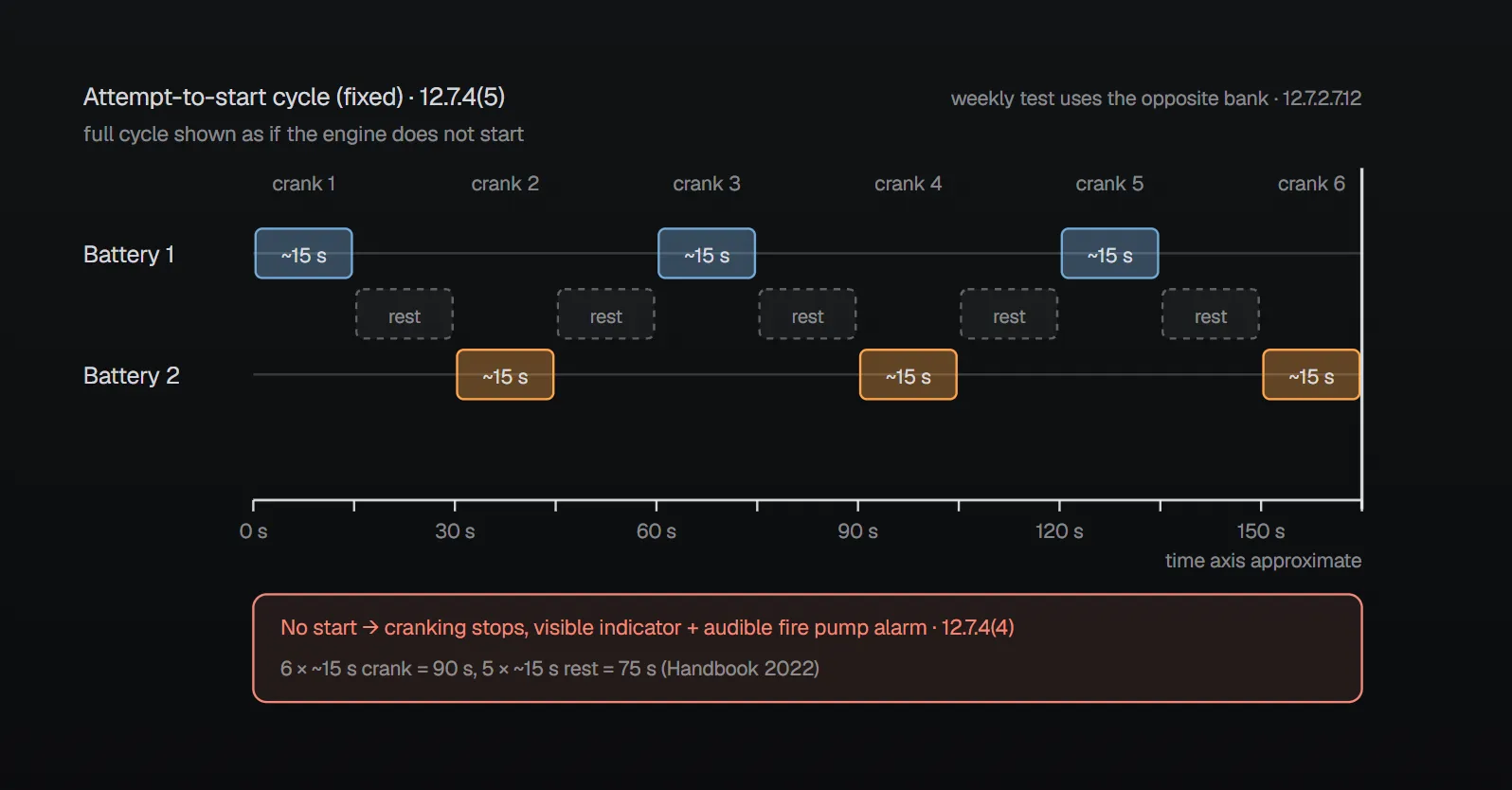
In short: an automatic controller is also operable as a nonautomatic controller, and its primary power source is not ac (12.7.1). The pressure-sensing device at its low setting starts the pump if it is not already running (12.7.2.1.8). The controller alternates two batteries through six cranks of about 15 seconds separated by five rests of about 15 seconds, then stops cranking and alarms if the engine has not started (12.7.4). Automatic shutdown after an automatic start is permitted only during automatic testing, on overspeed or where the AHJ approves, with a minimum run timer of at least 30 minutes (12.7.5.2.1, 12.7.5.2.2).
Automatic and nonautomatic
Annex A.12.7 (from NFPA 70): automatic means self-acting under an impersonal influence; nonautomatic means personal intervention is required, which does not necessarily mean a manual controller. An automatic controller is also operable as a nonautomatic one, and the controller’s primary power source is not ac electric power (12.7.1.1, 12.7.1.2).
Pressure starting
| Rule | Paragraph |
|---|---|
| A pressure-sensing device with adjustable high and low calibrated set points as part of the controller; no water piping extended into the controller (Annex A: piping and devices may be attached outside) | 12.7.2.1.1.1, 12.7.2.1.1.2 |
| Multistage multiport pumps: a dedicated sensing device and a dedicated pressure recorder for each discharge port; not applicable to non-pressure-actuated controllers | 12.7.2.1.1.3–12.7.2.1.1.5 |
| No pressure snubber or restrictive orifice in the device; no valve or restriction in the controller ahead of it; no shutoff valve in the sensing line | 12.7.2.1.2, 12.7.2.1.4, 12.7.2.1.8 |
| Responsive to water pressure in the fire protection system; withstands a momentary surge of 400 psi (27.6 bar) or 133% of maximum rated pressure, whichever is higher, without losing accuracy | 12.7.2.1.5, 12.7.2.1.6 |
| Provision to relieve pressure at the device to test the controller and pumping unit | 12.7.2.1.7 |
| An electronic sensor is monitored in automatic testing: a silenceable visual and audible signal if the reading exceeds the higher of 10 psi (0.68 bar) or 3.33% of maximum rated pressure during a solenoid drain start, or if output is below 10% of rated span or zero output, or more than 10% above full scale | 12.7.2.1.3–12.7.2.1.3.2 |
The piping side of the sensing line is in the pressure sensing line article.
Other ways to start
- Where the pump supplies special water control equipment such as deluge or dry-pipe valves, the engine may start before the pressure switch would; starting is initiated by opening the control circuit loop containing that equipment (12.7.2.2.1–12.7.2.2.3).
- Remote stations for nonautomatic continuous operation cannot stop the engine (12.7.2.3).
- Automatic starting on loss of ac power is not permitted unless the AHJ requires it (12.7.2.4).
- With multiple pumps, each controller has a sequential timing device so no two drivers start together; a pump supplying suction to another starts within 10 seconds before the pump it supplies and series controllers are interlocked; multiple units start at 5 to 10 second intervals; failure of a leading driver does not prevent the next from starting (12.7.2.5.1–12.7.2.5.4). See fire pumps arranged in series.
- Broken or shorted control conductors leaving the pump room may cause continuous running but cannot prevent starting (12.7.2.6.1, 12.7.2.6.2). With a positive displacement pump the controller provides a circuit and timer to open and then close the dump valve after starting; per the Handbook (2022) the starter would otherwise crank against water-filled cylinders (12.7.2.6.4).
Automatic testing
- The controller automatically starts, runs and shuts down the engine at the minimum test frequency and duration required by NFPA 25; the run shows as a pressure drop on the recorder, initiated by a solenoid drain valve on the pressure control line (12.7.2.7.1–12.7.2.7.3).
- If no other starting or running cause exists, the engine shuts down at least on high engine temperature, low oil pressure, high cooling water temperature, overpressure, leak detection, low reservoir level and lowest permissible suction pressure; the last two need not shut it down in no-flow testing (12.7.2.7.4, 12.7.2.7.4.1).
- If a starting cause occurs after a shutdown, the controller restarts the engine regardless of those conditions (12.7.2.7.5). Annex A.12.7.2.7.5 lists starting causes as a pressure drop, a deluge valve contact opening, a remote start signal or a manual pushbutton start.
- A starting cause during testing ends the test, returns the controller to automatic and actuates a silenceable signal (12.7.2.7.7). A local means cancels all automatic testing, and subsequent weeks crank on the opposite battery bank (12.7.2.7.10, 12.7.2.7.12).
- Network remote testing uses an authorized user’s cybersecure connection on equipment evaluated for cybersecurity; a remote stop is allowed only during the test, and the controller stops remote testing and returns to standby on loss of connectivity or after 30 minutes (12.7.2.8.1–12.7.2.8.6). See automated inspection, testing and monitoring.
Manual operation and starting equipment
A manually operated switch or valve on the controller starts the engine so that the pressure switch cannot affect it, keeps it running until manually stopped, and failure of automatic circuits does not affect manual operation (12.7.3.1.1–12.7.3.1.4). The operator can test automatic operation by opening the solenoid valve drain (12.7.3.2.1).
| Starting equipment | Paragraph |
|---|---|
| Two battery units, each complying with 11.2.7.2.1; manual and automatic starting possible with either | 12.7.4(1) |
| Starting current from one battery and then the other on successive operations; automatic changeover except for manual start | 12.7.4(2), 12.7.4(3) |
| Fixed cycle: six crank periods of about 15 seconds separated by five rest periods of about 15 seconds | 12.7.4(5) |
| If the engine has not started at the end of the cycle, cranking stops with a visible indicator and audible fire pump alarm | 12.7.4(4) |
| If one battery is inoperative or missing, the control locks in on the remaining battery | 12.7.4(6) |
NFPA 20 Handbook (2022): six cranks and five rests add up to 90 seconds of cranking and 75 seconds of rest, 2¾ minutes in total.
Stopping
- Manual shutdown uses the main switch or stop valve inside the controller, or a stop button or valve outside the enclosure; the outside stop shuts the engine down only if all starting causes have returned to normal, and the controller returns to full automatic (12.7.5.1).
- No automatic shutdown while starting and running causes are present. It is permitted only during automatic testing, when the engine overspeed device operates, and where the AHJ approves (12.7.5.2, 12.7.5.2.1). On overspeed the controller removes power from engine running devices, prevents further cranking, alarms and locks out; it cannot be reset until the engine overspeed device is manually reset (12.7.5.2.1(2)). Where automatic shutdown is permitted, a minimum run timer of at least 30 minutes is used (12.7.5.2.2).
- Automatic control circuits whose failure could prevent starting and running are completely bypassed during manual start and run (12.7.6).
Why?
- Manual stopping: Annex A.12.7.5.2 prefers manual shutdown, as a controller may stop the pump during a real fire when relatively low flow suggests pressure is satisfied. The Handbook (2022) adds that a stopped engine may not restart, and an interruption of more than a few seconds can open more sprinklers. Annex A.12.7.5.2.2: 30 to 45 minutes is usually enough to dry out the exhaust and bring the engine and oil to normal temperature.
- Shut down in tests, not in fires: per the Handbook (2022), under a true demand the pump and driver are sacrificial and the engine is not stopped for high temperature or low oil pressure; the controller protects the engine only during a test.
- Sequential starting: the Handbook (2022) says all pressure switches trip together on a sudden demand; sequencing prevents excessive hydraulic stress, and ignoring it has destroyed pump houses when the surge broke underground headers and elbows.
- Sensing: per the Handbook (2022) a snubber can trap pressure and prevent starting; a transducer reading low runs the pump needlessly and one reading high fails to start it.
Mistakes named in the sources
- Using the outside stop button to take the controller out of service: the Handbook (2022) says this is not permitted.
- Staggering pressure switch settings to get sequential starting: per the Handbook (2022) it works only with a very slowly rising demand; on a sudden drop all switches trip at once.
- A shutoff valve, snubber or orifice in the sensing path (12.7.2.1.2, 12.7.2.1.8).
Checklist
- Is the sensing device adjustable and surge rated, with no valve or snubber in the path? (12.7.2.1)
- Do remote stations not stop the engine, and is ac-loss starting used only if the AHJ requires it? (12.7.2.3, 12.7.2.4)
- With multiple pumps, are sequential timers and 5 to 10 second intervals in place? (12.7.2.5)
- Do automatic testing, the shutdown list and restart work, with opposite banks on alternate weeks? (12.7.2.7)
- Do two batteries, the 6 × 15 s cycle and lock-in on a failed battery work? (12.7.4)
- Is automatic shutdown off, or used only where permitted with a 30-minute timer? (12.7.5.2)
Frequently Asked Questions
What is the diesel engine cranking cycle?
A fixed cycle of six crank periods of about 15 seconds separated by five rest periods of about 15 seconds (NFPA 20-2025 12.7.4(5)). Current comes from one battery and then the other on successive operations (12.7.4(2)); if the engine does not start, cranking stops and an alarm operates (12.7.4(4)).
Can the engine start with one battery failed?
Yes. If one battery is inoperative or missing, the control locks in on the remaining battery during cranking (12.7.4(6)); either battery unit can start the engine manually or automatically (12.7.4(1)).
Can a diesel fire pump stop automatically?
Not while starting and running causes are present (12.7.5.2). Automatic shutdown is permitted only during automatic testing, on overspeed or where the AHJ approves, with a minimum run timer of at least 30 minutes (12.7.5.2.1, 12.7.5.2.2).
Can several pumps start at the same time?
No. Each controller has a sequential timing device; units start at 5 to 10 second intervals, and a pump supplying suction to another starts within 10 seconds before the pump it supplies (12.7.2.5.1–12.7.2.5.3).
Should a diesel pump start when utility power fails?
No; automatic starting on loss of ac power is not permitted unless the AHJ requires it (12.7.2.4). The Handbook (2022) says this stops the pump being used as an ac power loss alarm.
SprinkCalc — Fire Sprinkler Design Across Three Standards
SprinkCalc covers hazard classification, design density and area, K-factor selection, water demand and hydraulic calculations for NFPA 13, FM Global and BS EN 12845 in a single iOS app, and exports a professional PDF report.
Download SprinkCalc on the App Store
MEP Calc — 110+ Engineering Calculators
MEP Calc bundles 110+ engineering modules in one iOS app: 21 fire calculations plus heating, cooling, HVAC, plumbing, steam and natural gas.
Download MEP Calc on the App StoreNFPA 20-2025, Standard for the Installation of Stationary Pumps for Fire Protection: 12.7.1.1, 12.7.1.2; 12.7.2.1.1.1–12.7.2.1.8; 12.7.2.2.1–12.7.2.2.3; 12.7.2.3; 12.7.2.4; 12.7.2.5.1–12.7.2.5.4; 12.7.2.6.1–12.7.2.6.4; 12.7.2.7.1–12.7.2.7.12; 12.7.2.8.1–12.7.2.8.6; 12.7.3.1.1–12.7.3.2.2; 12.7.4; 12.7.5.1–12.7.5.2.2; 12.7.6; Annex A.12.7, A.12.7.2.1.1.2, A.12.7.2.7.5, A.12.7.5.2, A.12.7.5.2.2 (explanatory). NFPA 20 Handbook 2022 commentary: Section 12.7.