A diesel-driven fire pump is only as reliable as an engine that is run regularly and can be maintained. NFPA 20-2025 Section 11.6 writes this as a design and installation rule: the engine is installed so it can be run weekly, kept clean and have its batteries tested. Fuel maintenance (11.6.4) is in the fuel tank article and room temperature (11.6.5) in the pump room article; periodic inspection, testing and maintenance frequencies belong to NFPA 25 (Annex A.11.6.2).
In short: the engine is installed so it can be started at least once a week and run for at least 30 minutes to attain normal running temperature (11.6.1.1); it runs smoothly at rated speed, while an engine with variable speed pressure limiting control may run at reduced speed holding factory-set pressure (11.6.1.2, 11.6.1.3). The engine can be kept clean, dry and well lubricated (11.6.2); batteries can be kept charged at all times and tested frequently (11.6.3). The emergency manual sequence is posted step by step on the engine (11.6.6.1).
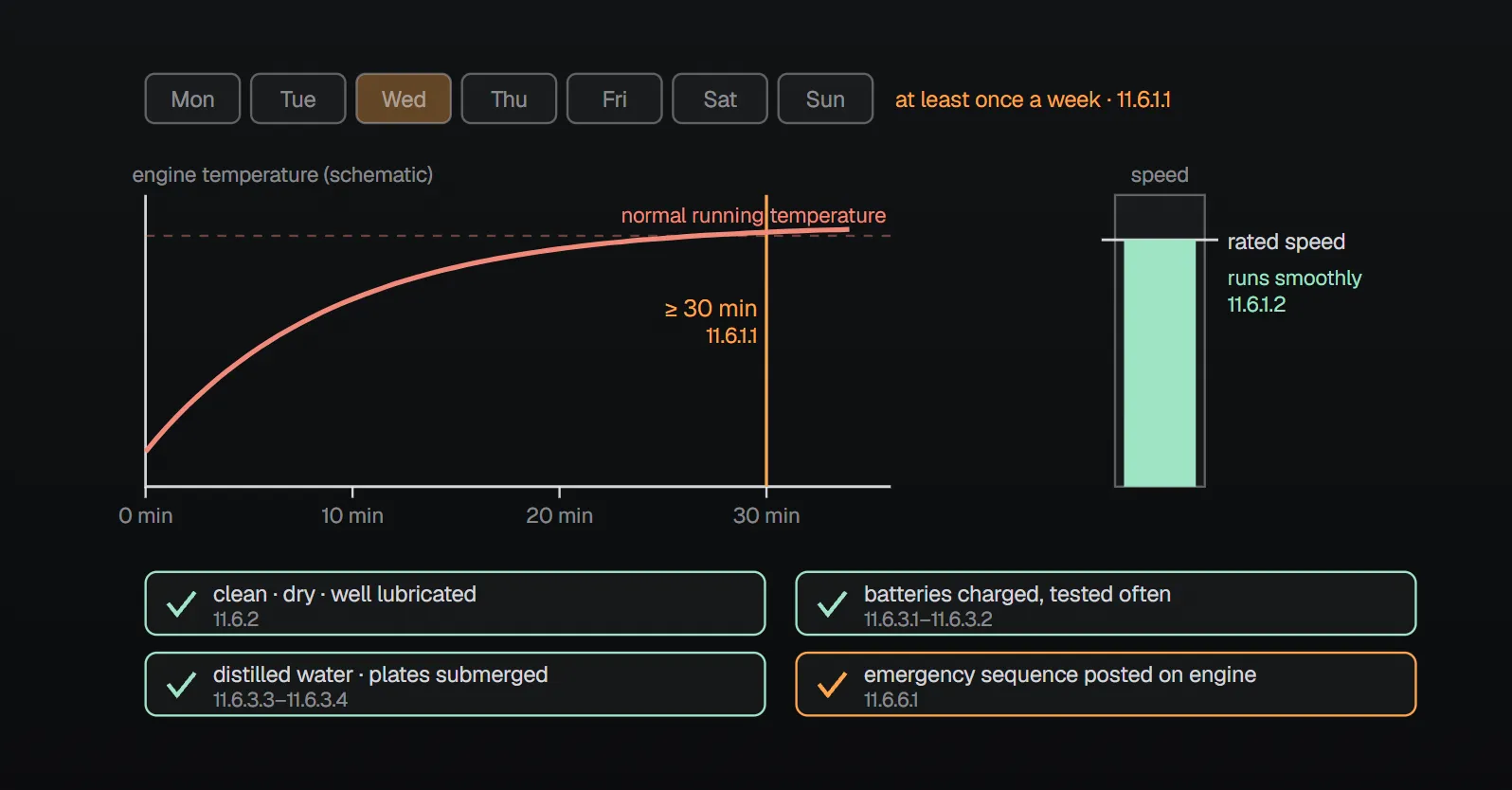
Weekly run
| Case | Rule | Paragraph |
|---|---|---|
| All diesel engines | Can be started at least once a week and run at least 30 minutes to attain normal running temperature | 11.6.1.1 |
| Constant-speed engine | Runs smoothly at rated speed | 11.6.1.2 |
| Engine with variable speed pressure limiting control | May run at reduced speed provided factory-set pressure is maintained and it runs smoothly | 11.6.1.3 |
The controller performs the weekly run: it automatically starts, runs and shuts down the engine at the minimum test frequency and duration required by NFPA 25, and the run shows on the pressure recorder as a pressure drop (12.7.2.7.1, 12.7.2.7.2). Details are in the diesel engine starting and control article. Annex A.12.7.5.2.2 notes that a 30 to 45 minute run is usually long enough to dry out the exhaust and bring the engine and oil up to normal operating temperature; longer times could require larger fuel tanks.
Engine and battery maintenance
- The engine is designed and installed so it can be kept clean, dry and well lubricated for adequate performance (11.6.2). Annex A.11.6.2 refers to NFPA 25 for maintenance of engines, batteries, fuel supply and environmental conditions.
- Batteries are installed so they can be kept charged at all times and tested frequently for cell condition and amount of charge (11.6.3.1, 11.6.3.2).
- Only distilled water is used in battery cells; battery plates are kept submerged at all times (11.6.3.3, 11.6.3.4).
- An automatic charger is not a substitute for proper maintenance of battery and charger (11.6.3.5).
- Battery and charger are placed so periodic inspection of both is physically possible; the inspection confirms the charger operates correctly, the battery water level is correct and the battery holds its charge (11.6.3.6, 11.6.3.6.1).
Battery capacity, starting arrangement and charger rules are in the batteries and charging article.
Emergency starting and stopping
- The emergency manual operating sequence, arranged step by step, is posted on the fire pump engine (11.6.6.1).
- The engine manufacturer is responsible for listing any specific instructions for emergency operation of this equipment (11.6.6.2).
Why?
- Diligent care: per Annex A.11.6, internal combustion engines have moving parts of such design and number that they cannot give reliable service without diligent care; the manufacturer’s instruction book should be readily available, operators should know its contents and observe all of it in detail.
- 30 minutes: the NFPA 20 Handbook (2022) commentary says this lets the engine reach full operating temperature and evaporate condensation from the crankcase, and gives the operator time to check pump operation, the cooling loop, the battery chargers and other pump room components needing inspection. Any irregularity should be investigated and repaired immediately. The Handbook (2022) adds that a 30-minute run heats the lube oil to drive out moisture, prevents wet stacking of the exhaust and uses some stored fuel, helping avoid excessive fuel aging.
- Battery care: the Handbook (2022) notes lead-acid batteries last 24 to 30 months and that where two batteries make a starting set it is best to replace both. A battery needing excessive water should be checked for overcharging; keeping plates covered helps prevent battery explosions, because exposed plates can arc or spark and ignite hydrogen present during starting and charging.
- Posted instructions: the Handbook (2022) says the emergency sequence must be clearly posted, typically on the engine near the instrument panel, because the responder in an emergency may not be fully qualified under Section 4.3.
Mistakes named in the sources
- Relying on the automatic charger instead of maintaining battery and charger (11.6.3.5).
- Using anything but distilled water or leaving plates exposed (11.6.3.3, 11.6.3.4).
- Placing battery and charger where they cannot be inspected (11.6.3.6).
- Keeping the emergency sequence only in a manual instead of posting it on the engine (11.6.6.1).
Checklist
- Can the engine be run once a week for at least 30 minutes? (11.6.1.1)
- Does it run smoothly at rated speed, or hold factory-set pressure if variable speed? (11.6.1.2, 11.6.1.3)
- Can the engine be kept clean, dry and lubricated? (11.6.2)
- Are battery and charger accessible for inspection, with distilled water and submerged plates? (11.6.3)
- Is the emergency manual sequence posted on the engine? (11.6.6.1)
Frequently Asked Questions
How often and how long is a diesel fire pump engine run?
Under NFPA 20-2025 11.6.1.1 the engine is designed and installed so it can be started at least once a week and run at least 30 minutes to attain normal running temperature. The controller follows NFPA 25 for the frequency and duration of the weekly test (12.7.2.7.1).
Must the engine run at rated speed during the weekly run?
Yes, it runs smoothly at rated speed (11.6.1.2). An engine with variable speed pressure limiting control may run at reduced speed provided factory-set pressure is maintained and it runs smoothly (11.6.1.3).
What water goes into fire pump batteries?
Only distilled water (11.6.3.3), and the plates stay submerged at all times (11.6.3.4). The Handbook (2022) notes that excessive water use can indicate overcharging.
Is battery maintenance needed with an automatic charger?
Yes. The automatic feature of a charger is not a substitute for maintaining battery and charger (11.6.3.5); periodic inspection confirms the charger works, the water level is right and the battery holds its charge (11.6.3.6.1).
Where are emergency starting instructions posted?
The emergency manual sequence is posted step by step on the fire pump engine (11.6.6.1); the engine manufacturer lists any specific instructions (11.6.6.2).
SprinkCalc — Fire Sprinkler Design Across Three Standards
SprinkCalc covers hazard classification, design density and area, K-factor selection, water demand and hydraulic calculations for NFPA 13, FM Global and BS EN 12845 in a single iOS app, and exports a professional PDF report.
Download SprinkCalc on the App Store
MEP Calc — 110+ Engineering Calculators
MEP Calc bundles 110+ engineering modules in one iOS app: 21 fire calculations plus heating, cooling, HVAC, plumbing, steam and natural gas.
Download MEP Calc on the App StoreNFPA 20-2025, Standard for the Installation of Stationary Pumps for Fire Protection: 11.6.1.1–11.6.1.3; 11.6.2; 11.6.3.1–11.6.3.6.1; 11.6.6.1, 11.6.6.2; 12.7.2.7.1, 12.7.2.7.2; Annex A.11.6, A.11.6.2, A.12.7.5.2.2 (explanatory). NFPA 20 Handbook 2022 commentary: Sections 11.6 and 12.7.2.7.