The capacity, connections, level indication and location of a diesel fire pump fuel tank are covered in the fuel tank article. This article collects the rest of NFPA 20-2025 Section 11.4: fuel piping fittings and the return line, protection of exposed lines, the fuel solenoid valve, fuel type and marking, and static electricity; plus the detail of the overfill sign and two small rules left out of the tank article.
In short: with black steel pipe the fittings are steel or malleable iron (11.4.4.2.1). Every fuel line exposed to traffic or possible damage gets a guard, pipe protection or approved double-walled pipe (11.4.4.6). An electric solenoid valve controlling the engine fuel supply is capable of manual mechanical operation or of being manually bypassed on control circuit failure (11.4.4.7). Fuel type and grade are as specified by the engine manufacturer; the grade is shown on the engine nameplate and on the tank in contrasting letters at least 2 in. (50 mm) high (11.4.5.1, 11.4.5.3, 11.4.5.4). Tank, pump and piping are bonded and grounded (11.4.6.2).
Fuel piping
| Topic | Rule | Clause |
|---|---|---|
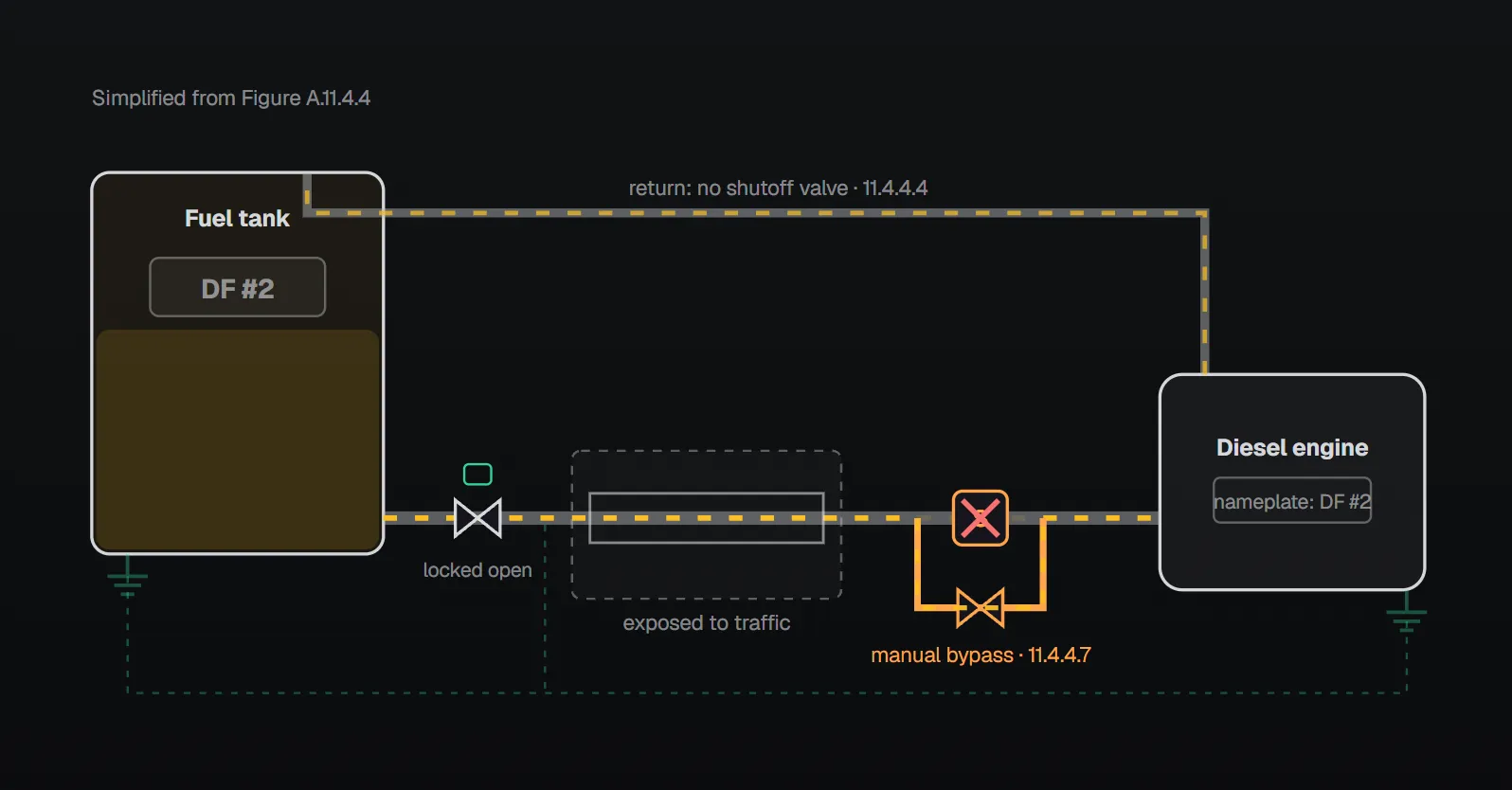
| Guide | NFPA 31 can be used as a guide for diesel fuel piping; Figure A.11.4.4 shows a suggested fuel system | A.11.4.4 |
| Fittings | Where black steel pipe is used, fittings are steel or malleable iron | 11.4.4.2.1 |
| Return line | Installed per the engine manufacturer’s recommendation; check valve only when the manufacturer requires it | 11.4.4.3, 11.4.4.3.1 |
| Line protection | Guard, pipe protection or approved double-walled pipe for all fuel lines exposed to traffic or possible damage | 11.4.4.6 |
| Solenoid valve | An electric solenoid valve controlling the engine fuel supply is capable of manual mechanical operation or of being manually bypassed on control circuit failure | 11.4.4.7 |
Annex A.11.4.4.6 suggests a covered floor trough, angle, channel steel or other adequate (mechanical or nonmechanical) protection cover on fuel lines exposed to traffic, protecting the supply and return lines between the tank and the diesel driver. Per the Handbook (2022), pipe and fittings should be black steel or stainless steel, and supply and return lines should be installed without the traps that often occur where block or concrete containment walls are used. The galvanized/copper ban, the no-shutoff rule and the locked-open valve are in the tank article (11.4.4.2, 11.4.4.4, 11.4.4.5).
Notes of Figure A.11.4.4
- Fuel piping is sized to the engine manufacturer’s specifications.
- Excess fuel can be returned to the fuel supply pump suction only if the engine manufacturer recommends it; some engines may need a fuel return pump.
- The secondary filter is behind or before the engine fuel pump per the manufacturer; a check valve in the return only where the manufacturer requires it.
- Supply and return are kept as far apart as possible in the tank to prevent direct recirculation; the tank drain end is pitched down 1/4 in. per ft (6.35 mm per m); a 1 in. (25.4 mm) drain valve where not subject to freezing, a 1 in. (25.4 mm) drain plug where it is.
- The fill cap is outside with a 1/16 in. (1.6 mm) mesh removable wire screen; the weather vent is outside and screened.
Why must the solenoid valve open by hand?
Per Annex A.11.4.4.7 the valve is a fuel shut-off solenoid in the engine fuel supply plumbing for normal stopping by starving the engine of fuel; it is part of the engine’s third-party listing and supplied by the engine supplier, and emergency stop is not its purpose. The required manual operation or bypass lets fuel reach the engine if the solenoid itself or its control circuitry fails. Handbook (2022): if the valve fails closed, the engine cannot be started; a manual bypass lets it start in an emergency, and the valve need not be sourced and installed separately in the field. Other engines stop by regulating fuel flow to zero mechanically or electrically.
Fuel type and marking
- The type and grade of diesel fuel are as specified by the engine manufacturer (11.4.5.1). Annex A.11.4.5 recommends pour point and cloud point at least 10°F (5.6°C) below the lowest expected fuel temperature.
- Where local air quality rules allow only DF #1 and no driver listed for DF #1 is available, an engine listed for DF #2 may be used with its nameplate rated horsepower derated 10 percent, provided the engine manufacturer approves DF #1 (11.4.5.2).
- The fuel grade is shown on the engine nameplate required by 11.2.2.1 (11.4.5.3) and on the tank in letters at least 2 in. (50 mm) high in a color contrasting with the tank (11.4.5.4).
- Residual fuels, domestic heating furnace oils and drained lubrication oils are not used (11.4.5.5).
Annex A.11.4.5.1 does not recommend biodiesel and other alternative fuels for fire protection engines because of unknown storage life, and recommends petroleum fuels only. The Handbook (2022) adds that biodiesel has a lower heating value than petroleum fuel, so the engine produces less horsepower. Per the Handbook, contrasting 2 in. (50 mm) letters are easily visible in the pump room and readily available as decals. Annex A.11.6.4 also explains that stored fuel degrades, tanks should be kept water-free, and fuel maintenance should begin on the day of installation and first fill.
Static electricity
- Tank, pump and piping are designed and operated to prevent electrostatic ignitions (11.4.6.1).
- Tank, pump and piping are bonded and grounded (11.4.6.2); the bond and ground are physically applied or inherently present by the nature of the installation (11.4.6.3).
- Any electrically isolated section of metallic piping or equipment is bonded and grounded to prevent hazardous accumulation of static electricity (11.4.6.4).
Annex A.11.4.6 calls the subject complex and refers to NFPA 77; the standard gives no further reason.
Level indication: overfill sign and supervisory signal
The second way to prevent overfilling is a permanent sign at the fill point with the tank calibration chart and filling instructions; the person filling first determines how full the tank is and calculates the fuel (gallons or liters) needed to reach 90 percent. Where ice, snow or weather could make the sign unreadable, the procedure and chart may be kept in an office window, lock box or other location accessible to the person filling. The third way is any approved overfill prevention procedure (11.4.2.4). The Handbook (2022) answers the concern that a low fuel indication on the controller will not be heard in an unattended pump room with 11.4.2.3: low fuel (below 2/3) initiates a supervisory signal, so the warning is audible at the central panel.
Two rules left from the tank article
- Each tank has an engine return connection no smaller than the fuel return piping from the engine (11.4.1.5.5, 11.4.1.5.5.1).
- Vents from the interstitial space of a double-wall tank meet 11.4.1.6.2 and 11.4.1.6.3 and are not manifolded with the vent from the primary compartment (11.4.1.6.4).
Errors named in the sources
The Handbook (2022) warns against fuel lines installed with traps that often form at block or concrete containment walls. For the other rules the sources give no separate field-error example.
Checklist
- With black steel pipe, are fittings steel or malleable iron? (11.4.4.2.1)
- Are lines exposed to traffic or damage guarded or approved double-walled? (11.4.4.6)
- Can the fuel solenoid valve be operated or bypassed manually? (11.4.4.7)
- Is the fuel grade on the engine nameplate and on the tank in contrasting letters at least 2 in. (50 mm) high? (11.4.5.3, 11.4.5.4)
- Are tank, pump and piping bonded and grounded, with no isolated metallic section left? (11.4.6.2, 11.4.6.4)
For weekly running and engine maintenance see the diesel engine weekly run article.
Frequently Asked Questions
May a diesel fire pump fuel line have a solenoid valve?
Yes; an electric solenoid valve controlling the engine fuel supply must be capable of manual mechanical operation or of being manually bypassed on control circuit failure (NFPA 20-2025 11.4.4.7). Per Annex A.11.4.4.7 it is for normal stopping, not emergency stop.
How is the fuel grade marked on the tank?
In letters at least 2 in. (50 mm) high in a color contrasting with the tank (11.4.5.4); the grade is also shown on the engine nameplate (11.4.5.3).
Can biodiesel be used?
Fuel type and grade follow the engine manufacturer (11.4.5.1). Annex A.11.4.5.1 does not recommend biodiesel or other alternative fuels because of unknown storage life, and recommends petroleum fuels only.
Can an engine listed for DF #2 run on DF #1?
Where local air quality rules allow only DF #1 and no driver listed for DF #1 is available, yes if the engine manufacturer approves; nameplate rated horsepower is derated 10 percent (11.4.5.2).
Must the fuel tank and piping be grounded?
Yes. Tank, pump and piping are bonded and grounded, and electrically isolated metallic sections are bonded and grounded too (11.4.6.2, 11.4.6.4). Annex A.11.4.6 refers to NFPA 77 for detail.
SprinkCalc — Fire Sprinkler Design Across Three Standards
SprinkCalc covers hazard classification, design density and area, K-factor selection, water demand and hydraulic calculations for NFPA 13, FM Global and BS EN 12845 in a single iOS app, and exports a professional PDF report.
Download SprinkCalc on the App Store
MEP Calc — 110+ Engineering Calculators
MEP Calc bundles 110+ engineering modules in one iOS app: 21 fire calculations plus heating, cooling, HVAC, plumbing, steam and natural gas.
Download MEP Calc on the App StoreNFPA 20-2025, Standard for the Installation of Stationary Pumps for Fire Protection: 11.4.1.5.5, 11.4.1.5.5.1, 11.4.1.6.4; 11.4.2.3, 11.4.2.4; 11.4.4.2.1, 11.4.4.3, 11.4.4.3.1, 11.4.4.6, 11.4.4.7; 11.4.5.1–11.4.5.5; 11.4.6.1–11.4.6.4; Annex A.11.4.4, Figure A.11.4.4, A.11.4.4.6, A.11.4.4.7, A.11.4.5, A.11.4.5.1, A.11.4.6, A.11.6.4 (explanatory). NFPA 20 Handbook 2022 commentary: 11.4.2 FAQ, 11.4.4.2, 11.4.4.7, A.11.4.5.1 and 11.4.5.4 commentary.