On a diesel-driven fire pump, the engine nameplate rating is not the power the pump can actually draw at site altitude and temperature. NFPA 20-2025 Sections 11.1 and 11.2.1–11.2.3 set the engine type, listing, power definition and the altitude–temperature correction. Reasons are taken only from Annex A and the NFPA 20 Handbook (2022) commentary.
In short: The engine is compression ignition (diesel); spark-ignited engines are not used (11.1.3.1, 11.1.3.2), and it is listed for fire pump service (11.2.1). Power is rated at standard SAE conditions; deduct 3% for each 1000 ft (300 m) above 300 ft (91 m) (11.2.2.4) and 1% for every 10 °F (5.6 °C) above 77 °F (25 °C) (11.2.2.5). After these corrections the 4-hour minimum rating is not less than the brake horsepower the pump needs at rated speed under load (11.2.2.7).
Engine type and listing
- Chapter 11 gives minimum performance requirements for diesel engine drivers; accessory devices such as monitoring and signaling are included where needed for that performance (11.1.1, 11.1.2).
- Diesel engines for fire pump drive are compression ignition; spark-ignited internal combustion engines are not used (11.1.3.1, 11.1.3.2).
- The engine is listed for fire pump service (11.2.1).
Power rules
| Item | Rule | Section |
|---|---|---|
| Nameplate | Shows the listed horsepower available to drive the pump | 11.2.2.1 |
| 4-hour rating | Equipped for fire pump service, the engine’s 4-hour minimum rating is at least 10% above the listed nameplate horsepower | 11.2.2.2 |
| Accepted rating | Horsepower listed by the testing laboratory for standard SAE conditions | 11.2.2.3 |
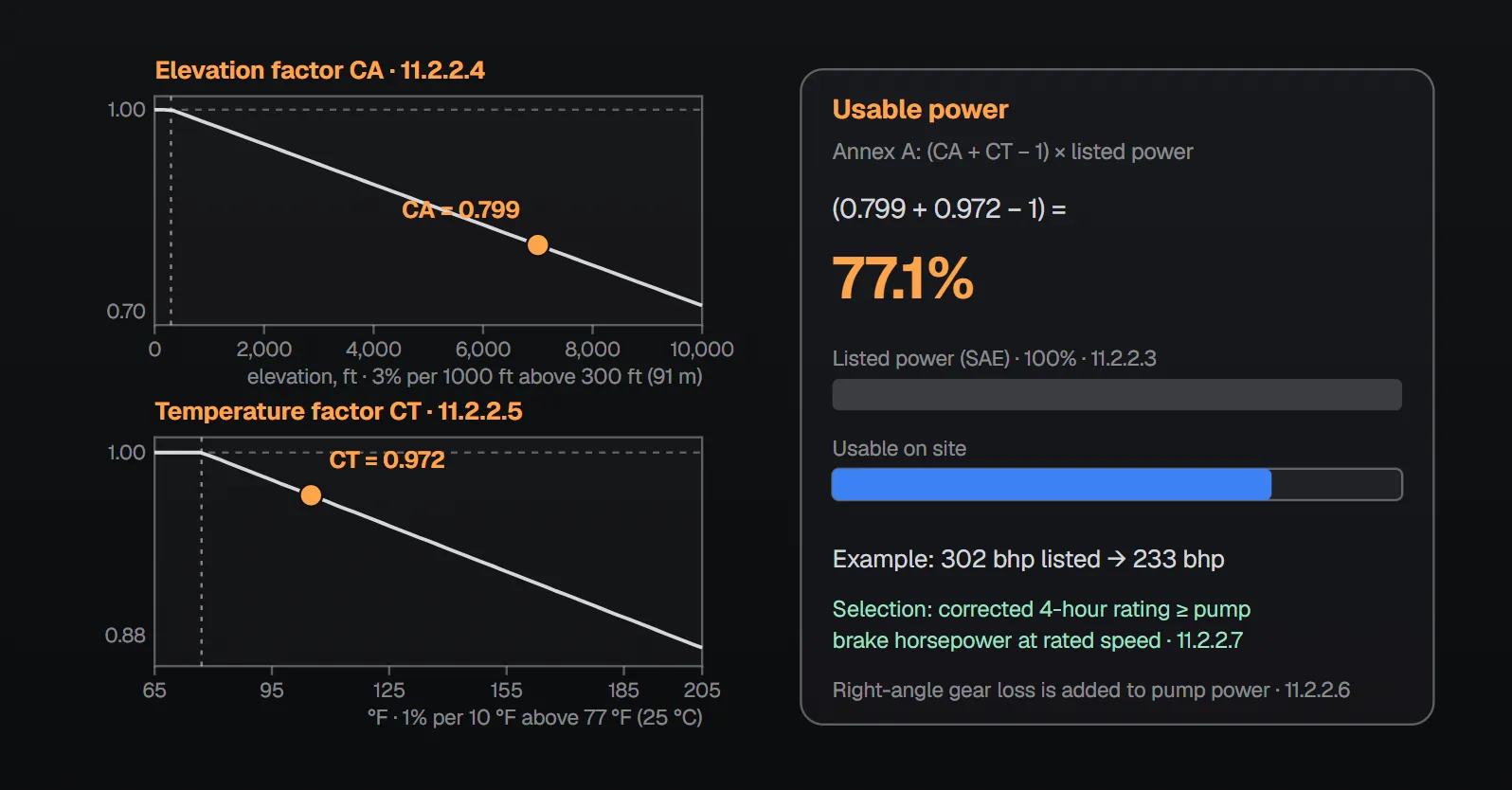
| Altitude | Deduct 3% for each 1000 ft (300 m) above 300 ft (91 m) | 11.2.2.4 |
| Temperature | From the SAE-corrected rating, deduct 1% for every 10 °F (5.6 °C) above 77 °F (25 °C) | 11.2.2.5 |
| Right-angle gear | Where a right-angle gear drive is used between a vertical turbine pump and its driver, the pump power requirement is increased for the gear loss | 11.2.2.6 |
| Result | After the above, the 4-hour minimum rating ≥ the brake horsepower needed at rated pump speed, under load, at the listed environmental conditions | 11.2.2.7 |
Correction equation
The two Annex A curves give the elevation factor (CA) and the temperature factor (CT); both fall linearly and corrected power = (CA + CT − 1) × listed power (Figure A.11.2.2.4, Figure A.11.2.2.5). Annex A.11.2.2.5 adds that pump room temperature rise is considered when setting the maximum ambient temperature.
Handbook (2022) example: a 302 bhp listed engine will run at 7000 ft (2134 m) elevation and 105 °F (40.5 °C) ambient. The curves give CA ≈ 0.80 and CT ≈ 0.973; (0.80 + 0.973 − 1) × 302 ≈ 233 bhp. The engine is selected on this corrected rating.
Engine-to-pump connection
Horizontal shaft engines have a means to attach a flexible coupling adaptor, a flexible connecting shaft adaptor, a stub shaft or a torsional coupling directly to the flywheel (11.2.3.1). For alignment rules see fire pump foundation and coupling alignment.
Why?
- Diesel: Annex A.11.1.3 says the compression ignition diesel has proved the most dependable internal combustion engine for driving fire pumps. Per the Handbook (2022), spark-ignited engines were dropped from NFPA 20 in the 1974 edition and there are no listings for them.
- Altitude and temperature: The Handbook (2022) explains that higher altitude and temperature expand the air, leaving fewer oxygen molecules per volume, so the power produced by combustion drops.
- 10% and 4 hours: Annex A.11.2.2.2 says the 4-hour minimum power is tested and witnessed during listing. Per the Handbook (2022), 11.2.2.2 is meant for the listing agency, not for engine selection; continuous ratings shorter than 4 hours are not acceptable for fire pump drivers.
- Gear loss: Per the Handbook (2022), right-angle gear loss is not part of the pump rated power; it is added to the maximum pump power demand and is obtained from the gear manufacturer.
Points raised in the sources
- Handbook (2022): the project engineer should give the maximum air temperature at the engine air intake (air cleaner inlet) so the installer and pump manufacturer can choose the right engine. Without it the temperature correction cannot be made.
- Handbook (2022): for an engine listed over a speed range, available power is found by linear interpolation at the operating speed.
- The nameplate typically shows manufacturer, model, rated speed, maximum power available to the pump, serial number, required fuel grade, year of manufacture and listing mark (Handbook 2022). For the pump’s own plate see fire pump nameplate.
Checklist
- Is the engine compression ignition and listed for fire pump service? (11.1.3.1, 11.2.1)
- Are elevation and maximum ambient temperature (including room temperature rise) known? (11.2.2.4, 11.2.2.5, Annex A.11.2.2.5)
- With a right-angle gear, is the gear loss added to pump power? (11.2.2.6)
- Is the corrected 4-hour rating at least the brake horsepower needed at rated speed? (11.2.2.7)
- On a horizontal shaft engine, is the coupling attached directly to the flywheel? (11.2.3.1)
For engine–controller–pump matching see driver and controller compatibility; for the governor and alarms see governor and overspeed.
Frequently Asked Questions
Can a gasoline or gas engine drive a fire pump?
No. The engine is a compression ignition diesel; spark-ignited internal combustion engines are not used (NFPA 20-2025 11.1.3.1, 11.1.3.2). Per the Handbook (2022) they were dropped from the standard in the 1974 edition.
How is a diesel fire pump engine derated for altitude?
From the rating at standard SAE conditions, deduct 3% for each 1000 ft (300 m) above 300 ft (91 m) (11.2.2.4). The Annex A curve shows the deduction as a straight line (Figure A.11.2.2.4).
Which temperature is used for the temperature derate?
Deduct 1% for every 10 °F (5.6 °C) above 77 °F (25 °C) (11.2.2.5). Annex A.11.2.2.5 asks that pump room temperature rise be considered for the maximum ambient; the Handbook (2022) says it is the temperature at the engine air intake and should be given by the project engineer.
How are altitude and temperature derates combined?
Annex A equation: corrected power = (CA + CT − 1) × listed power. In the Handbook (2022) example a 302 bhp engine at 7000 ft (2134 m) and 105 °F (40.5 °C) drops to (0.80 + 0.973 − 1) × 302 ≈ 233 bhp.
When is engine power adequate for the pump?
After altitude, temperature and any right-angle gear loss, the engine’s 4-hour minimum rating must equal or exceed the brake horsepower needed at rated pump speed under load (11.2.2.6, 11.2.2.7).
SprinkCalc — Fire Sprinkler Design Across Three Standards
SprinkCalc covers hazard classification, design density and area, K-factor selection, water demand and hydraulic calculations for NFPA 13, FM Global and BS EN 12845 in a single iOS app, and exports a professional PDF report.
Download SprinkCalc on the App Store
MEP Calc — 110+ Engineering Calculators
MEP Calc bundles 110+ engineering modules in one iOS app: 21 fire calculations plus heating, cooling, HVAC, plumbing, steam and natural gas.
Download MEP Calc on the App StoreNFPA 20-2025, Standard for the Installation of Stationary Pumps for Fire Protection: 11.1.1–11.1.3.2; 11.2.1; 11.2.2.1–11.2.2.7; 11.2.3.1; Annex A.11.1.3, A.11.2.2.2, A.11.2.2.4, A.11.2.2.5, Figures A.11.2.2.4 and A.11.2.2.5 (explanatory). NFPA 20 Handbook 2022 commentary: Sections 11.1, 11.2.1–11.2.3.