Before a fire pump enters its field acceptance test, two jobs are finished: the suction piping is flushed, and the suction and discharge piping are hydrostatically tested. NFPA 20-2025 covers both in 14.1, in a fixed order: flushing occurs before the hydrostatic test (14.1.1.2), and the installing contractor furnishes a certificate for both before the acceptance test (14.1.3).
In short: underground portions of suction piping are flushed at the rate in Table 14.1.1.1 or at the hydraulically calculated system demand, whichever is greater (14.1.1.1). If the supply cannot provide the table rate, the flush is at least 150 percent of rated flow; failing that, the greater of 100 percent of rated flow and the maximum system demand (14.1.1.3, 14.1.1.3.1). Suction and discharge piping are hydrostatically tested at not less than 200 psi (13.8 bar) or 50 psi (3.4 bar) above the maximum pressure maintained in the system, whichever is greater, and the pressure is held without loss for 2 hours (14.1.2.1, 14.1.2.1.1).
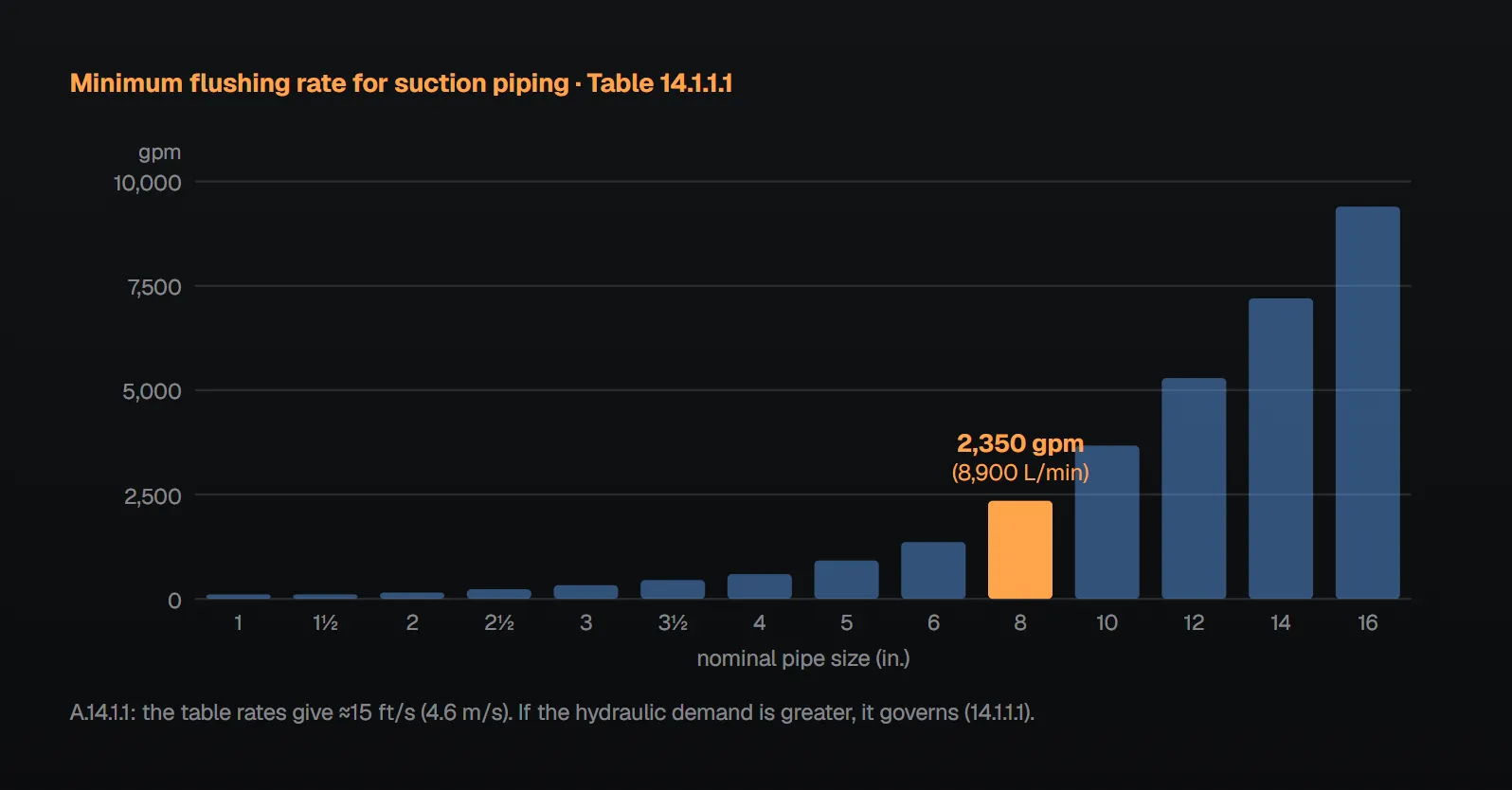
Flushing (14.1.1)
Underground portions of suction piping are flushed at a flow rate not less than Table 14.1.1.1 or at the hydraulically calculated water demand of the system, whichever is greater (14.1.1.1). Flushing occurs prior to the hydrostatic test (14.1.1.2).
| Nominal pipe size (in.) | Flow rate (gpm) | Nominal pipe size (mm) | Flow rate (L/min) |
|---|---|---|---|
| 1 | 37 | 25 | 140 |
| 1½ | 85 | 38 | 330 |
| 2 | 150 | 50 | 570 |
| 2½ | 229 | 65 | 870 |
| 3 | 330 | 75 | 1,250 |
| 3½ | 450 | 85 | 1,710 |
| 4 | 590 | 100 | 2,240 |
| 5 | 920 | 125 | 3,490 |
| 6 | 1,360 | 150 | 5,150 |
| 8 | 2,350 | 200 | 8,900 |
| 10 | 3,670 | 250 | 13,900 |
| 12 | 5,290 | 300 | 20,100 |
| 14 | 7,200 | 350 | 27,300 |
| 16 | 9,400 | 400 | 35,600 |
Per Annex A.14.1.1, the table rates are the minimum recommended and produce a velocity of approximately 15 ft/sec (4.6 m/sec). The aim is to keep stones, silt and other debris out of the pump and the fire protection system. If the existing supply cannot reach the rate, a supplemental source such as a fire department pumper could be necessary; the flush is performed, witnessed and signed off before the connection to the suction piping is completed.
When the supply cannot provide the table rate (14.1.1.3)
- If the maximum flow available from the water supply cannot provide the table rate, the flushing rate is at least 150 percent of the rated flow of the connected fire pump (14.1.1.3).
- If the supply cannot provide 150 percent of rated flow either, the flushing rate is the greater of 100 percent of rated flow of the connected pump and the maximum flow demand of the fire protection system (14.1.1.3.1).
- This reduced flush is acceptable if the flow is as much as can be safely achieved and exceeds the fire protection system design flow rate (14.1.1.3.2).
Per the NFPA 20 Handbook (2022) commentary, stones, gravel, wood blocks, bottles, work gloves and burlap bags have been found in underground piping, and objects far from the pump can be carried into it at the high flows of the acceptance test. Flushing is not required for the tank, reservoir, pond, river or other body of water itself, but the pipe between a stored supply and the pump suction is flushed. For such sources, before the acceptance flow test it should be verified that no obstructing material is in the water path, the suction piping is clear, and the suction screen is in place, clean and undamaged (see suction screen and anti-vortex plate). The Handbook notes that the flushing rates in NFPA 24 for private fire service mains rest on a lower velocity; pump suction piping is flushed to NFPA 20.
Hydrostatic test (14.1.2)
- Suction and discharge piping are hydrostatically tested at not less than 200 psi (13.8 bar) or at 50 psi (3.4 bar) in excess of the maximum pressure to be maintained in the system, whichever is greater (14.1.2.1).
- The pressure is maintained without loss for 2 hours (14.1.2.1.1); loss is determined by a drop in gauge pressure or visual leakage (14.1.2.1.2).
| Maximum pressure maintained in the system | + 50 psi | Test pressure (the greater) |
|---|---|---|
| 120 psi | 170 psi | 200 psi (13.8 bar) |
| 150 psi | 200 psi | 200 psi (13.8 bar) |
| 175 psi | 225 psi | 225 psi |
The pressures in the table are examples; the rule is 14.1.2.1 alone. The 50 psi margin governs once the maximum pressure exceeds 150 psi.
Per the Handbook (2022) commentary:
- The test pressure applies at the pump discharge flange and may exceed the rated pressure of system components. The test is primarily a quality check on the installation; cracked fittings, leaky valves and bad joints are routinely found during it.
- The test covers all suction and discharge piping between the suction pipe control valve and the discharge pipe control valve; bypass, meter, jockey pump, cooling water piping and hose header piping are included, with the normally closed hose header control valve open.
- If the main relief valve setting is below the test pressure, the valve can be temporarily set at or above the test pressure, then reset and verified afterwards (see main relief valve). The circulation relief valve is temporarily plugged for the test (see circulation relief valve).
- Underground and aboveground piping should be isolated for the hydrostatic test, because NFPA 24 permits limited leakage in underground piping.
Packaged fire pump assemblies, including packaged pump houses and skids, are tested by the packaging facility; leakage through packing glands is permitted, the system is continuously repressurized, and no other leakage or pressure drop is permitted (14.1.2.2 through 14.1.2.2.3). Details: packaged fire pump assembly.
Certificate (14.1.3)
The installing contractor furnishes a certificate for flushing and hydrostatic test before the field acceptance test starts (14.1.3). Annex A.14.1.3 shows a sample contractor’s material and test certificate for fire pump systems (Figure A.14.1.3(a)) and one for private fire service mains (Figure A.14.1.3(b)). Per the Handbook (2022) commentary, if the pump installer did not install the suction piping, the installer obtains, reviews and furnishes a copy of the suction pipe installer’s certificates; piping should not be connected to the underground stub-up without the underground certificate, and the certificate should name NFPA 20 as the flushing standard. For the acceptance test itself see fire pump field acceptance test.
Common field mistakes
- Flushing after the hydrostatic test: contrary to 14.1.1.2.
- Flushing suction piping at a low rate: 14.1.1.1 requires the table rate or the calculated demand, whichever is greater; per the Handbook, the lower NFPA 24 rates are not enough for pump suction.
- Testing below 200 psi: 14.1.2.1 requires at least 200 psi.
- Not watching the pressure for 2 hours: 14.1.2.1.1 requires 2 hours without loss.
- Starting the acceptance test without a certificate: contrary to 14.1.3.
Checklist
- Underground suction piping flushed at the Table 14.1.1.1 rate or the calculated demand, whichever is greater (14.1.1.1).
- If the supply falls short, the 150 percent, then 100 percent or maximum demand rule applied (14.1.1.3 through 14.1.1.3.2).
- Flushing done before the hydrostatic test (14.1.1.2).
- Test pressure: at least 200 psi or maximum pressure + 50 psi, the greater (14.1.2.1).
- 2 hours without loss; gauge and visual check (14.1.2.1.1, 14.1.2.1.2).
- Packaged unit tested by the packaging facility (14.1.2.2).
- Flushing and hydrostatic test certificate furnished before the acceptance test (14.1.3).
Frequently Asked Questions
At what rate is fire pump suction piping flushed?
Underground suction piping is flushed at the Table 14.1.1.1 rate or the hydraulically calculated system demand, whichever is greater (14.1.1.1). For example, the table rate for 8 in. (200 mm) pipe is 2,350 gpm (8,900 L/min).
What if the water supply cannot provide the table rate?
Flush at no less than 150 percent of the connected pump’s rated flow (14.1.1.3); if that is not possible, at the greater of 100 percent of rated flow and the maximum system demand (14.1.1.3.1). The reduced flush is acceptable if it is as much as can be safely achieved and exceeds the design flow (14.1.1.3.2).
What are the hydrostatic test pressure and duration?
Not less than 200 psi (13.8 bar) or 50 psi (3.4 bar) above the maximum pressure maintained in the system, whichever is greater (14.1.2.1); held without loss for 2 hours, with loss determined by a gauge pressure drop or visual leakage (14.1.2.1.1, 14.1.2.1.2).
Which comes first, flushing or the hydrostatic test?
Flushing occurs before the hydrostatic test (14.1.1.2). The installing contractor furnishes a flushing and hydrostatic test certificate before the acceptance test starts (14.1.3).
What happens to the relief valves during the test?
The standard gives no rule on this. Per the NFPA 20 Handbook (2022) commentary, if the main relief valve is set below the test pressure it can be temporarily set at or above it and reset afterwards; the circulation relief valve is temporarily plugged for the test.
SprinkCalc — Fire Sprinkler Design Across Three Standards
SprinkCalc covers hazard classification, design density and area, K-factor selection, water demand and hydraulic calculations for NFPA 13, FM Global and BS EN 12845 in a single iOS app, and exports a professional PDF report.
Download SprinkCalc on the App Store
MEP Calc — 110+ Engineering Calculators
MEP Calc bundles 110+ engineering modules in one iOS app: 21 fire calculations plus heating, cooling, HVAC, plumbing, steam and natural gas.
Download MEP Calc on the App StoreNFPA 20-2025, Standard for the Installation of Stationary Pumps for Fire Protection: 14.1.1.1–14.1.1.3.2 and Table 14.1.1.1; 14.1.2.1–14.1.2.2.3; 14.1.3; Annex A.14.1.1, A.14.1.3 and Figures A.14.1.3(a), A.14.1.3(b) (explanatory). NFPA 20 Handbook 2022 commentary: Section 14.1.