On small electric fire pumps, a “limited service controller” may be used instead of a full-service fire pump controller. NFPA 20-2025 covers it briefly in Section 10.7: which motors it may serve and the three points where it differs from a full controller. This article explains the rule and the NFPA 20 Handbook (2022) commentary. Starting and stopping rules are the same for both: starting and stopping.
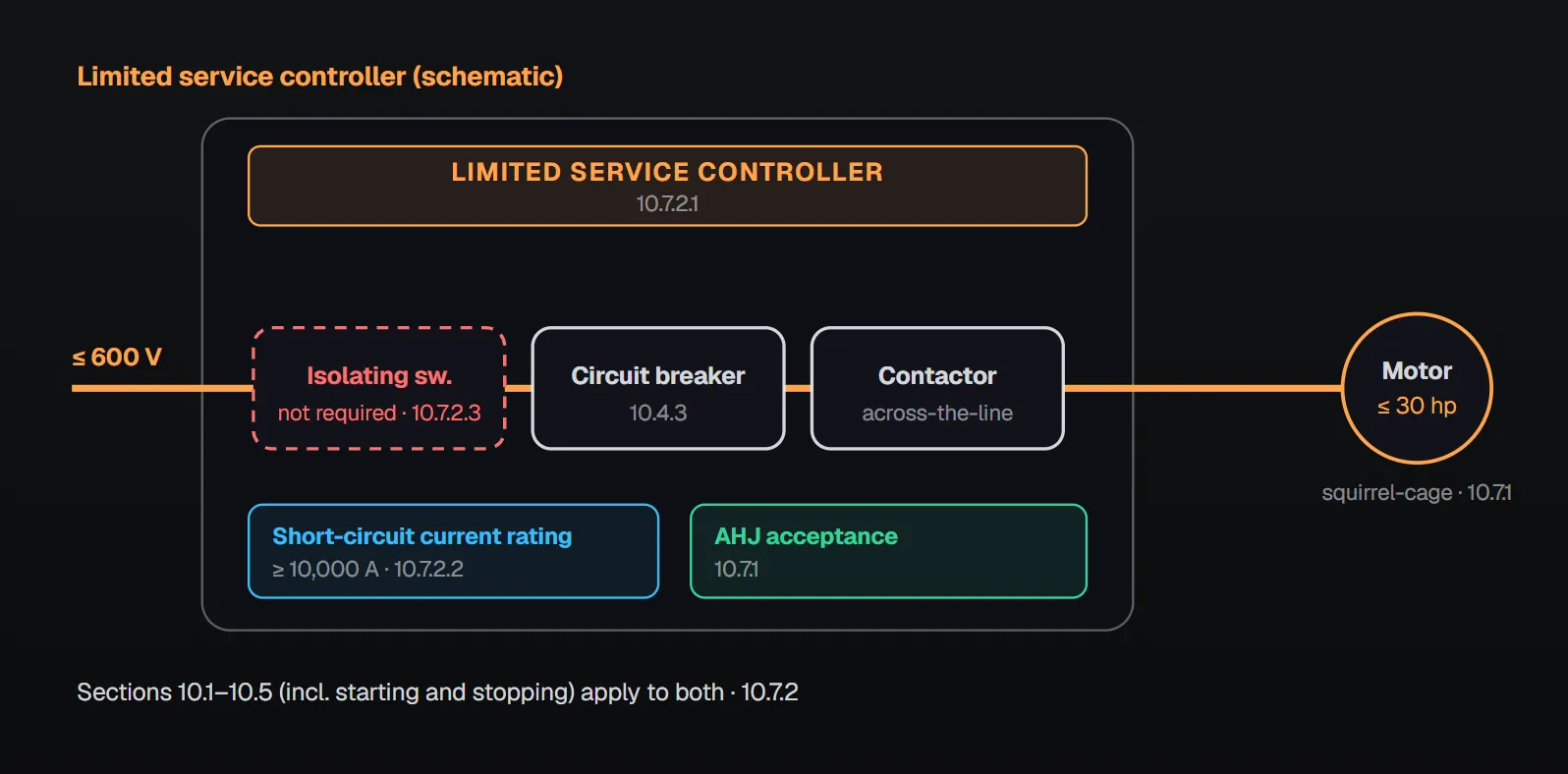
In short: a limited service controller is an automatic controller for across-the-line starting of squirrel-cage motors of 30 hp or less, 600 V or less, and is permitted only where acceptable to the authority having jurisdiction (10.7.1). Sections 10.1 through 10.5 apply (10.7.2). The differences: marking “Limited Service Controller” (10.7.2.1), a short-circuit current rating of at least 10,000 A (10.7.2.2) and no manually operated isolating switch of 10.4.2 required (10.7.2.3).
What the rule says
| Item | Limited service controller | Clause |
|---|---|---|
| Motor | Squirrel-cage, 30 hp or less, 600 V or less | 10.7.1 |
| Starting | Automatic, across-the-line | 10.7.1 |
| Permission | Where acceptable to the AHJ | 10.7.1 |
| Applicable provisions | Sections 10.1 through 10.5 | 10.7.2 |
| Marking | In lieu of 10.1.2.5.1, “Limited Service Controller”; manufacturer name, identifying designation, controller maximum rated pressure, enclosure type and complete electrical rating | 10.7.2.1 |
| Short-circuit current rating | Not less than 10,000 A | 10.7.2.2 |
| Manually operated isolating switch (10.4.2) | Not required | 10.7.2.3 |
A full-service controller is marked “Electric Fire Pump Controller” with the same information (10.1.2.5.1). Per 10.7.2, the provisions of Sections 10.1 through 10.5 apply unless specifically addressed in 10.8.2.1 through 10.8.2.3; the provisions specific to limited service controllers are in 10.7.2.1–10.7.2.3.
Why and where (Handbook commentary)
The standard gives no reasoning for these clauses. Per the NFPA 20 Handbook (2022), limited service controllers were introduced many years ago as an economical alternative for premises that would otherwise have had no fixed fire suppression equipment; applied properly, they give a degree of protection against fire spread. They should not be confused with pressure maintenance (jockey) pump controllers, which maintain system pressure against leaks. Jockey pump rules: jockey pump sizing and connection.
Per the Handbook, the differences from a full-service controller are a limit of 30 hp at a maximum of 600 V and a required short-circuit rating of only 10,000 A, so it recommends as best practice a short-circuit study on every installation or an optional 100,000 A short-circuit rating. Since the 10.4.2 isolating switch is not required, it recommends adding a permitted disconnect on the line side of the controller. Not all AHJs or insurers accept this type of controller, so acceptance should be confirmed for every installation.
The 2013 change
Per the Handbook (2022), editions before 2013 allowed a limited service controller to use, in place of 10.4.3.3.1 and 10.4.4, an inverse time nonadjustable circuit breaker with a standard rating between 150 percent and 250 percent of motor full-load current. The 2013 edition removed that exemption: limited service controllers now have the same circuit breaker and overcurrent characteristics as full-service controllers. Per the Handbook, the main remaining difference is the absence of the separate isolating switch; the change was made because the motor protection curves of limited service controllers varied more widely. Circuit breaker and locked rotor protection: fire pump controller components.
Common field mistakes
- A limited service controller on a motor above 30 hp or above 600 V: outside 10.7.1.
- Using it without AHJ acceptance: 10.7.1 makes acceptance a condition.
- Not checking the controller rating against available fault current: the Handbook (2022) recommends a short-circuit study; the rating is at least 10,000 A (10.7.2.2).
- Taking a jockey pump controller for a limited service controller: the Handbook (2022) separates the two.
Checklist
- Squirrel-cage motor, ≤ 30 hp, ≤ 600 V; across-the-line starting (10.7.1).
- AHJ acceptance (10.7.1).
- “Limited Service Controller” marking and the data of 10.7.2.1.
- Short-circuit current rating ≥ 10,000 A and suited to the available fault current (10.7.2.2).
- Without an isolating switch, a line-side disconnect (Handbook recommendation; 10.7.2.3).
- The rest of Sections 10.1–10.5, including starting and stopping (10.7.2).
Frequently Asked Questions
Which motors can a limited service controller serve?
As an automatic controller for across-the-line starting of squirrel-cage motors of 30 hp or less, 600 V or less, where acceptable to the AHJ (10.7.1).
How does it differ from a full-service controller?
Marking “Limited Service Controller” (10.7.2.1), a short-circuit current rating of at least 10,000 A (10.7.2.2) and no 10.4.2 isolating switch required (10.7.2.3); otherwise 10.1–10.5 apply (10.7.2).
Is the circuit breaker different in a limited service controller?
Per the Handbook (2022), a different breaker was allowed before 2013; since the 2013 edition the same circuit breaker and overcurrent characteristics as a full-service controller are required.
Is a limited service controller a jockey pump controller?
No. Per the Handbook (2022), jockey (pressure maintenance) pump controllers maintain pressure against leaks; a limited service controller serves a small fire pump.
SprinkCalc — Fire Sprinkler Design Across Three Standards
SprinkCalc covers hazard classification, design density and area, K-factor selection, water demand and hydraulic calculations for NFPA 13, FM Global and BS EN 12845 in a single iOS app, and exports a professional PDF report.
Download SprinkCalc on the App Store
MEP Calc — 110+ Engineering Calculators
MEP Calc bundles 110+ engineering modules in one iOS app: 21 fire calculations plus heating, cooling, HVAC, plumbing, steam and natural gas.
Download MEP Calc on the App StoreNFPA 20-2025, Standard for the Installation of Stationary Pumps for Fire Protection: 10.1.2.5.1; 10.4.2; 10.7.1; 10.7.2; 10.7.2.1–10.7.2.3. NFPA 20 Handbook 2022 commentary: Section 10.7.